

7 Best Forcible Entry Tools for Residential Fires
Table of Contents
- 1. Halligan Bar: The Go-To Pry Tool for Residential Forcible Entry
- 2. Flat Head Axe: Striking Power for the Irons
- 3. Battering Ram and Hydraulic Entry Tools for Heavily Secured Doors
- 4. Bolt Cutters and Cutting Equipment for Residential Lock Hardware
- 5. Through-the-Lock Entry Techniques and K-Tool Options
- 6. Non-Destructive Entry Methods: Shove Knives and Mylar Bypass Tools
- 7. Lock Picking and Bypass Tools for Residential Emergency Access
- Hook and Irons Alternative for Firefighters: Modern Tool Sets to Consider
- Frequently Asked Questions
Last Updated: September 14, 2026
1. Halligan Bar: The Go-To Pry Tool for Residential Forcible Entry
The Halligan bar is the single most versatile of all forcible entry tools for residential fires, combining a fork, an adze, and a pick head in one forged steel bar. It pries, strikes, and twists, and it pairs with a flat head axe to form the classic set of irons.
At Black Helmet, we hear from crews across the country about which tools earn their place on the truck. The Halligan almost always leads the list.
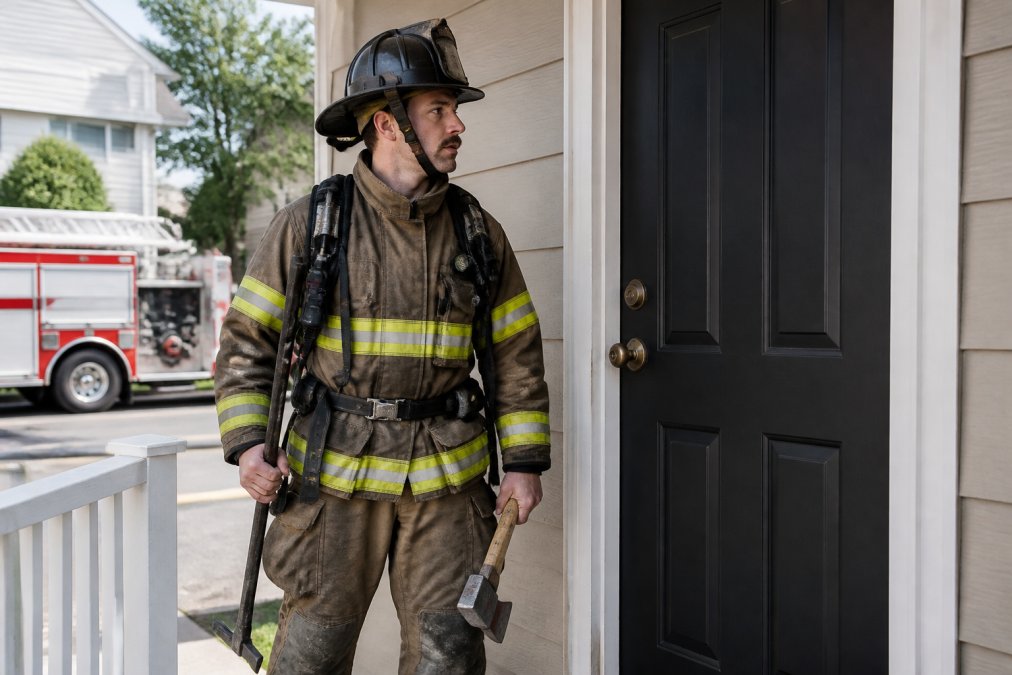
The standard Halligan runs 30 to 36 inches and weighs roughly 8 to 10 pounds, and that weight-to-length ratio matters (nist.gov). A shorter bar offers more control in tight hallways, while a longer bar delivers greater mechanical advantage on a stubborn door frame. The fork end slips between the door and jamb to spread the gap; the adze end drives into the frame for prying; the pick end punches through lightweight residential construction when a gap does not exist.
Residential doors differ from commercial ones in ways that change how you use the Halligan. Most homes have hollow-core or solid-core wood doors set in pine or composite frames, often with only a builder-grade deadbolt and a spring latch. That construction fails faster under prying than a steel commercial frame, so a few controlled sets with the fork usually beat brute force.
2. Flat Head Axe: Striking Power for the Irons
A flat head axe is the striking half of the irons, and its 8-pound head delivers the force that drives a Halligan through a door frame (NFPA). It also chops through roof decking, walls, and hinges when prying alone will not finish the job.
Pairing matters more than the axe itself. The firefighter on the axe swings; the firefighter on the Halligan sets and controls the bar. Good teams synchronize so the axe lands on the Halligan's adze, never on the firefighter holding it. A 6-pound axe suits most residential work because it swings faster in a hallway, while an 8-pound head carries more momentum through heavier framing.

The flat head also serves as a hinge attack tool. On an outward-swinging residential door, driving the axe behind the hinge pins and prying the hinge side is often faster than attacking the latch side, especially when the door has a security plate reinforcing the deadbolt.
3. Battering Ram and Hydraulic Entry Tools for Heavily Secured Doors
Battering rams and hydraulic entry tools deliver concentrated force for doors that resist prying, including reinforced residential entries with security plates or multiple deadbolts. They trade portability and finesse for raw power.
A manual battering ram works on a simple principle: mass times swing speed equals force at the contact point. Crews need a clear swing path and two people to control it, which is why a ram is awkward in a narrow residential hallway. Hydraulic rams solve the space problem. They generate spreading force from a compact tool head, and the operator pumps a handle or a foot pump to push the door and jamb apart. The trade-off is setup time. A hydraulic ram takes longer to position and activate than a Halligan, so it earns its place only when the door is genuinely fortified.
For most residential fires, a ram or hydraulic tool is a fallback, not a first move. Reach for one when the frame is steel-reinforced, when the door is metal-skinned, or when prying has already failed twice.
4. Bolt Cutters and Cutting Equipment for Residential Lock Hardware
Bolt cutters cut through padlocks, chains, and hardened shackles that prying cannot defeat, and they belong on the truck for residential gates, sheds, and security bars. Cutting is the third leg of forcible entry tools, alongside prying and striking.
Residential properties increasingly use padlocked gates, storage sheds, and window security bars, all of which resist a Halligan. A 24-inch bolt cutter handles most padlocks and light chain; a 36-inch cutter gives more use for hardened shackles and thicker bars. For window security bars, a rotary saw or a reciprocating saw with a metal-cutting blade clears the way faster than cutters, though it throws sparks and noise, which matters on a fireground where you may not know what is behind the door.
Match the cutter to the material. Cutting a case-hardened shackle with an undersized cutter chips the jaws and gets you nowhere. If the shackle resists the first firm squeeze, move up to a larger cutter or switch to a powered saw.
5. Through-the-Lock Entry Techniques and K-Tool Options
Through-the-lock entry removes the lock cylinder itself and uses the internal mechanism to open the door, which preserves the door and frame for non-destructive access. It is the preferred method when the situation allows time and the door is otherwise sound.
The K-tool is a forked metal device that slides over a lock cylinder and grips it so a slide hammer or a pry bar can pull the cylinder out of the door (NIST Special Publication 800-63B). Once the cylinder is out, the firefighter reaches the latch or deadbolt mechanism and actuates it directly. The A-tool is a similar cylinder-pulling device with a different jaw geometry, and crews often carry both because cylinder shapes vary. The bam-bam tool works on a related principle, driving into the lock body to manipulate the mechanism from outside.
Through-the-lock entry takes practice. The technique rewards patience: a controlled pull with a slide hammer removes the cylinder cleanly, while a panicked yank deforms the door and turns a non-destructive entry into a destructive one.
6. Non-Destructive Entry Methods: Shove Knives and Mylar Bypass Tools
Non-destructive entry methods open a door without damaging it, which matters when the door is the only barrier between occupants and a threat, and when the property will be restored rather than replaced. The shove knife and the mylar bypass tool are the two workhorses.
A shove knife is a thin, flat blade with a hooked tip that slips between the door and the strike plate to trip a spring latch. It works on inward-swinging doors with a simple latch and no deadbolt engaged. The mylar technique uses a flexible plastic card, often a piece of mylar film, slid between the door and frame to push the latch back. Both methods fail the moment a deadbolt is thrown, which is why they are situational tools, not universal ones.
The risk-benefit calculation is straightforward. Non-destructive entry is quieter and faster on an unsecured door, but if you spend two minutes failing with a shove knife while a deadbolt holds, you have lost time you cannot get back. Try the quiet method once, then commit to a prying or striking approach.
| Method | Best For | Time to Open | Door Damage |
|---|---|---|---|
| Shove knife | Latched, inward-swinging doors | Seconds | None |
| Mylar bypass | Spring latch, no deadbolt | Seconds | None |
| Through-the-lock | Locked cylinder, sound door | 1-3 minutes | Cylinder only |
| Halligan and axe | Most residential doors | Under a minute | Frame and latch |
| Hydraulic ram | Reinforced, heavily secured doors | Several minutes | Significant |
7. Lock Picking and Bypass Tools for Residential Emergency Access
Lock picking and bypass tools open a lock without force, using the lock's own mechanism. Picks, rakes, and tension wrenches manipulate the pins inside a cylinder until it turns, and bypass tools defeat specific lock designs without picking them at all.
On a fireground, picking is rarely the first choice. It takes steady hands, good light, and time, and a working fire gives you none of those. Where picking earns its place is in non-emergency access: lockouts, welfare checks, and situations where the door must survive the entry intact. A basic pick set with a tension wrench, a rake, and a few hooks covers most residential pin-tumbler cylinders. A bypass tool handles the locks that resist picking, such as certain padlocks and knob locks with shielded cylinders.
Learn the tools before you need them. A firefighter who has picked a cylinder a hundred times in training can open one in seconds under pressure; a firefighter who has never held a pick will not learn on the fireground.
Hook and Irons Alternative for Firefighters: Modern Tool Sets to Consider
Modern tool sets bundle the irons and the accessories into configurations that cut weight and setup time, which is the main reason crews look for a hook and irons alternative. Instead of carrying a separate Halligan, axe, and pry bar, many departments now issue integrated sets with a married Halligan and axe, a compact pry tool, and a multi-purpose hook.
The trade-offs are real. A lighter set is faster to carry up stairs and easier to control in a hallway, but it may sacrifice striking mass or prying length. Heavier traditional irons hit harder and reach further, but they wear a firefighter down over a long shift. The right answer depends on your response profile: a department running mostly single-family residential calls can often justify a lighter set, while a crew working older, heavily secured properties may want the full-weight irons.
What matters most is repetition. No tool set replaces training, and the crews who open doors fastest are the ones who have drilled with their actual tools, on actual residential doors, until the sequence is automatic.
If you want gear that carries that same pride off the fireground, Black Helmet makes apparel built for the fire service community, from the Hook & Halligan Premium Tee that honors Chief Hugh Halligan's legacy to the Hook And The Halligan laminate decal for your helmet or locker.

Frequently Asked Questions
What are the most common forcible entry tools used by firefighters?
The Halligan bar and flathead axe, known as the irons, are the most common. Other tools include battering rams, hydraulic entry tools, bolt cutters, shove knives, and K-tools for through-the-lock entry. For residential fires, the Halligan bar is often the first tool chosen because it can pry, strike, and twist.
What is the 'irons' in firefighting?
The irons refer to the paired set of a Halligan bar and a flathead axe. The axe is used to strike the Halligan, driving it into door frames or locks, while the Halligan provides leverage for prying. This combination is standard on many fire apparatus for forcible entry.
How do you choose the right forcible entry tool for a residential door?
Consider the door construction and lock type. Inward-opening doors with wooden frames often yield to a Halligan bar and axe. Heavily secured doors may require a battering ram or hydraulic tool. For non-destructive entry, try a shove knife or Mylar bypass tool first. Always match the tool to the specific door and security features.
What are the best non-destructive entry tools for firefighters?
Shove knives and Mylar bypass tools are top choices for non-destructive entry. They slip past latches without damaging the door. Through-the-lock techniques using K-tools or A-tools also allow entry by manipulating the lock cylinder. These methods are ideal for residential emergencies where preserving the door is a priority.
Forcible entry rewards preparation over improvisation. The crews that open residential doors fastest are the ones who have trained with the right tools until the sequence is second nature. Black Helmet has served more than 100,000 firefighters with apparel that honors the brotherhood, tradition, and sacrifice of the fire service, and our satisfaction guarantee backs every order. Get started with Black Helmet and wear your pride on and off the job.
