

Halligan Bar vs Flat Head Axe for Entry: The Irons
Table of Contents
- Halligan Bar vs Flat Head Axe: Why One Tool Is Not Enough
- The Irons Forcible Entry: Understanding the Married Set
- How to Marry the Irons: Technique and Tool Balance
- Forcible Entry Techniques for Residential Fires: When to Strike and When to Pry
- Material Science and Durability: What to Look For
- Tool Maintenance and Care for Long-Term Reliability
- Conclusion: Building Your Entry Point Strategy
- Frequently Asked Questions
Last Updated: September 9, 2026
The debate over the halligan bar vs flat head axe for entry is a false one. For generations of firefighters, the answer has never been choosing between these two tools, but rather mastering both as a single, interlocked system known as the irons. At Black Helmet, we respect the traditions that keep crews safe, and no tradition is more fundamental than forcible entry. This guide breaks down the mechanical synergy of the married set, why one tool without the other leaves you at a disadvantage on the fireground, and how to choose and maintain equipment that performs when building access is the difference between a rescue and a recovery.

The core insight most guides miss is this: the halligan bar vs flat head axe is not a competition. The Halligan provides the prying, pulling, and using force, while the flat head axe delivers the raw striking power and cutting capability. One is the fulcrum and the other is the engine. When you understand how to marry these tools, you gain a mechanical advantage that no single tool can replicate, turning a stubborn door gap into an entry point in seconds.
Halligan Bar vs Flat Head Axe: Why One Tool Is Not Enough
Relying on only one of these tools slows down your tactical entry and can compromise the entire operation. The Halligan bar excels at prying and forcing, but it lacks the mass to breach heavy construction or drive itself deep into a door gap without a striking force. Conversely, the flat head axe is a powerful striking and cutting tool, but its blade and flat head cannot generate the targeted use needed to pop a lock or pull a window frame.
The irons forcible entry concept exists because these tools compensate for each other's weaknesses. A Halligan needs to be struck to seat its fork or adze into a gap. The flat head axe needs a point of application for its force. Together, they form a system that can handle everything from swinging residential doors to breaching walls during overhaul.

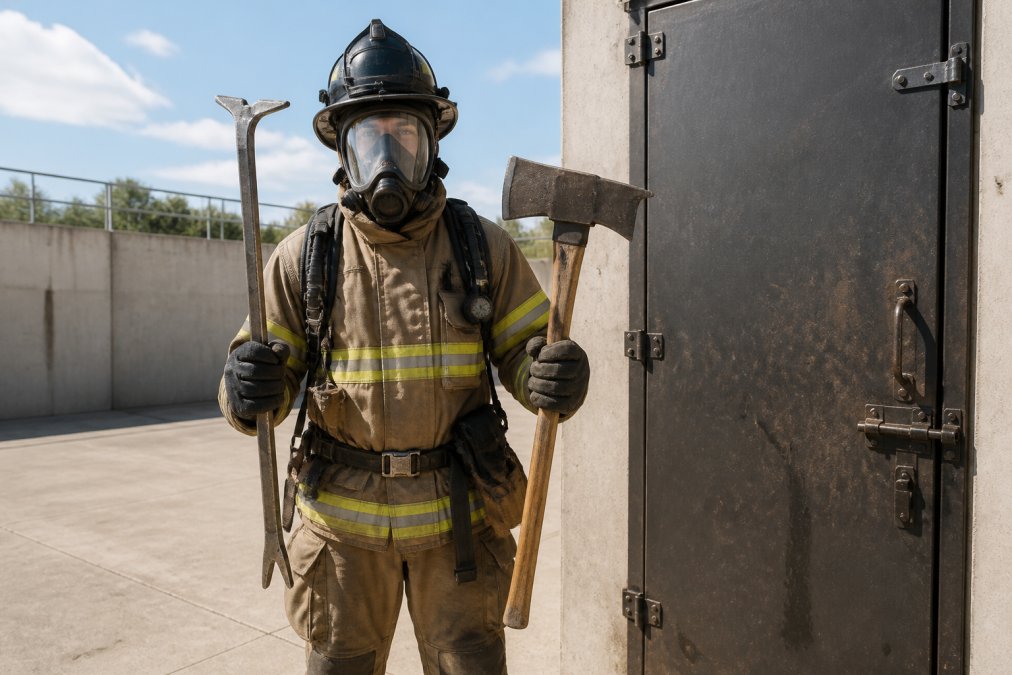
The Irons Forcible Entry: Understanding the Married Set
The irons is the standard term for the combination of a Halligan bar and a flat head axe carried together as a single forcible entry tool set. This pairing is foundational in the fire service because it provides both the use and the momentum required to force entry through most building components, from wooden doors to metal security grates.
Carrying them as a married set ensures you always have the right tool for the evolving conditions on the fireground. The tools are typically interlocked or carried side-by-side to keep hands free for climbing and crawling. This is not just a convenience; it is a tactical decision that ensures the forcible entry team arrives with a complete solution, ready to adapt their technique to the specific barrier they face.
The Halligan Bar: The Prying and Pulling Powerhouse
The Halligan bar is a multi-purpose prying tool featuring a fork or claw at one end, an adze and point at the other, and a striking surface near the fork. Its design is optimized for use, allowing a firefighter to force a door gap, pry open locks, or pull ceiling material during overhaul. The adze end is effective for breaching thin materials and opening automobile doors, while the fork is designed to pull locks and hasp. The key to the Halligan's effectiveness is its ability to transfer force with high mechanical advantage, making it the primary tool for creating an initial purchase point.
The Flat Head Axe: The Striking and Cutting Force
The flat head axe serves as the striking and cutting force of the irons. The flat head provides a large, durable striking surface used to drive the Halligan bar deep into a door gap or through a lock. The axe blade is essential for cutting through roofing materials, wooden doors, and other barriers where prying alone is ineffective. The weight of the axe head provides the momentum needed for forceful strikes, and its tool balance is critical; a well-balanced axe allows for accurate, powerful swings without excessive fatigue during prolonged operations. This tool is the engine that converts your physical effort into the force needed to breach structural integrity.
How to Marry the Irons: Technique and Tool Balance
The proper technique for marrying the irons involves more than just carrying both tools to the door. It requires an understanding of how to position and strike the Halligan to maximize efficiency and minimize wasted effort. The standard approach is to set the adze or fork of the Halligan into the door gap near the lock or latch, then use the flat head axe to strike the Halligan's striking surface with controlled, forceful blows.
Tool balance is critical here. A Halligan that is too heavy or an axe that is poorly weighted will throw off your timing and reduce the power of your strikes. When selecting equipment, you should look for a set that feels balanced in your hands, allowing for smooth, coordinated movements. The goal is to work as a single unit: the axe becomes an extension of your arm, and the Halligan becomes the precise point of force application. Practicing this drill builds muscle memory, ensuring that under the stress of a working fire, your hands know exactly what to do without conscious thought. fire helmet accessory fit.
Forcible Entry Techniques for Residential Fires: When to Strike and When to Pry
Choosing the right forcible entry technique for residential fires depends entirely on the construction of the door and the state of the building. A common mistake is attacking every door with the same method. For a standard wooden swinging door, the priority is to create a purchase point at the gap between the door and the frame, typically near the lock (iaff.org). For metal doors or those with security plates, you may need to use the adze end of the Halligan to create a gap where none exists, a process that requires more force and a different striking angle.
The decision of when to strike and when to pry comes down to reading the door. If the door gap is visible and the lock is exposed, prying with the Halligan alone may suffice. If the gap is tight or the door is reinforced, you must strike the Halligan with the axe to seat it deeper, then pry. This scenario-based decision-making is what separates a smooth, efficient entry from a prolonged struggle that delays your search and rescue operations. Understanding the structural integrity of the building and the type of door you face allows you to select the correct tool application from the start.
Forcing Swinging Doors
For a conventional swinging door, the most efficient method is the "pop and pull" technique. First, set the fork or adze of the Halligan bar into the gap between the door and the jamb, just above or below the lock. Using the flat head axe, strike the Halligan sharply to seat it firmly. Then, apply downward or outward pressure on the Halligan to force the lock bolt to shear or the jamb to splinter. Once the door pops open, you can discard the Halligan to the side and make entry. This method is fast and effective for most residential wooden doors, but it requires accurate tool placement and decisive force application to avoid wasting time on a poorly set tool.
Breaching Walls and Overhaul Operations
During overhaul, the irons are used for breaching walls and pulling ceilings to expose hidden fire. The flat head axe is the primary tool for this work, used to cut through drywall and lath, while the Halligan bar is employed to pull the breached material down and open up the wall cavity. The fork end of the Halligan is ideal for pulling plaster and lath, and the adze can be used to pry open baseboards and window frames. This phase of the operation is physically demanding, and having a well-balanced, durable set of tools reduces fatigue and speeds up the process of ensuring the fire is fully extinguished.
Material Science and Durability: What to Look For
The material and construction of your tools determine their longevity and reliability on the fireground. Most high-quality Halligan bars and axe heads are drop-forged from a single piece of steel, a process that aligns the grain of the metal to create a denser, stronger tool that resists bending and breaking under extreme force (nist.gov). Cheaper tools are often cast or welded, which can create weak points that fail at the worst possible moment.
When evaluating a Halligan bar, look for a solid steel construction without seams or welds, particularly at the fork and adze. The striking surface should be flat and wide enough to provide a reliable target for the axe. For the flat head axe, the head should be securely attached to the handle, and the handle itself should be made of a durable material like hickory or a reinforced composite that can absorb shock without splintering. The tool balance of the full set is also a factor of material science; a tool that is too heavy in the head will tire you out, while one that is too light will lack the momentum for forceful strikes. Investing in quality, drop-forged tools is an investment in your safety and effectiveness.
Tool Maintenance and Care for Long-Term Reliability
Your irons will only perform as well as you maintain them. After every use, clean the tools to remove debris, moisture, and any chemicals that could cause corrosion. The striking surfaces and cutting edges should be inspected regularly for burrs, nicks, or signs of metal fatigue. A dull axe blade is dangerous because it can glance off the target instead of cutting, so keep the edge sharp with a file or grinder, maintaining the correct bevel angle (the CDC).
The handles of axes require specific attention. Wooden handles should be checked for cracks, splinters, and looseness. A loose axe head is a serious hazard, as it can fly off during a swing. If the handle is damaged, replace it immediately. Metal tools should be lightly oiled to prevent rust, especially in humid environments. Proper tool maintenance is not just about extending the life of your equipment; it is about ensuring that when you need to force entry to save a life, your tools are ready to perform exactly as intended.
| Tool | Primary Role | Key Strength | Best For |
|---|---|---|---|
| Halligan Bar | Prying and pulling | use and mechanical advantage | Creating purchase points, pulling locks, overhaul |
| Flat Head Axe | Striking and cutting | Momentum and cutting force | Driving the Halligan, breaching walls, cutting roofs |
| The Irons (Combined) | Complete forcible entry | Versatility and synergy | All entry points, from doors to walls |
Conclusion: Building Your Entry Point Strategy
Mastering the halligan bar vs flat head axe for entry is about committing to the system of the irons. The tools are not rivals; they are partners in a dance of force and use that has opened countless doors for firefighters. By understanding the mechanics of prying and striking, practicing your technique, and maintaining your gear, you build a reliable entry point strategy that serves you on every call.
The tools that define our trade are worthy of respect, and so are the traditions behind them. At Black Helmet, we honor the legacy of the fire service with gear that reflects the pride of the brotherhood. Whether you are looking for a tribute to the tools you carry or a gift for a firefighter who has served, our apparel is designed for those who understand the job.
Choosing the right approach to forcible entry is a matter of training and trust in your equipment. Black Helmet is the firefighter-owned brand that understands the culture and the tools of the trade, offering premium apparel and accessories that represent the legacy of those who serve. Our designs are crafted to honor the tradition and brotherhood of the fire service, backed by a satisfaction guarantee. Get started with Black Helmet and wear your pride with gear that is as authentic as the job itself.
Frequently Asked Questions
Why are the Halligan bar and flat head axe used together?
They are used together because they complement each other's functions. The Halligan bar is designed for prying, twisting, and pulling, while the flat head axe provides the striking force needed to seat the adze or fork into a door gap. This combination, known as 'the irons,' gives firefighters the mechanical advantage and versatility required for most forcible entry scenarios on the fireground.
What is the combination of a Halligan bar and a flat head axe called?
This combination is traditionally called 'the irons' or 'the married set.' It is one of the most common and effective tool pairings in the fire service. The term highlights how the two tools function as a single system, where the axe head is used to strike the Halligan to gain purchase, and the Halligan is then used for prying and forcing.
How does a flat head axe assist in door breaching?
The flat head axe assists in door breaching primarily by providing a striking surface. Firefighters use the flat side of the axe head to drive the fork or adze of the Halligan bar into the gap between the door and the frame. Once the Halligan is seated, the axe can be used to strike the bar to force the lock or spread the door, making it a critical component of the forcible entry process.
What is the difference between a hooligan bar and a Halligan bar?
A Halligan bar is a specific tool with a fork on one end and an adze and point on the other, designed for prying and twisting. A hooligan tool, or hooligan bar, is a different design that typically has a fork on one end and a flat wedge or claw on the other. While both are used for forcible entry, the Halligan is generally preferred for its versatility and the mechanical advantage its adze end provides for prying.
