

What Makes Quality Firefighter Apparel Durable
Table of Contents
- What Makes Quality Firefighter Apparel Durable: The Foundation
- NFPA 1971 Standards and Regulatory Compliance
- Firefighter Turnout Gear Materials: Outer Shell, Moisture Barrier, and Thermal Liner
- Advanced Materials: Nomex, Kevlar, PBI, and Emerging Innovations
- Firefighter PPE Maintenance: Cleaning, Decontamination, and Longevity
- Bunker Gear Lifespan: Inspection, Replacement Cycles, and Real-World Performance
- Proper Fit, Sizing, and Ergonomic Design Impact on Durability
- Brand Comparison: How Manufacturers Approach Durability Differently
Last Updated: July 25, 2026
What Makes Quality Firefighter Apparel Durable: The Foundation
Durability in firefighter apparel isn't just about thread count or fabric weight, it's about how every layer, seam, and fiber works together to withstand repeated exposure to heat, moisture, abrasion, and contamination. A turnout gear failure on the fireground means a firefighter operating with compromised protection. That's why durability is foundational to safety.
This guide examines NFPA standards, material science, construction techniques, and maintenance practices that determine whether firefighter apparel lasts years or months.
Why Durability Matters Beyond the Fireground
Gear fails during routine use, not dramatic moments. A station wear shirt that shrinks after five washes or bunker gear with compromised seams reduces protection and forces departments to replace equipment more frequently, straining budgets.
Quality firefighter apparel that lasts five years instead of two represents significant cost savings for departments managing dozens or hundreds of uniforms, while reducing waste. For firefighters, gear that doesn't degrade means they're not replacing personal station wear every season.
NFPA 1971 Standards and Regulatory Compliance
What NFPA 1971 Requires
NFPA 1971 is the baseline standard for protective ensembles for structural firefighting and proximity firefighting. It defines minimum performance requirements for every component, from outer shell to thermal liner. Outer shells must resist flame and heat. Moisture barriers must prevent liquid and steam penetration. Thermal liners must insulate against radiant and convective heat. Seams must maintain integrity under stress.
However, NFPA 1971 sets a floor, not a ceiling. Gear can meet the standard on day one and still degrade rapidly under real-world conditions, repeated laundering, fireground contaminants, UV exposure, and thermal cycling.
Beyond NFPA: Additional Testing for Real-World Durability
The most durable firefighter apparel undergoes testing beyond NFPA 1971 requirements. Manufacturers test for Martindale abrasion resistance, colorfastness, and shrinkage across multiple wash-dry cycles. Advanced testing examines seam strength after heat and moisture exposure, and carcinogenic particulate retention.
Some manufacturers conduct real-world durability studies, tracking gear performance across fire departments over extended periods. This field data is far more predictive of real-world durability than laboratory standards alone.
Firefighter Turnout Gear Materials: Outer Shell, Moisture Barrier, and Thermal Liner
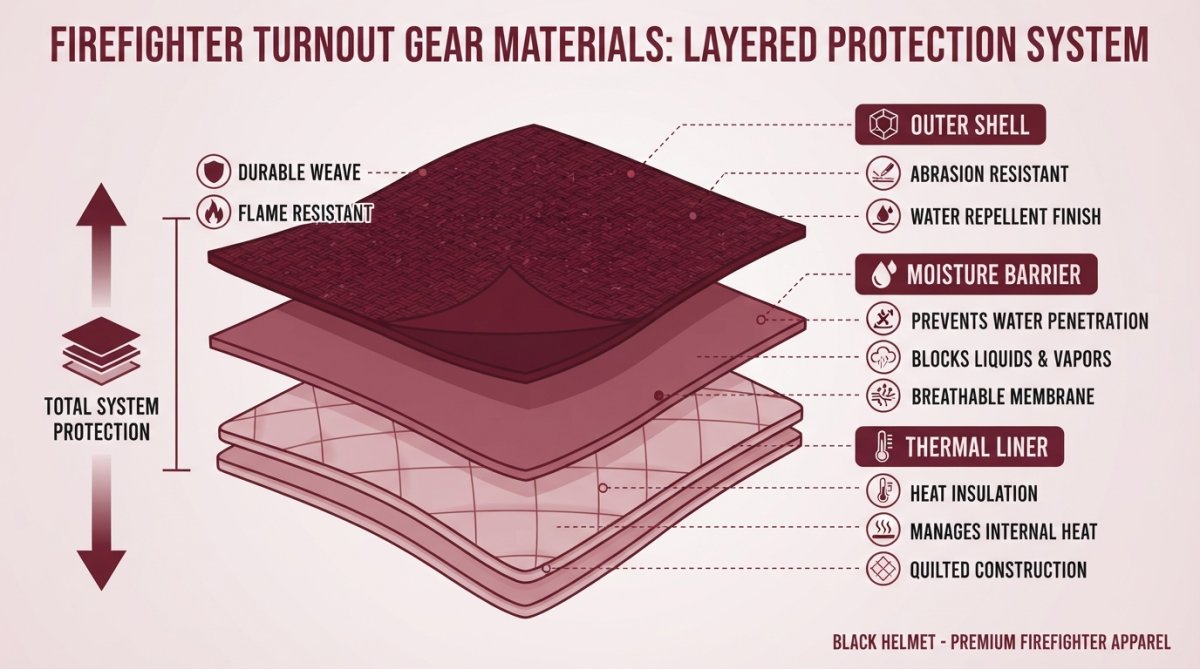
Turnout gear is engineered as a three-layer protective system. Each layer serves a specific function, and the durability of each directly impacts the entire ensemble.
Outer Shell Fabrics and Abrasion Resistance
The outer shell is the first line of defense against flame, heat, and physical abrasion. Aramid fibers like Nomex and Kevlar dominate because they resist flame and maintain structural integrity at high temperatures. Nomex is the most common choice, flame-resistant, affordable, and proven through decades of use. Kevlar offers superior cut and abrasion resistance but at higher cost. Many manufacturers blend these fibers to balance performance and price.
The weave matters as much as the fiber. A tight rip-stop weave resists tearing and abrasion better than a loose weave. Quality outer shells maintain their protective properties and appearance through hundreds of hours of use, while inferior shells show visible wear, fading, and tears within months.
Moisture Barrier and Breathability Trade-offs
The moisture barrier sits between the outer shell and thermal liner, preventing liquid water and steam from reaching the thermal liner while allowing moisture vapor to escape. The most common moisture barriers use laminated or coated materials like GORE-TEX® or Crosstech®, which use microporous membranes that block liquid water while allowing water vapor through.
Quality moisture barriers maintain their performance through multiple wash cycles and thermal exposure. Cheaper barriers often show reduced breathability and water repellency after just a few decontamination cycles. A moisture barrier that breathes well keeps firefighters comfortable, which means they wear the gear correctly and for longer periods without degradation from improper handling.
Thermal Liner Performance and Heat Resistance
The thermal liner is the innermost layer, directly against the firefighter's skin. It must insulate against radiant and convective heat while remaining flexible. Materials like PBI (Polybenzimidazole), CarbonX, and Tecasafe Plus are engineered specifically for thermal protection. PBI won't melt, drip, or ignite, even under extreme heat.
Quality thermal liners maintain their insulative properties even after exposure to high heat and repeated washing. Seam construction is critical, reinforced seams with heat-resistant thread hold better than single-line stitching.
Advanced Materials: Nomex, Kevlar, PBI, and Emerging Innovations
Aramid Fibers and Synthetic Alternatives
Nomex has been the industry standard for decades because it delivers consistent flame resistance and thermal protection at reasonable cost. It doesn't melt or drip under extreme heat, but can degrade under repeated thermal cycling. Kevlar offers superior cut and abrasion resistance but is significantly more expensive.
PBI stands apart because it doesn't rely on aramid chemistry. It's a synthetic polymer engineered to maintain structural integrity at temperatures exceeding 600°F. PBI doesn't melt, drip, or ignite. The trade-off is cost and weight.
Emerging alternatives like CarbonX and Tecasafe Plus combine aramid and non-aramid fibers with advanced polymer technology, aiming to match or exceed traditional aramid durability while improving breathability and comfort.
The durability question isn't which fiber is "best" in absolute terms, but which fiber best resists the specific degradation mechanisms it will face. Gear that sees frequent structural firefighting with extreme heat exposure benefits from PBI or CarbonX. Gear used primarily for wildland firefighting might prioritize Kevlar blends.
Material Science Innovations Enhancing Durability
Manufacturers are developing fibers with enhanced resistance to carcinogenic particulate absorption and moisture barriers that maintain performance through more decontamination cycles. Thermal stability research focuses on preventing fiber embrittlement from repeated heating and cooling cycles.
Seam technology is advancing through bonded seams or hybrid constructions that combine thread with adhesive backing, resisting failure better under thermal stress. New coating technologies reduce the rate at which breathability degrades, extending the effective lifespan of the moisture barrier.
Firefighter PPE Maintenance: Cleaning, Decontamination, and Longevity
Proper Laundering Protocols to Preserve Durability
How gear is laundered is as important as how it's manufactured. Water temperature matters, hot water can degrade certain fibers and adhesives in moisture barriers. Most manufacturers recommend warm water. Harsh detergents break down fibers and compromise water repellency. Specialized firefighter gear detergents are formulated to clean without degrading materials.
Drying is critical. Machine drying at high heat can melt or shrink synthetic fibers. Air drying or low-heat drying preserves material integrity. Gear washed after significant exposure lasts longer than gear worn multiple times between washes. Departments that implement documented laundering protocols with specific water temperatures, detergent types, and drying methods see gear lasting significantly longer.
Decontamination Standards and Fireground Contaminants
Decontamination is different from regular laundering. Fireground exposure introduces carcinogenic particulates, heavy metals, and toxic compounds requiring specific removal protocols. NFPA 1851 provides decontamination standards designed to remove fireground contaminants without damaging protective properties.
Contaminants left in gear can chemically degrade fibers, compromise moisture barrier integrity, and reduce thermal liner lifespan. Gear properly decontaminated maintains its protective properties much longer.
Bunker Gear Lifespan: Inspection, Replacement Cycles, and Real-World Performance
When to Replace Turnout Gear: The 10-Year Rule and Beyond
NFPA 1971 and NFPA 1851 recommend replacing structural firefighting gear every 10 years. However, gear that sees heavy use might need replacement sooner, while well-maintained gear might remain safe beyond 10 years.
The key is regular inspection. Quality gear should be inspected after every significant exposure and formally inspected at least annually. Some departments now use advanced inspection techniques, including thermal imaging to detect moisture barrier degradation and material testing to verify thermal protection, allowing for more data-driven replacement decisions.
The most durable gear allows for extended service life because it resists degradation mechanisms that force replacement. Gear manufactured with quality materials, proper construction, and durability-focused design can reliably serve beyond 10 years with proper maintenance.
Firefighter Testimonials: Gear Durability in Specific Scenarios
Structural firefighting gear faces intense heat exposure, physical abrasion, and repeated thermal cycling. Gear that maintains seam integrity and thermal liner flexibility through these cycles is genuinely durable.
Wildland firefighting presents different challenges. Gear faces extreme abrasion from brush and sharp vegetation. Wildland gear that resists puncture and maintains flexibility demonstrates real durability.
Station wear faces frequent laundering, sun exposure, and weather. Quality station wear maintains color, fit, and structural integrity through hundreds of wash cycles. Firefighters who invest in quality gear consistently report longer service life and better performance.
Proper Fit, Sizing, and Ergonomic Design Impact on Durability
Fit affects durability significantly. Gear that's too tight restricts movement and concentrates stress on seams. Gear that's too loose bunches and creates stress points where fabric rubs against itself.
Proper fit distributes stress evenly across the entire ensemble. Seams experience consistent tension rather than concentrated stress. Ergonomic design in modern firefighter apparel accounts for actual movement during operations. Articulated sleeves, gusseted underarms, and strategically placed seams reduce stress on high-wear areas.
A firefighter wearing properly fitted gear from a quality manufacturer will see that gear last significantly longer than the same firefighter wearing poorly fitted budget gear.
Brand Comparison: How Manufacturers Approach Durability Differently
What Sets Premium Brands Apart
The difference between premium firefighter apparel and budget alternatives shows up in material selection, construction methods, and durability testing. Premium manufacturers invest in higher-grade aramid fibers, advanced moisture barriers, and reinforced seam construction. They conduct extensive durability testing and adjust designs based on real-world feedback.
Budget manufacturers prioritize cost reduction, using lower-grade fibers, simpler construction, and minimal durability testing. The result is gear that meets minimum NFPA standards but degrades rapidly under real-world conditions.
Black Helmet approaches gear durability with a focus on quality that reflects the demands of the fire service. As a firefighter-owned brand, we understand that gear needs to perform consistently across years of use. Our apparel selection emphasizes materials and construction methods proven to resist degradation, with attention to the maintenance practices that firefighters actually follow.
Premium manufacturers also design gear that's easy to inspect, easy to maintain, and constructed to allow for targeted repairs rather than complete replacement, extending usable life and reducing total cost of ownership.
| Factor | Premium Brands | Budget Brands | Impact on Durability |
|---|---|---|---|
| Fiber Grade | High-grade aramid blends | Lower-grade synthetics | Premium lasts 2-3x longer |
| Seam Construction | Reinforced, heat-resistant | Single-line stitching | Premium resists failure under stress |
| Moisture Barrier | Advanced coatings, multiple cycles | Basic coating | Premium maintains breathability longer |
| Thermal Liner | PBI or advanced blends | Basic aramid | Premium resists thermal degradation |
| Durability Testing | Extensive, real-world validation | Minimal testing | Premium performance proven |
| Maintenance Design | Easy inspection, targeted repair | Difficult to assess | Premium extends service life |
When you calculate total cost of ownership, accounting for replacement frequency, maintenance requirements, and the risk of gear failure, premium gear is substantially more economical. A department replacing budget gear every 3-4 years spends more over a decade than a department using premium gear lasting 8-10 years.
Quality firefighter apparel durability results from proper material selection, rigorous construction, smart design, and consistent maintenance. Departments and individual firefighters that prioritize these elements invest in gear that performs when it matters most. Black Helmet's commitment to firefighter apparel durability reflects our deep understanding of what the fire service actually needs: gear that doesn't fail, lasts for years, and earns the trust of the people wearing it. Explore gear designed with durability as the foundation, and experience the difference quality construction makes on every call.
Frequently Asked Questions
What materials are used in durable firefighter apparel?
Quality firefighter apparel uses three-layer construction: an outer shell (typically Nomex, Kevlar, or PBI aramid fibers) for abrasion resistance, a moisture barrier (often GORE-TEX® or Crosstech®) to prevent liquid penetration while allowing breathability, and a thermal liner for heat protection. These materials meet NFPA 1971 standards and work together to provide thermal protection, tear strength, and durability under extreme fireground conditions.
How do NFPA 1971 standards ensure firefighter apparel durability?
NFPA 1971 establishes minimum performance requirements for turnout gear, including tests for flame resistance, thermal protection, tensile strength, tear strength, seam strength, and abrasion resistance using the Martindale abrasion test. The standard also requires durability testing after simulated use and laundering cycles. Compliance with NFPA 1971 ensures gear maintains protective properties throughout its service life and can withstand repeated fireground exposure.
How does proper maintenance affect firefighter apparel durability?
Regular decontamination and proper laundering are critical to extending bunker gear lifespan. Fireground contaminants, including carcinogenic particulates, can degrade materials if not removed promptly. Following manufacturer guidelines for washing temperature, detergent type, and drying methods prevents shrinkage and material degradation. Inspection after each use identifies damage early, and proper storage away from direct sunlight preserves thermal stability and colorfastness, potentially extending gear life well beyond minimum replacement cycles.
What is the typical lifespan of firefighter turnout gear?
The industry standard is the 10-year rule: turnout gear should be replaced after 10 years of service, regardless of condition. However, actual lifespan depends on frequency of use, proper maintenance, storage conditions, and exposure to extreme heat or chemical contaminants. Structural firefighters using gear regularly may need replacement sooner than wildland firefighters with less frequent deployment. Annual inspections help determine if gear meets NFPA 1971 standards before the 10-year mark.
This article was written using GrandRanker
