

What Does 5 5 5 Mean to a Firefighter? The Last Alarm
Table of Contents
- What the 5 5 5 Signal Means to a Firefighter
- The Firefighter Bell Ceremony Meaning: Honor, Respect, and the Final Call
- The History of Fire Department Bell Signals: From Telegraph Key to Tradition
- The Meaning of the 5-5-5-5 Signal: Four Fives, One Purpose
- The Bell Ceremony and Line of Duty Deaths
- 5-5-5 vs. Fire Alarm Levels: Two Very Different Signals
- Regional Variations and How the Signal Lives On Today
- Frequently Asked Questions
Last Updated: September 12, 2026
What the 5 5 5 Signal Means to a Firefighter
What does 5 5 5 mean to a firefighter? It is the last alarm: a ceremonial bell signal struck in five-second intervals, three times over, to mark the death of a comrade in the line of duty. It is not a fire alarm, not a call to respond, and not a number anyone wants to hear over the radio. It is a farewell, and it is one of the most sacred sounds in the fire service.
At Black Helmet, we've spent years serving the firefighter community, and the questions we hear most often about the 5-5-5 have nothing to do with equipment. They come from family members who heard the bells at a memorial service and wanted to understand what they were hearing. That alone tells you something: this signal carries weight far beyond the firehouse.
Below, we'll break down exactly what the 5 5 5 means, where it came from, how it differs from fire alarm levels, and how departments across the country keep the tradition alive today.
The Firefighter Bell Ceremony Meaning: Honor, Respect, and the Final Call
The firefighter bell ceremony meaning is simple on its surface and heavy underneath: it is a public act of mourning that treats a fallen firefighter's final call as a moment of honor, not just a notification. The ceremony typically centers on a single bell, rung slowly and deliberately, while the department stands at attention.
The structure of the ceremony follows a recognizable pattern:
- A designated firefighter strikes the bell in a series of five-second intervals
- The sequence is repeated three times, representing the end of the shift
- The final strike signals that the firefighter has "returned to quarters" for the last time
- A moment of silence follows before the ceremony concludes
That phrase, "returned to quarters," matters. In firehouse tradition, it means a crew has finished its work and come home. Applied to a line-of-duty death, it says the fallen firefighter has completed the final shift. The bell does not announce a loss so much as it confirms a homecoming.
The History of Fire Department Bell Signals: From Telegraph Key to Tradition
The history of fire department bell signals begins with the telegraph, not with ceremony, and the mechanism matters more than most retellings admit. Before radios, departments relied on a network of coded alarm boxes wired to a central station. Each box had a unique number, and when a citizen pulled the hook, the box transmitted that number as a series of electrical pulses. The dispatcher's register, and the bells in every firehouse on the circuit, tapped out the same pattern.
The dominant hardware for most of that era was the Gamewell system, which by the late 1800s had become the de facto standard for municipal fire alarm telegraphy. A Gamewell box did not send a voice or a location name. It sent a number, and the number was read as a rhythm. Box 132, for example, was struck as one pulse, a pause, three pulses, a pause, two pulses. Firefighters learned to count the strikes the way a modern crew parses a radio channel.
The coding itself was borrowed from Morse. Short and long pulses, dots and dashes, were grouped into sequences that a trained ear could decode in seconds. A first-alarm box, a second-alarm box, and a special-call box each had their own number, and the pattern of strikes told the crew where to go and how serious the incident was before anyone spoke a word.
When radio and digital dispatch replaced the telegraph, the bells stopped being necessary for response. What survived was the code itself, repurposed for something the technology could never handle: grief. Departments kept the strike patterns as ceremonial signals, and the five-second interval, five strikes, pause, five strikes, pause, five strikes, became the standard cadence for mourning.
That evolution explains something a lot of people miss. The 5-5-5 was never designed to be poetic. It was a working signal that outlived its job and found a better one. The same is true of the broader fire service bell tradition: the tool changed purpose, but the language stayed.
The Meaning of the 5-5-5-5 Signal: Four Fives, One Purpose
The meaning of the 5-5-5-5 signal, often called "four fives," is the fire service's way of announcing that a firefighter has died in the line of duty. The number is struck as five distinct strikes, paused, then repeated four times in total.
Here is how the sequence breaks down:
| Signal | Strike Pattern | Purpose |
|---|---|---|
| 5-5-5 | Three sets of five strikes | Mourning signal for a fallen firefighter |
| 5-5-5-5 (Four Fives) | Four sets of five strikes | Line-of-duty death announcement |
| Single alarm sequence | Varies by department | Operational dispatch, not ceremonial |
| Bell ceremony | Slow, timed intervals | Memorial service and final call |
The "four fives" designation shows up in department general orders, memorial service programs, and national standard guidance on funeral protocol (firehero.org). The exact number of repetitions can vary by department, which is where regional differences come in, but the core idea holds: five strikes, repeated, means a firefighter is gone.
The Bell Ceremony and Line of Duty Deaths
Line of duty deaths are the reason the bell ceremony exists, and the ceremony is built around a specific set of physical objects and actions. A bell is placed at the front of the service. A firefighter's helmet and folded flag are displayed nearby. The department stands in formation.
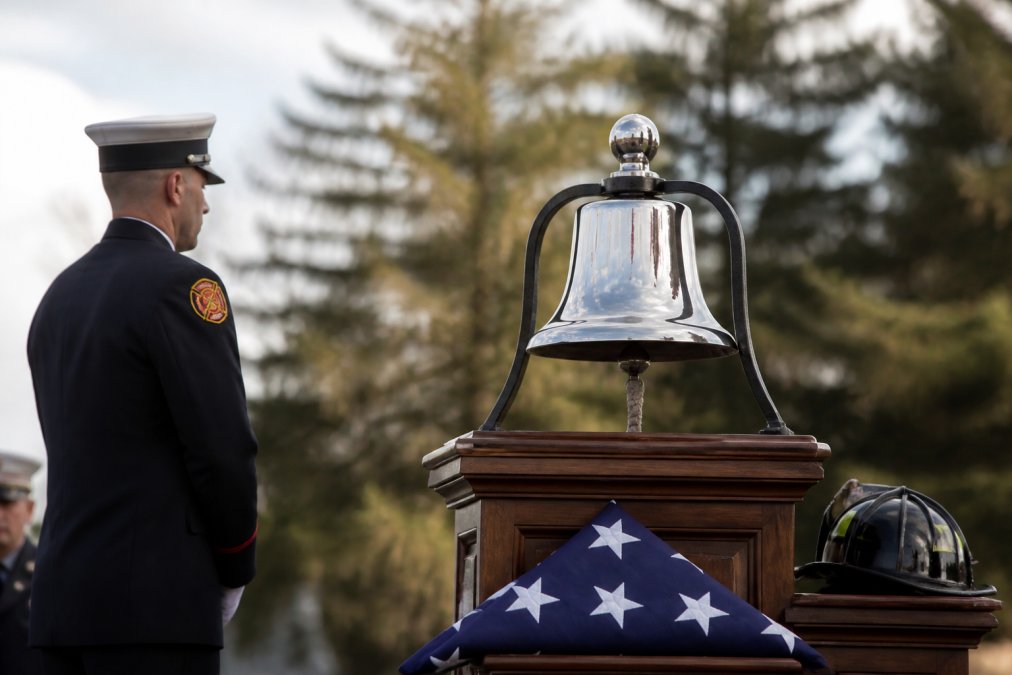
The ceremony usually follows a set order: an opening prayer or moment of silence, the ringing of the bell, the reading of the fallen firefighter's name and years of service, and a final radio call. That last element, the "last call," is a modern addition in many departments. A dispatcher broadcasts the firefighter's unit and name, waits, and then announces that the firefighter is out of service for the final time.
What most people don't realize is how much variation exists in how departments perform this. Some hold the ceremony at the station. Others hold it at the graveside. Some combine it with a full honors funeral that includes a caisson, a bagpipe band, and a flyover. The bell is the constant.
The National Fallen Firefighters Foundation provides guidance and support for departments planning these services, and its memorial weekend draws families from across the country each year.
5-5-5 vs. Fire Alarm Levels: Two Very Different Signals
What does 5 5 5 mean to a firefighter compared with fire alarm levels? They are completely separate systems, and confusing them is the single most common misunderstanding about this topic. A "five-alarm fire" describes the size and resource demand of an active incident. The 5-5-5 describes a death.
Fire alarm levels work as an escalating dispatch system:
- A first alarm sends the initial responding units
- Each additional alarm brings more companies, more apparatus, and more command staff
- A five-alarm fire is a major incident requiring a large multi-company response
- Alarm levels are operational and are announced during an active emergency
The 5-5-5 is ceremonial and is never announced during an active incident. It is struck at a memorial service, a funeral, or a department ceremony. The only thing the two share is the number five.
That overlap is exactly why the confusion persists. Someone hears "five alarms" on the news and then hears "5-5-5" at a service and assumes they're related. They are not. One describes how big a fire is. The other describes how much a firefighter meant.
Regional Variations and How the Signal Lives On Today
Regional variations in signaling are real, and the most consequential one is the split between 5-5-5 and 4-4-4. Both are ceremonial bell signals, both are used to honor fallen firefighters, and both are frequently confused, sometimes even inside the same department's written protocol.
The distinction most commonly cited in fire service tradition is this: 5-5-5 is the mourning signal struck at a memorial service or funeral, while 4-4-4 is often described as the signal used to announce a line-of-duty death to the department, or in some traditions as the signal for a firefighter who has died but not in the line of duty. The exact usage is not uniform. Some departments use 5-5-5 for both purposes. Others reserve 4-4-4 for a specific class of notification. A few use neither and rely on a radio "last call" alone.
That inconsistency is not a failure of the tradition. It is a feature of how the tradition spread. Bell codes were local by design, each city's alarm box network had its own numbering, and each department's ceremonial customs grew out of its own history. When the telegraph era ended, there was no national body that standardized the mourning cadence. Departments kept what their members had learned, and the patterns drifted.
What that means in practice is that a family attending a memorial in one region may hear a sequence that differs from what a family in another region heard. The constant is not the exact count. It is the cadence: slow, deliberate strikes, spaced to give the listener time to feel the weight of each one.
Beyond the 5-5-5 vs. 4-4-4 question, other variations show up in how the ceremony is performed. Some departments strike the bell in strict five-second intervals. Others use a slower cadence for the final sequence. Some include a spoken "last call" over the radio; others rely on the bell alone. A few departments have retired the bell entirely in favor of a moment of silence, though this is uncommon.
What keeps the tradition alive is not uniformity. It is repetition. Every time a department rings the bell for a fallen member, the next generation of firefighters learns the signal by hearing it. That is how a telegraph code from the 1800s became a living ritual in 2026.
The U.S. Fire Administration tracks line-of-duty death data and publishes guidance that many departments reference when planning memorial services. That data is a reminder of why the ceremony exists at all.
For those who want to carry the tradition beyond the ceremony, wearing it matters too. Black Helmet's Signal 5555 9/11 Memorial Premium Tee was built around exactly this symbol: the last alarm, rendered as something you can wear on duty, off duty, or at a memorial. It is not a novelty shirt. It is a marker of shared history.

Frequently Asked Questions
What does 5 5 5 mean in the fire department?
In fire service tradition, 5 5 5 (often written 5-5-5-5) is a bell signal struck in four groups of five strikes. It is a memorial alarm that announces a firefighter has died in the line of duty. The signal is typically rung at funerals, memorial services, and department ceremonies as a final call for a fallen comrade.
What is the significance of the 5-5-5 signal during a funeral?
At a firefighter's funeral, the 5-5-5-5 signal is rung after the eulogy or at the graveside. It represents the fallen firefighter's last alarm, signaling that they have answered their final call and returned to quarters. The bell ceremony is a solemn moment of honor and respect, often followed by the playing of taps and the presentation of a folded flag to the family.
How did the tradition of striking the bells originate in the fire service?
The tradition dates back to the 1800s when fire departments used telegraph systems and alarm bells to dispatch crews. Each fire alarm box had a unique signal code, and bells in the firehouse would strike that code to alert firefighters. When a firefighter died in the line of duty, the bells would strike a special signal to announce the loss, which evolved into the 5-5-5-5 memorial signal.
What is the difference between 5-5-5-5 and a five-alarm fire?
A five-alarm fire is an operational term indicating the number of fire companies needed to fight a blaze. It has nothing to do with the memorial 5-5-5-5 signal, which is a ceremonial bell strike honoring a fallen firefighter. The confusion arises because both use the number five, but one is about emergency response and the other is about remembrance.
