

Wildland Firefighter Apparel and Gear: 2026 Guide
Table of Contents
- Wildland Firefighter Apparel and Gear: What the Job Actually Requires
- NFPA 1977 Compliant Clothing: The Standard That Sets the Floor
- Wildland Fire PPE Requirements: What You Must Have on the Line
- Wildland Brush Shirts and Fire-Resistant Pants: Layer by Layer
- Best Firefighter Hoodies for Off-Duty and Station Wear
- Interface Gear, Packs, and Load-Bearing Equipment
- Gear Weight vs. Durability: The Trade-Off Every Crew Faces
- Maintenance and Care: Making Your Gear Last More Than One Season
- Frequently Asked Questions
Last Updated: September 15, 2026
Wildland Firefighter Apparel and Gear: What the Job Actually Requires
Wildland firefighter apparel and gear is the system of protective clothing, load-bearing equipment, and accessories built to keep crews alive on the fireline, where the threats are radiant heat, embers, abrasive terrain, and long shifts on foot. This guide from Black Helmet breaks down what the job demands, from NFPA 1977 compliant clothing to interface gear.
The market has shifted toward lighter, more breathable layers because heat stress sidelines more firefighters than flames do. The gear question is never "what's the toughest fabric," it's "what's the right balance of protection, weight, and breathability for your conditions."
We'll cover the standards that set the floor, the four required PPE categories, layering systems, and how to make a kit last. Black Helmet has outfitted fire service crews since 2008, and 100,000+ firefighters have worn our apparel.
NFPA 1977 Compliant Clothing: The Standard That Sets the Floor
NFPA 1977 compliant clothing meets the National Fire Protection Association's Standard on Protective Clothing and Equipment for Wildland Fire Fighting, covering minimum design, performance, and testing requirements for fireline garments. It is the baseline, not the ceiling.
The standard governs brush shirts, fire-resistant pants, coveralls, and accessories, testing for flame resistance, thermal protection, and durability after repeated laundering (NFPA 1977 Standard Development). Gear that carries the NFPA 1977 certification has been tested to hold its protective properties through a set number of wash cycles, which matters because a garment that loses its flame resistance after a season is worse than useless. The NFPA 1977 standard overview spells out the full testing protocol.
Compliance is not a permanent label. Altering a garment, adding a patch with the wrong adhesive, or washing with the wrong detergent can void certification without you knowing. Check the care tag before you customize anything.
Wildland Fire PPE Requirements: What You Must Have on the Line
Wildland fire PPE requirements are the minimum items a firefighter must wear or carry on wildland fire suppression, defined by agency policy and NFPA 1977. Missing one can pull you off the line.
The Four Required Categories
- Protective garments: brush shirt, fire-resistant pants or coveralls, rated to NFPA 1977
- Head and face protection: helmet with appropriate shroud or neck protection
- Hand and foot protection: leather gloves and all-leather or approved wildland boots
- Load-bearing and safety equipment: line pack, fire shelter, and harness where required
The fire shelter is the last line of defense, the garments buy time and reduce burn injury, and load-bearing gear keeps your hands free and essentials accessible.
Structural vs. Wildland: Why the Gear Is Not Interchangeable
Structural turnout gear is built for interior firefighting: heavy, bulky, and loaded with insulation and moisture barriers that trap heat. Wildland gear prioritizes breathability, moisture-wicking performance, and light weight because the job is hours of hiking and digging in heat.
Wearing structural gear on a wildland assignment is a heat-stress risk, not extra safety. Keep the two systems separate, and never assume a structural ensemble covers a wildland assignment.
Wildland Brush Shirts and Fire-Resistant Pants: Layer by Layer
The brush shirt and pants are the core of the system, and fabric choice decides whether you finish the shift strong or fade in two hours.
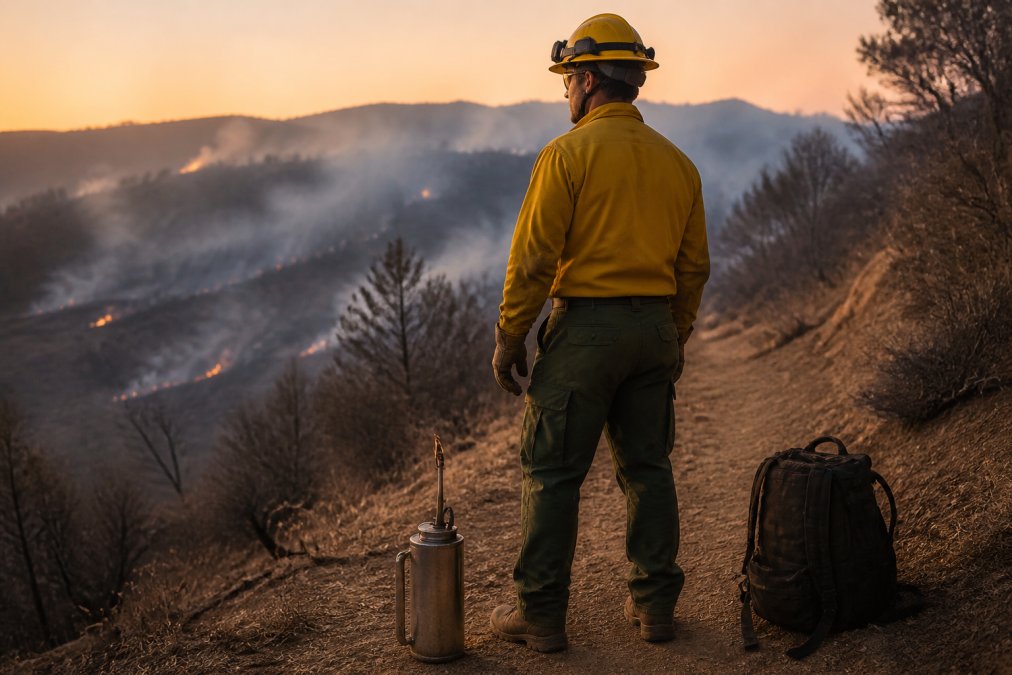
Brush Shirts: Nomex, Moisture-Wicking Blends, and What to Look For
Nomex remains the benchmark for flame-resistant brush shirts because it will not melt or drip and resists ignition. It is an inherently flame-resistant aramid, so protection is built into the fiber and cannot wash out. Modern blends add moisture-wicking fibers to move sweat off your skin.
When you compare shirts, look at three specs, not the marketing copy:
- Fabric weight. Most wildland brush shirts land in the 4.5 to 7.5 oz/yd² range (NFPA Journal). Lighter weights breathe and dry faster; heavier weights resist abrasion and snags. A 5.5 oz/yd² aramid blend is a common middle ground for mixed assignments.
- Construction. Flat-felled or double-needle seams resist blowout under pack straps. A stand-up collar and a full front closure that covers the zipper or buttons block embers from reaching your neck and chest.
- Cut. A relaxed cut that allows full arm extension without the hem pulling out of your waistband. Raglan sleeves improve overhead reach; set-in sleeves fit closer but can bind when you swing a tool.
A common mistake is buying the heaviest shirt for "durability." A lighter breathable shirt keeps core temperature down, and heat stress reduction is the biggest factor in staying functional. NFPA 1977 testing evaluates flame resistance, thermal shrinkage, and durability after laundering, so a certified lightweight shirt has passed the same baseline tests as a heavy one.
Brush Pants: Abrasion Resistance and Ergonomic Design
Fire-resistant pants take more abuse than any other garment: snagging on brush, kneeling in ash, sliding down slopes. Abrasion resistance at the knees and seat matters most. Look for reinforced knee panels, a double-layer seat, and bar-tacked stress points at pocket corners and belt loops.
Ergonomic design, articulated knees and a gusseted crotch, lets you step high and squat low without binding. A gusseted crotch is a diamond or triangular fabric insert that adds range of motion without bulk, and it separates a pant you can work in from one you fight all day.
Fit at the waist matters too. Pants that ride down when you bend force constant adjustment, a distraction you can't afford on a steep line. Look for a secure closure system and a cut that stays put through a full range of motion. Suspenders or a belt can help, but the pant itself has to be cut for movement.
Layering for Variable Climates
This is where a kit either works or fails.
A practical three-layer approach for wildland work:
Sizing and Fit: Get This Right Before You Buy
Best Firefighter Hoodies for Off-Duty and Station Wear
Interface Gear, Packs, and Load-Bearing Equipment
What "Interface" Actually Means
Line Packs: Load Distribution and Fit
Look for these features:
Harnesses and Load-Bearing Systems
The Fit Rule That Beats Every Feature List
Maintenance and Inspection of Load-Bearing Gear
Gear Weight vs. Durability: The Trade-Off Every Crew Faces
| Priority | Lean Toward | Trade-Off |
|---|---|---|
| Speed and endurance | Lighter brush shirt and pants | Less abrasion resistance |
| Extended durability | Heavier, reinforced fabrics | More heat retention, slower |
| Variable climate | Layering system | More pieces to manage |
| Load carrying | Padded, fitted harness | Added weight |
Maintenance and Care: Making Your Gear Last More Than One Season
Frequently Asked Questions
What clothing do wildland firefighters wear?
Wildland firefighters wear a layered system built around NFPA 1977 certified garments: a fire-resistant brush shirt, fire-resistant brush pants, leather or flame-resistant gloves, a fire shelter, and a helmet. Base layers are moisture-wicking and non-melting. Outer layers include high-visibility vests for aviation operations. The system prioritizes breathability and heat stress reduction over the heavier thermal protection used in structural firefighting.
What are the NFPA standards for wildland firefighting gear?
NFPA 1977 is the Standard on Protective Clothing and Equipment for Wildland Fire Fighting. It covers brush shirts, brush pants, coveralls, gloves, helmets, and fire shelters. The standard tests flame resistance, thermal protection, tear resistance, and abrasion resistance. It also sets minimum design requirements for ergonomic design and high-visibility markings. Gear must be recertified or replaced if it fails inspection. NFPA 1977 compliant clothing is the baseline for any wildland crew.
What is the difference between structural and wildland firefighting gear?
Structural gear (NFPA 1971) is built for interior firefighting with heavy thermal liners, vapor barriers, and turnout coats that trap heat. Wildland gear (NFPA 1977) is lighter, more breathable, and designed for extended movement across terrain. Structural gear causes heat stress during wildland work, and wildland gear lacks the thermal protection needed inside a burning building. The two systems are not interchangeable, and using the wrong one on the wrong incident creates a safety risk.
Why is flame-resistant (FR) clothing required for wildland firefighting?
Flame-resistant clothing does not melt or drip when exposed to radiant heat or brief flame contact. Synthetic fabrics like polyester and nylon can melt into skin, causing deeper burns than the initial heat exposure. NFPA 1977 requires that brush shirts, pants, and coveralls resist ignition and self-extinguish. FR protection buys time during a burnover or when working near flare-ups. It is a required layer, not an optional upgrade.
What should be in a wildland firefighter's personal gear bag?
A standard line pack includes a fire shelter in its case, a headlamp with spare batteries, leather gloves, eye protection, a hydration bladder, high-energy food, a weatherproof notebook, and a small first-aid kit. Crews also carry a spare brush shirt or base layer, extra socks, and sun protection. The bag itself should be load-bearing and tear-resistant. Many wildland firefighters keep a second bag staged with clean station wear and a fresh set of protective layering.
How do you maintain and clean wildland firefighting apparel?
Brush shirts and pants should be washed in warm water with a mild detergent, never bleach or fabric softener. Fabric softener leaves a flammable residue that undermines flame-resistant properties. Turn garments inside out, wash separately from heavily soiled items, and tumble dry on low. Inspect seams, zippers, and reflective trim after every wash. Any garment with charring, holes, or failed trim should be removed from service. Gear maintenance extends the life of NFPA 1977 certified clothing and keeps it compliant.
