

How to Know When to Replace Firefighter Helmets
Table of Contents
- Start With the 10-Year Service Life Limit
- Step 1: Check the Manufacture Date and Label
- Step 2: Run a Visual Inspection for Cracks, Crazing and Heat Damage
- Step 3: Decide Whether to Replace After an Impact
- Step 4: Assess Leather Helmets and Whether They Can Be Recertified
- Step 5: Document the Inspection and Decommission Retired Helmets
- Scheduling Your Next Helmet Review
- Frequently Asked Questions
Last Updated: November 10, 2026
Start With the 10-Year Service Life Limit
If you are asking when to replace firefighter helmets, the short answer is this: structural helmets have a mandatory service life of 10 years from the date of manufacture. Many departments treat that date as a hard stop, even when a helmet looks fine.
Wildland helmets follow a shorter clock. Wildland helmets are often held to a shorter service life, so check which type you carry before you plan your next purchase.
Black Helmet builds apparel and accessories for the fire service, but a helmet's age is a safety question, not a style one. Your department's policy and the manufacturer's guidance always come first.
Step 1: Check the Manufacture Date and Label
Start by finding the label inside the helmet. It lists the manufacture date, model and serial number. That date sets your replacement clock, not the day you were issued the helmet.
Write the date down and count forward 10 years for structural helmets, or 5 years for wildland helmets. Put a reminder in your calendar a few months before the deadline.
- Find the label inside the shell or suspension
- Note the manufacture date, not the purchase date
- Set a reminder 3 to 6 months before retirement
Watch out: Some older helmets have faded labels. If you cannot read the date, treat the helmet as unverified and report it to your officer.
The table below summarises the key dates and inspection points you need when checking a helmet's age.
| Helmet type | Service life | Clock starts from |
|---|---|---|
| Structural | 10 years | Manufacture date |
| Wildland | 5 years | Manufacture date |
| Any helmet with unreadable label | Treat as unverified | Report to officer |
Step 2: Run a Visual Inspection for Cracks, Crazing and Heat Damage
Between age checks, look the helmet over every shift. Turn it in good light and check the shell for cracks, crazing (fine surface cracks), warping and heat damage. Look at the faceshield, ear covers and chinstrap too.
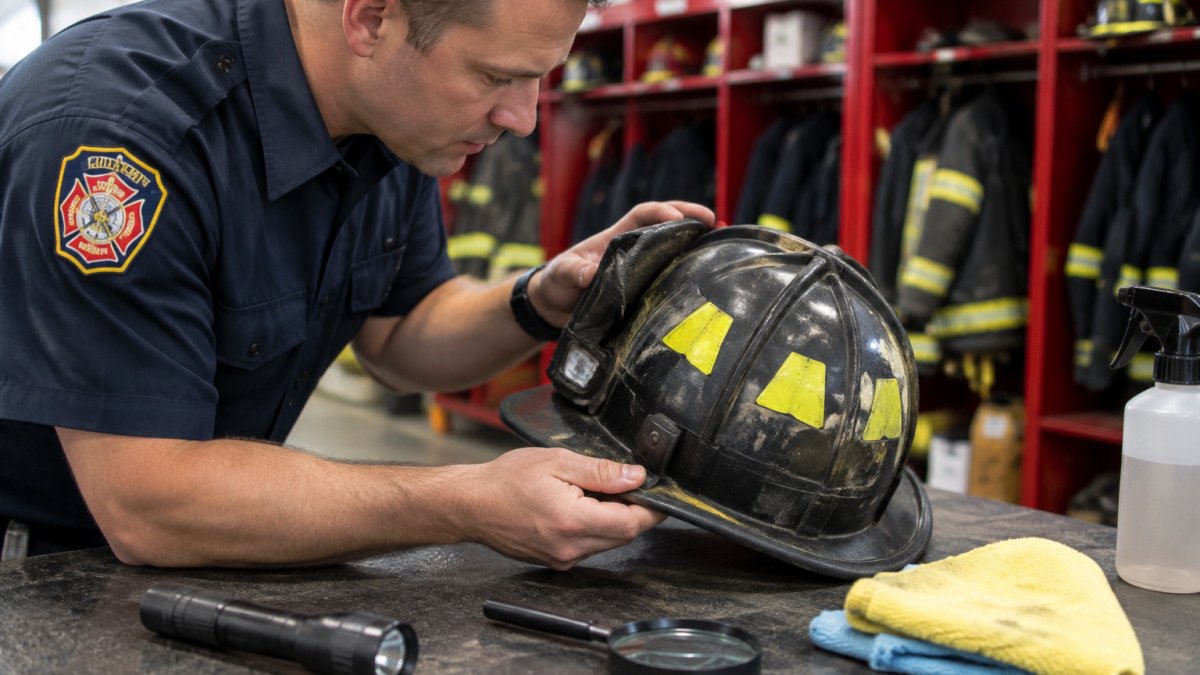
Heat and UV exposure break down shell material over time. A helmet that has seen a lot of fire can fail a visual check long before its 10-year date.
- Cracks or soft spots in the shell mean the helmet comes out of service
- Crazing, chalky surfaces or bubbling point to heat or UV damage
- Loose suspension, cut straps or a worn chinstrap need repair or replacement
Step 3: Decide Whether to Replace After an Impact
A hard blow or a fire event can damage a helmet even when the outside looks intact. Treat any significant event as a trigger for a documented post-incident inspection, and pull the helmet from service until that inspection is complete.
Use this checklist after an incident, working from the outside in:
- Shell: look for cracks, dents, flattened areas, or spots where the surface has lifted or bubbled. Run a gloved hand over the entire shell, since some fractures are easier to feel than to see.
- Brim and edges: check for splits, chips, or areas where the edge has softened or warped from heat.
- Faceshield and mounting points: confirm the shield still seats and latches correctly, and check the rivets or brackets for cracking or loosening.
- Suspension: inspect the webbing, adjusters, and retention system for burns, cuts, fraying, or stretched straps. Replace the suspension if any component fails.
- Chinstrap and hardware: test buckles and D-rings, and look for heat discoloration on the strap.
- Liner and ear covers: note any melted fabric, delamination, or odor that suggests heat exposure reached the interior.
Record the findings with the date, helmet ID, incident reference, and the name of the inspector. A helmet that passes the visual check after a minor event still belongs in the log, because a record of prior exposure helps whoever inspects it next.
Decision rules:
- Any visible crack, deformation, or soft spot in the shell means remove from service and replace.
- Heat discoloration, melted components, or a suspension that will not hold its adjustment means repair or replace before the next call.
- A helmet that was struck hard or knocked off a head should be removed and sent for evaluation, even if no damage is visible.
- If the manufacturer's instructions address post-incident evaluation, follow them over any general guidance here.
Watch out: a helmet can look clean and still carry heat damage inside the suspension and liner, so never judge it by the shell alone.
Step 4: Assess Leather Helmets and Whether They Can Be Recertified
Leather helmets are a special case. Some departments still run them, and some firefighters ask whether an old leather helmet can be recertified. The research available to us does not confirm a recertification process for leather helmets, so do not assume one exists. Check with your department and the manufacturer before you keep a leather helmet in service past its listed life.
Leather needs regular care whatever its age. Clean it as the maker directs and inspect it monthly for cracking and dry spots.
Step 5: Document the Inspection and Decommission Retired Helmets
Keep a simple record of each inspection: the date, helmet ID, findings, corrective action, and the name of the person who checked it. This log protects you and your department if a helmet is ever questioned, and it gives the next inspector a history to work from.
Retirement is a safety step, not a housekeeping one. A retired helmet that stays in a locker, gets handed to a friend, or turns up on a secondary market can end up on someone's head. Decommission it so it cannot be worn again.
A practical decommissioning sequence:
- Remove the department markings, unit numbers, and reflective trim so the helmet is no longer identifiable as active gear.
- Mark the shell clearly as retired, using a permanent marker or a durable tag that will survive handling.
- Cut or otherwise permanently damage the suspension and the shell so it cannot be reassembled or used. Follow your department's approved method, since some agencies require a specific destruction process.
- Record the retirement in the helmet log with the date and the method used.
- Route the destroyed helmet through your department's disposal channel rather than a general waste bin, especially if the department has a policy on contaminated gear.
Some firefighters ask whether a retired helmet can be kept as a keepsake. That is a decision for your officer and your department's policy. If a keepsake is approved, it should be permanently rendered unwearable and clearly labeled as display-only, so it never re-enters service.
Watch out: a helmet that is sold, donated, or traded without decommissioning can be used by someone who has no idea of its service history or condition, which is the main risk this step exists to prevent.
For ideas on marking a firefighter's career milestones, see our retirement gifts for firemen guide.
Scheduling Your Next Helmet Review
Build helmet checks into your routine instead of waiting for a problem. Schedule a visual inspection every shift, a documented review every year, and a replacement check at the 10-year mark for structural helmets.
Your next step is simple: pull your helmet today, read the manufacture date, and set a reminder for its replacement date.
Frequently Asked Questions
How long do firefighter helmets last?
Structural fire helmets carry a mandatory retirement age of 10 years from the date of manufacture, . Wildland helmets are often held to a shorter service life. Service life is a ceiling, not a target: a helmet that shows cracks, heat damage or impact deformation should come out of service before its date. Check your department's policy and the manufacturer's label for the exact dates that apply to your gear.
Is a 10-year-old firefighter helmet still good?
A structural helmet that is exactly 10 years from its manufacture date has reached the end of its service life under the common industry standard, so it should be retired rather than kept in service. Helmets younger than that still need routine inspection for cracks, crazing, shell deformation and heat damage. Age alone does not confirm safety, and a helmet can be retired early if it has sustained structural damage.
Should a firefighter helmet be replaced after an impact?
Yes, a helmet that has taken a significant impact should be inspected immediately and removed from service if the shell is cracked, dented, deformed or the suspension system is damaged. Impact damage can be invisible on the outside because the shell may have lost its ability to absorb a second strike. Document the incident, tag the helmet out of service, and follow your department's post-incident procedure before returning it to use.
How often should firefighter helmets be inspected?
Inspect helmets routinely, typically at the start of each shift or after each use, and perform a more thorough check at least monthly or as your department's policy requires. Look at the shell, chinstrap, ear covers, face shield attachments and suspension system. Clean with approved agents only, since harsh cleaners can weaken materials. Keep a log of inspection dates so you can show when each helmet was last checked.

