

How to Be a Good Firefighter Teammate: 9 Essential Practices
Table of Contents
- What It Means to Be a Good Firefighter Teammate
- Build Trust Through Integrity and Accountability
- Master Firefighter Team Communication
- Develop Firefighter Leadership Skills That Elevate Your Crew
- Maintain Physical Fitness and Operational Readiness
- Engage in Firefighter Team Building Exercises
- Handle Conflict Resolution in High-Stress Environments
- Support Peer Mental Health and Recovery Protocols
Last Updated: August 2, 2026
Knowing how to be a good firefighter teammate means understanding that every decision, word, and action affects the people who depend on you when lives are on the line. Research shows that teams with strong interpersonal dynamics experience fewer operational errors and higher crew satisfaction. Below are nine essential practices that transform how your station operates.
What It Means to Be a Good Firefighter Teammate
Being a good firefighter teammate means showing up as someone your crew can absolutely rely on, in emergencies, the station house, during training, and when things get difficult. It's the person who notices when a rookie is struggling and steps in without being asked. It's the veteran who admits mistakes instead of covering them up.
The firehouse culture depends on mutual respect and accountability. What most guides miss is that teamwork isn't about being liked, it's about being trustworthy. A crew doesn't need to be best friends. They need to know that when the alarm sounds, everyone will do their job with precision and put the team first.

Build Trust Through Integrity and Accountability
Trust is earned through integrity, doing the right thing even when nobody's watching. This means following through on commitments, maintaining your equipment, showing up on time, and being honest about your capabilities and mistakes.
When something goes wrong, you own it. You don't deflect blame or make excuses. Crews that operate this way develop a culture where people speak up about problems early instead of hiding them until they become dangerous. High-performing stations have zero tolerance for excuses but complete support for people who acknowledge mistakes and fix them.
Integrity also means consistency. You treat the chief the same way you treat the rookie. You follow procedures on easy calls and hard ones. This consistency builds the kind of trust that holds crews together under pressure.
Master Firefighter Team Communication
Clear communication prevents chaos during emergency response and prevents misunderstandings that erode crew cohesion.
Active Listening on the Fireground
Active listening means you're fully present when someone is speaking, focused on understanding what they're saying and asking clarifying questions if something isn't clear.
On the fireground, this is a survival skill. When the incident commander gives orders, you listen for the specific assignment, location, and objective, then repeat it back to confirm understanding. When a crew member reports a problem, you listen for the actual danger, not just the emotion in their voice. In the station house, active listening builds relationships and creates space for peer support.
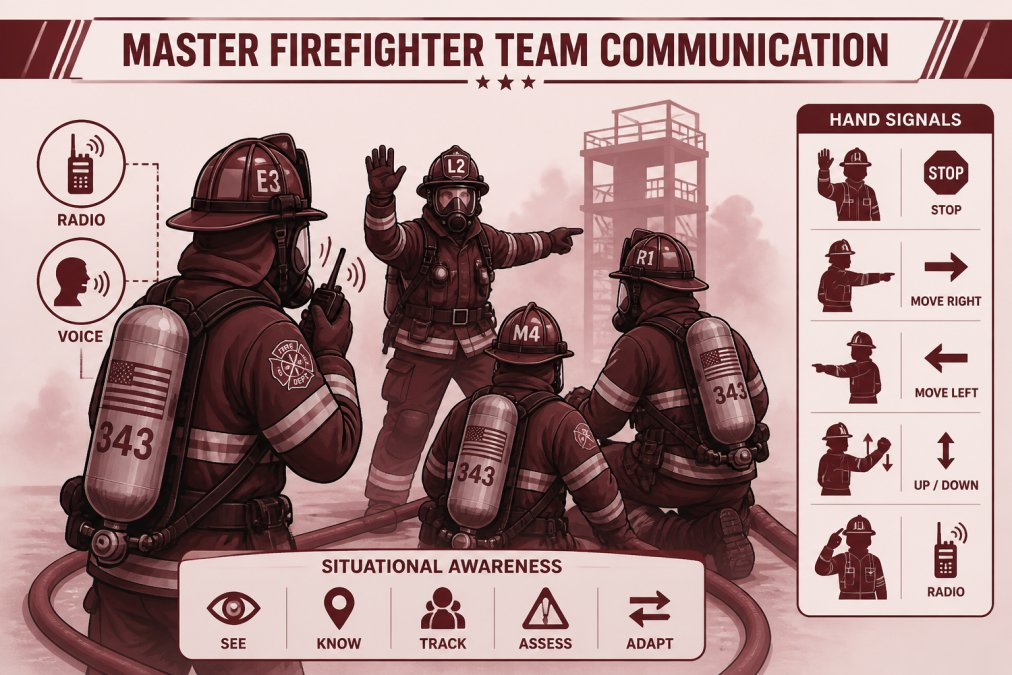
Clear Callouts and Situational Awareness
Situational awareness means you know what's happening around you and communicate it immediately. On the fireground, you're tracking building conditions, crew locations, water supply, and hazards. You call out changes: "Roof is getting soft on the Charlie side." "We're losing water pressure." These aren't casual observations, they're critical information that prevents disasters.
In station life, clear communication means you're direct about expectations and address safety issues directly and respectfully rather than complaining to others. This directness prevents resentment that poisons station culture.
Develop Firefighter Leadership Skills That Elevate Your Crew
Leadership in the fire service isn't about rank. It's about influence and making people around you better through example, mentorship, and how you handle pressure.
Lead by Example, Not by Rank
The most powerful leadership tool you have is your own behavior. If you maintain your gear with precision, show up ready to work, and handle difficult situations with composure, that sets the standard. You don't ask your crew to do something you wouldn't do. You're the first one to volunteer for the hard task.
This approach builds respect that rank alone never creates. A captain who leads by example has crews that follow orders because they trust the decision-making, not because they have to.
Mentorship and Supporting Rookies
Every experienced firefighter has an obligation to develop the next generation. Good mentorship is specific: show them exactly what they did wrong and what correct looks like. Give them opportunities to practice. Correct them in private, never in front of the crew.
Supporting rookies also means creating a safe environment for questions. A rookie who's afraid to ask for clarification is dangerous. A rookie who knows their mentor wants them to ask questions will speak up when they're unsure.
Maintain Physical Fitness and Operational Readiness
Physical conditioning isn't vanity, it's operational readiness. A firefighter who's not fit is a liability to their crew. They can't carry their partner out of a building or maintain the intensity needed during a long incident.
Being physically fit sends a message: you take the job seriously, you're prepared for whatever comes, and you respect your crew enough to be capable. Crews with strong fitness cultures have higher morale and better safety records.
Operational readiness extends beyond fitness. It means your equipment is always ready, your skills are current, you've studied the buildings in your district, and you've practiced your crew's standard operating procedures until they're automatic.
Engage in Firefighter Team Building Exercises
Team building in the fire service creates shared experiences that build crew cohesion and test how you work together under pressure.
Station House Etiquette and Crew Cohesion
Station house etiquette is the daily practice that builds crew cohesion. This includes respecting shared spaces, following the schedule, and treating equipment like it belongs to everyone. These small practices show respect for your crew's time and comfort. When everyone follows the same standards, the station runs smoothly.
Crew cohesion also means you know your crew's strengths and weaknesses. You know who's the best driver, who's strongest on the nozzle, who stays calm under pressure. This knowledge allows you to position people where they'll succeed.
Shared Meals and Downtime Bonding
Shared meals are one of the most underrated team-building activities in the fire service. When you cook together and eat together, you're building relationships that carry over to the fireground. A crew that eats well together typically communicates well together.
Downtime activities, working out together, studying for certifications, or just hanging out between calls, create familiarity that makes crews effective. You learn how people respond to stress, what motivates them, and how to communicate with them in ways that land.
| Team Building Practice | Purpose | Frequency |
|---|---|---|
| Shared meals | Build relationships and communication | Daily |
| Training drills | Test crew performance and identify gaps | Weekly |
| Equipment maintenance together | Ensure readiness and create shared responsibility | Daily |
| Social activities (games, workouts) | Develop camaraderie beyond the job | Weekly |
| Mentoring sessions | Develop skills and support newer firefighters | As needed |
Handle Conflict Resolution in High-Stress Environments
Conflict in the firehouse is inevitable. The question is whether your crew addresses it directly or lets it fester. Good firefighter teammates handle conflict quickly and respectfully.
Conflict resolution happens in private. You address the issue one-on-one, calmly, and with the goal of understanding their perspective. Most conflicts come from miscommunication or unmet expectations. Approach them with curiosity instead of defensiveness.
The de-escalation skills you use on calls apply to station conflicts too. You listen without interrupting, ask clarifying questions, and focus on solving the problem, not winning the argument. A crew that handles conflict well has higher trust and better communication.
Support Peer Mental Health and Recovery Protocols
The mental and emotional demands of the fire service are real. Firefighters experience trauma regularly and carry stress that affects their lives. A good firefighter teammate recognizes this and creates space for people to get help.
Supporting peer mental health means normalizing conversations about difficult calls and checking in on crew members who've been through something heavy. Know the resources available, peer support programs, counseling services, critical incident stress debriefing, and encourage people to use them.
A good firefighter teammate also recognizes the signs that someone's struggling: changes in behavior, withdrawal, increased irritability, substance use. You approach these conversations with compassion, not judgment. You listen, offer resources, and follow up.
Supporting peer mental health also means managing your own. You can't pour from an empty cup. If you're struggling, you get help. You model the behavior you want to see in your crew.
Being a good firefighter teammate is a daily practice, not a destination. It's the small decisions, how you communicate, how you handle mistakes, how you support your crew, how you maintain your fitness and mental health, that add up to create the kind of crew that functions at a high level under pressure.
Black Helmet was founded on the principle that the fire service is built on brotherhood and accountability. Our gear and apparel are designed for firefighters who understand that the job demands excellence in every area: physical, mental, emotional, and interpersonal. When you wear Black Helmet, you're representing a standard of professionalism and pride in the fire service. Explore our collection of challenge coins and apparel that honor the values of integrity, dedication, and crew loyalty that define the best firefighter teammates.

Frequently Asked Questions
What are the most important qualities of a good firefighter teammate?
The core qualities are integrity, reliability, adaptability, and accountability. A good firefighter teammate shows up ready to work, owns mistakes without excuses, communicates clearly under pressure, maintains physical fitness, and prioritizes crew safety over ego. Trust-building through consistent actions, not just words, separates exceptional teammates from average ones. Station life demands mutual respect and willingness to support others through both routine duties and high-stress emergencies.
How do firefighters build trust within their team and crew cohesion?
Trust develops through repeated demonstrations of competence, honesty, and dedication to the shared mission. Be technically proficient in your role, follow through on commitments, and admit when you don't know something rather than pretending. Participate in station life, cook meals together, engage in team building exercises, and show genuine interest in your crew's well-being. Trust accelerates when teammates see you prioritize crew safety, support rookies without judgment, and handle conflicts directly and respectfully.
What role does communication play in firefighter teamwork and emergency response?
Clear communication is non-negotiable on the fireground. It enables situational awareness, prevents dangerous mistakes, and ensures coordinated action during high-stress operations. Practice active listening, really hear what your crew is saying, not just waiting to respond. Use precise callouts, ask clarifying questions, and confirm understanding. Station life communication matters too: address conflicts early, share feedback constructively, and celebrate wins together. Strong interpersonal communication builds the foundation for effective emergency response.
How can a new firefighter become a valuable team member quickly?
Rookies earn respect through humility, work ethic, and willingness to learn. Ask questions, observe how senior firefighters operate, and take initiative on station duties without being asked. Show up physically and mentally prepared for every shift. Accept mentorship gracefully, your mentors are investing in your development and the crew's safety. Demonstrate reliability by being on time, following through on tasks, and supporting crew cohesion. Avoid trying to prove yourself through recklessness; steady competence and positive attitude build credibility faster than bravado.
This article was written using GrandRanker
