

Firefighter Hoodie NFPA 1975 Compliance Explained
Last Updated: November 5, 2026
Quick Summary
A firefighter hoodie meets nfpa 1975 compliance when its label or manufacturer documentation names the standard and edition it was tested to. NFPA 1975 covers station and work apparel worn at the firehouse or under turnout gear, not structural protective clothing. Always verify certification paperwork and check your department's uniform policy before buying.
- Look for the named NFPA 1975 edition on the garment label or documentation.
- NFPA 1975 covers station wear, not structural turnout gear.
- Vague fire-resistant claims without certification paperwork should be treated as unverified.
- Certification, compliance, and department approval are separate checks.
- Confirm your department's uniform policy before purchasing.
Table of Contents
- What NFPA 1975 Is and Who It Covers
- NFPA 1975 Requirements for Station and Work Apparel
- Station Wear Versus Turnout Gear: Where a Hoodie Fits
- What an NFPA 1975 Compliant Station Wear Hoodie Must Show
- NFPA 1975 vs 1977 and NFPA 2112: Which Standard Applies
- The NFPA 1970 Transition and Legacy Garments
- Buying and Caring for a Compliant Firefighter Hoodie
- Choosing Your Compliant Hoodie From Black Helmet
- Frequently Asked Questions
What NFPA 1975 Is and Who It Covers
The nfpa 1975 compliance standard is the National Fire Protection Association's specification for station and work apparel, the clothing firefighters wear around the firehouse and under their protective outer gear. Its purpose is to set requirements for flame-resistant garments so they do not contribute to injury when a firefighter is exposed to heat or flame. The standard was adopted in 1985 FireRescue1 coverage of the NFPA 1975 adoption history.
NFPA 1975 covers apparel worn at the station or under protective outer gear. It does not cover structural turnout gear, which is governed by different standards. That scope matters when you shop, because a hoodie that carries NFPA 1975 language is a station wear garment, not a replacement for turnout protection.
NFPA 1975 Requirements for Station and Work Apparel
The standard focuses on how a garment performs when exposed to heat and flame. Station wear is expected to resist ignition and avoid sustained burning, which is why fabric and fiber content are central to the requirements. Garments are evaluated through defined test methods rather than marketing descriptions.
Manufacturers certify a garment against the standard edition it was tested to. Buyers should look for that certification language on the garment or in its documentation, and should treat a vague "fire resistant" claim as unverified. Shoppers who want a checklist can start with the label and manufacturer documentation before anything else.
The standard evaluates garments through defined test methods rather than marketing descriptions, and certification must be checked against a named edition.
| Check | What to look for | Why it matters |
|---|---|---|
| Standard edition | Named edition on label or documentation | Certification is tied to a specific edition |
| Test basis | Defined test methods, not marketing claims | Performance is measured, not described |
| Certification claim | Standard named on the garment or documentation | Vague "fire resistant" wording is unverified |
| Buyer documentation | Certification paperwork available on request | Confirms compliance beyond the product page |
Station Wear Versus Turnout Gear: Where a Hoodie Fits
A station hoodie belongs in the station wear category. Turnout gear is the structural protective ensemble worn for fire attack, and it is built and certified to separate standards. A U.S. Fire Administration research document states that NFPA 1975-compliant station and work uniforms are not primary protective garments and cannot be relied on to provide full protection U.S. Fire Administration Executive Fire Officer Program research on uniform options.
In practice, a compliant hoodie is worn at the station, on work details, or under outer gear as a layer. It does not replace turnout protection. Keep that distinction clear whenever you describe a garment to a department or a buyer.
What an NFPA 1975 Compliant Station Wear Hoodie Must Show
Look for explicit NFPA 1975 language tied to a specific standard edition, a fabric or fiber description, and manufacturer documentation that supports nfpa 1975 compliance for the garment. A compliant hoodie should state its certification on the garment label or product listing, not just in a general product description.
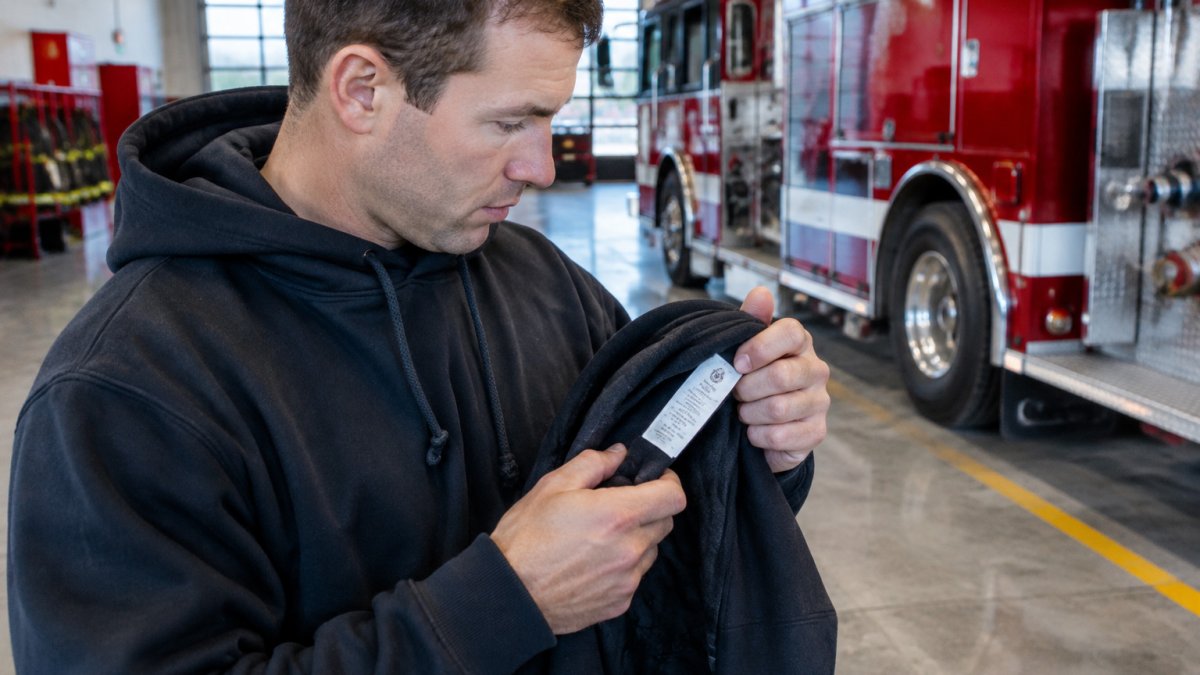
A useful buyer's check is to confirm three things: the standard and edition named, the fiber content, and whether documentation is available on request. If any of those are missing, ask the seller before purchasing.
Certification, compliance, and department approval are different things
These terms are often used interchangeably, but they mean different things. Certification is a third-party or manufacturer verification that a garment was tested to a named standard. Compliance means the garment meets the requirements of that standard. Department approval is a local decision by your fire department about which uniforms it will allow. A garment can be certified and compliant yet still not be approved by your department, so check your department's uniform policy before buying.
NFPA 1975 vs 1977 and NFPA 2112: Which Standard Applies
NFPA 1977 covers protective clothing and equipment for wildland firefighting, and NFPA 2112 covers flame-resistant garments for protection of industrial personnel against flash fire. Neither is the station wear standard. If you are buying a station hoodie, the relevant reference is NFPA 1975, and you should verify that the garment is labeled to it rather than to a different standard that happens to involve flame resistance.
Wildland firefighters in particular should confirm which protective standard governs their own gear, since the station-wear rules do not substitute for wildland protective requirements.
The NFPA 1970 Transition and Legacy Garments
NFPA 1970 is the consolidated standard for firefighter personal protective equipment. The U.S. Fire Administration reports that it consolidates NFPA 1971, 1975, and 1981 U.S. Fire Administration blog on the new PPE standard. The practical effect is that NFPA 1975 is no longer a standalone standard going forward, and station wear requirements now sit inside the consolidated document.
That change creates a common point of confusion for anyone holding legacy station wear. The question is not whether the old standard "still exists" in name, but which edition a given garment was certified to and whether that certification remains acceptable under current guidance and department policy. Guidance published in 2026 indicates that garments certified to the last standalone edition of NFPA 1975 remain compliant, and departments do not need to replace those uniforms solely because of this change CrewBoss PPE explainer on NFPA 1975 in 2026.
To verify a legacy hoodie, work from the garment outward:
- Read the label. Find the standard name and edition year the garment was certified to. That edition is the starting point for every later check.
- Match documentation to the garment. Confirm the manufacturer's certification documentation references the same edition and garment type as the label.
- Check current guidance and department policy. Confirm whether your department has adopted a position on legacy station wear and whether it requires any documentation on file.
- Re-check condition. A legacy garment that is torn, heavily stained, or worn out is a service-life question independent of its certification edition.
Watch out: do not assume a legacy garment has lapsed simply because the standard was consolidated, and do not assume it remains acceptable simply because it was once certified. The edition on the label, the manufacturer's documentation, current guidance, and your department's policy together determine the answer.
Buying and Caring for a Compliant Firefighter Hoodie
A compliant hoodie purchase is a documentation exercise as much as a style decision. Work through the following steps before you commit, and keep a copy of what you find in your department's uniform file.
- Identify the standard edition. Look for explicit NFPA 1975 language on the garment label or in the manufacturer's documentation, and note the edition year it was certified to. An edition reference is the anchor for every other check.
- Confirm the garment type. A station hoodie is station wear. Confirm the documentation describes it as station/work apparel and does not present it as structural or wildland protective clothing.
- Verify certification and compliance separately. Ask the seller for the certification documentation, not just a product-page claim.
- Check fiber content and construction claims. The label should state fiber content, and the documentation should support any flame-resistant or no-melt, no-drip language. Treat vague "fire resistant" wording as unverified.
- Confirm department approval. Certification does not equal permission. Check your department's uniform policy for allowed station wear, color, and layering rules before you buy.
- Request a current quote. Pricing depends on quantity, timing, and delivery, so request a current quote from Black Helmet rather than relying on an estimate.
Watch out: a product description alone does not establish compliance. If the seller cannot produce edition-specific documentation on request, treat the garment as unverified regardless of how the listing is worded.
Care and service life are part of continued suitability, not an afterthought. Follow the manufacturer's laundering instructions, because heat, harsh detergents, and repeated high-temperature drying can degrade flame-resistant finishes over time. Inspect garments regularly for tears, heavy staining, or fit issues, and retire any garment that no longer meets your department's policy. Certification is not a permanent status under all conditions; condition, care, and repairs all affect whether a garment remains suitable for use. Direct specific care and repair questions to the manufacturer and your department rather than assuming a certified garment stays compliant through any treatment.
Choosing Your Compliant Hoodie From Black Helmet
Black Helmet builds firefighter apparel for the fire service, and our hoodies are made for firefighters and the fire service community. Our range includes firefighter hoodies and sweatshirts in a variety of styles. Browse our firefighter hoodies and sweatshirts collection to compare styles.
Before you choose, read our guide to the NFPA 1975 no-melt, no-drip requirements if you are new to the standard. If you are also sorting station wear from other uniform items, our firefighter shirts guide covers where each piece fits. For a broader look at fabrics and styles, the fire department station wear buying guide walks through the choices.
Check your department's uniform policy, confirm the NFPA 1975 edition on the label, and buy the garment that matches both.
Frequently Asked Questions
What is NFPA 1975?
NFPA 1975 is the National Fire Protection Association standard covering station and work apparel worn by firefighters at the station or under protective outer gear. It sets flame-resistance and related requirements for those garments. It does not cover structural turnout gear. Buyers should confirm with the standard and their department how the consolidation of NFPA 1975 into NFPA 1970 affects garments certified to earlier editions.
Does NFPA 1975 apply to firefighter hoodies?
It can, if the hoodie is designed and marketed as station or work apparel. NFPA 1975 applies to station and work garments, including those worn under protective outer gear. A hoodie qualifies only when the manufacturer certifies it to the standard and provides documentation. Buyers should look for a garment label and manufacturer documentation that name the standard edition. A hoodie without that certification should not be assumed to meet NFPA 1975 requirements.
Is a station hoodie the same as structural firefighting protective clothing?
No. NFPA 1975 covers station and work apparel and explicitly excludes structural turnout gear, which falls under other NFPA standards. NFPA 1975-compliant station and work uniforms are not primary protective garments and cannot be relied on to provide full protection. A compliant hoodie is station wear, not a substitute for turnout gear.
What is the difference between NFPA 1975 and NFPA 1977?
NFPA 1975 covers station and work apparel, while NFPA 1977 covers protective clothing and equipment for wildland firefighting. The two standards address different working environments and different hazards. A wildland-focused garment should be evaluated against NFPA 1977, while a station hoodie is evaluated against NFPA 1975. Checking the standard named on the garment label and manufacturer documentation confirms which applies.
What is the difference between NFPA 1975 and NFPA 2112?
NFPA 2112 covers flame-resistant garments for protection of industrial workers against flash fire, which is a different hazard profile from the station and work apparel addressed by NFPA 1975. Industrial flame-resistant clothing and fire-service station wear are governed by different requirements. Buyers should not treat NFPA 2112 certification as equivalent to NFPA 1975 compliance for a firefighter station hoodie.
How can firefighters check whether a hoodie meets NFPA 1975?
Start with the garment label, which should name the standard and edition the garment is certified to. Then request the manufacturer's documentation, including the certification statement and test information. Confirm that the certified edition is one still recognized for the garment. Finally, verify with your department, because compliance with the standard is separate from whether your department approves the garment for station use. Keep documentation on file if your department requires it.
Can firefighters wear noncompliant hoodies at the station?
That depends on department policy. Compliance with NFPA 1975 is a certification question, while uniform policy is set by the department. A department may allow noncompliant hoodies for off-duty or non-hazardous station use, or may restrict them. Check your uniform policy before wearing any hoodie at the station, and do not wear a noncompliant hoodie under turnout gear.

