

Balance Firefighter Shift Work and Family Life
Table of Contents
- Understanding the 24/48 Shift Schedule and Its Impact on Family
- How to Transition from Night Shift to Day Shift Without Disrupting Family Routines
- Firefighter Shift Work Sleep Tips for Better Recovery and Mental Health
- Setting Boundaries Between Work and Home Life
- Firefighter Marriage Advice: Communication and Connection During Non-Traditional Schedules
- Managing Household Responsibilities and Quality Family Time
- Building Resilience and Recognizing Burnout in Your Household
- Frequently Asked Questions
Last Updated: August 31, 2026
Understanding the 24/48 Shift Schedule and Its Impact on Family
The 24/48 shift schedule, 24 hours on duty, 48 hours off, shapes everything from sleep patterns to family dinners. During those 24 hours, you're unavailable. Your spouse manages the household and often feels like a single parent. Then you return exhausted, needing recovery time while your family expects presence. The unpredictability compounds stress: you might have a quiet night or run calls until dawn, arriving home depleted.

At Black Helmet, we understand the tension firefighters navigate with this schedule. The ones who succeed don't fight the schedule, they build their family life around it. They set expectations early, communicate constantly, and protect specific windows for connection. The first step is accepting that balance doesn't mean equal time, it means intentional time.
How to Transition from Night Shift to Day Shift Without Disrupting Family Routines
Coming home after a night shift is when most firefighters struggle with the transition. You've been in crisis mode for hours, running on adrenaline, while your family is waking up expecting a normal morning.
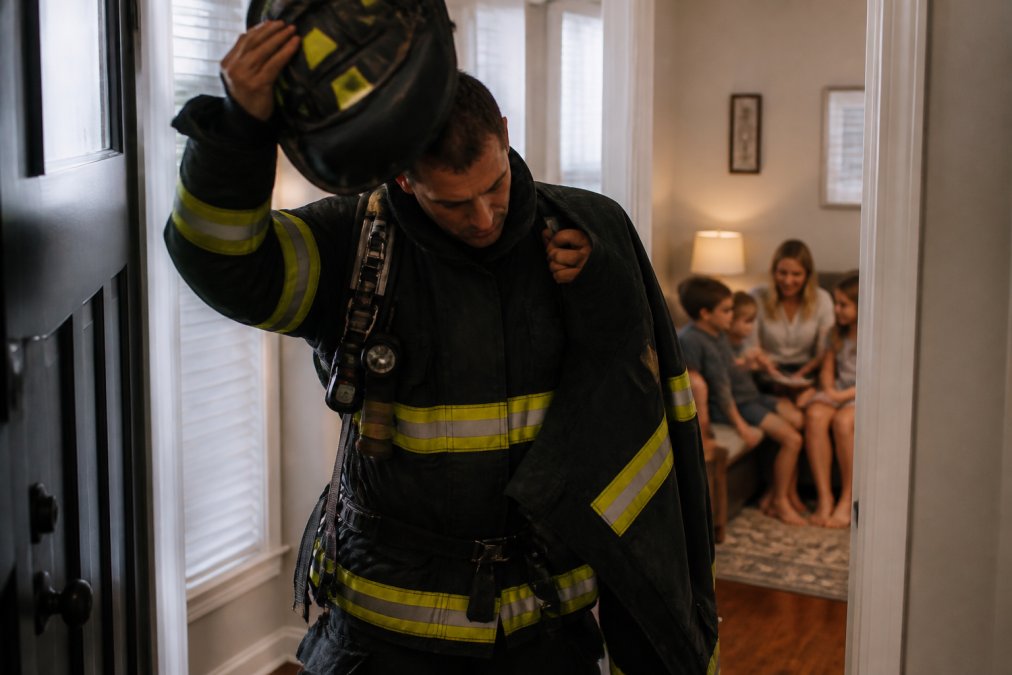
The transition needs to be physical, not just mental. Change clothes immediately, not just out of the uniform, but into something that signals "I'm home now." Spend 15 minutes alone before engaging with family. Consistency matters, your family learns to recognize the ritual and respect the boundary.
Sleep is your first priority, but timing matters. Come home at 8 AM and spend an hour with your family doing something low-key. Have coffee. Help with breakfast. Then communicate clearly: "I'm going to sleep for four hours. I'll be back for dinner." This prevents guilt and resentment.
Keep your bedroom cool and dark with blackout curtains. When you wake up, resist diving into household tasks immediately. Spend 20 minutes with your spouse or kids doing something that doesn't require decision-making. Then tackle chores. This prevents the dynamic where you come home, do tasks, and never actually connect.
Communication with your spouse is essential. Let them know: "I'm going to be foggy for the first hour. Don't ask me to make decisions." Most spouses appreciate the honesty and stop expecting you to be fully functional.
Firefighter Shift Work Sleep Tips for Better Recovery and Mental Health
Sleep quality determines everything else. Poor sleep compounds stress, damages your immune system, and makes you irritable at home (the NIH).
Your sleep environment is non-negotiable: dark, quiet, and cool. Invest in a white noise machine to mask household sounds. No caffeine after 2 PM if you're sleeping in the afternoon (the CDC). If you need the social ritual of coffee with your family, switch to decaf.
Physical recovery matters as much as sleep. A 20-minute walk, light stretching, or a warm shower helps transition your nervous system from alert to rest mode. Keep a notepad by your bed for racing thoughts, write them down and tell yourself you'll address them after sleep.
Chronic sleep deprivation increases anxiety and depression risk (peer-reviewed research). If you're more irritable at home or withdrawn, sleep quality is often the root. Track your sleep for two weeks using an app or simple notes. You'll see patterns about which shifts deplete you most and which recovery strategies actually work.
Setting Boundaries Between Work and Home Life
The boundary between work and home is where most firefighter marriages break down. Without it, the job bleeds into every conversation and moment.
A physical boundary helps. The Off-Duty Tread Doormat from Black Helmet serves as a literal transition point, you step on it, you leave the shift behind. Your family sees you step on that mat and understands: work stays outside.

Establish conversational boundaries: no detailed call stories at dinner. Save heavy processing for your spouse in private or with a peer who understands the job. If you're off-duty, you're off-duty. Don't check the fire department group chat constantly. Be present.
Emotional boundaries are hardest. If you come home angry after a bad call, name it clearly: "I had a rough shift. I need an hour to decompress. Then I'll be more present." Establish "no work talk" hours, maybe 6 PM to 8 PM, where you discuss your kids, plans, and relationship, not the job.
The strongest boundary is consistency. If you sometimes engage in work talk and sometimes don't, your family gets confused. Consistency builds trust that your off-duty time is truly theirs.
Firefighter Marriage Advice: Communication and Connection During Non-Traditional Schedules
Your marriage will either be strengthened by this schedule or destroyed by it. The non-traditional schedule forces intentional connection in ways many couples never learn.
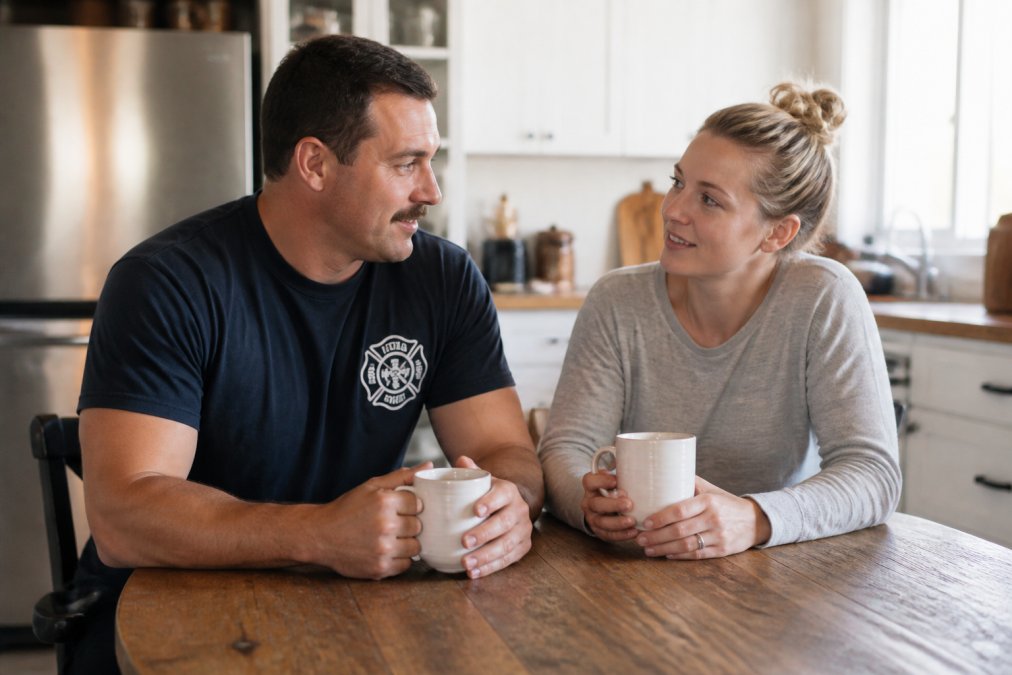
Communicate about the schedule itself. Sit down with your spouse and discuss what the 24/48 means for your relationship. How will you handle the 24 hours you're gone? What does your spouse need? How will you reconnect when you return?
Many couples benefit from a specific reconnection ritual. Maybe it's a walk after kids are in bed or sitting on the porch for 20 minutes. The activity matters less than consistency. Your spouse learns: "When he gets home from a shift, we have this time together."
Check-in communication during your shift has limits. A quick text saying you're thinking of them is good. Lengthy conversations about household problems while at the station isn't helpful. Agree on a communication pattern that prevents resentment without creating distraction.
Vulnerability matters more in a firefighter marriage. Your spouse needs to know you're struggling sometimes, not just that you're fine. When you're honest about difficulty, your spouse can support you instead of guessing what's wrong. natural stress relief.
Sexual intimacy often suffers due to exhaustion and timing, not lack of attraction. Acknowledge this. Schedule intimate time if needed, it removes spontaneity but gains reliability. Many couples find that reliability builds more connection than spontaneous moments.
Managing Household Responsibilities and Quality Family Time
The household doesn't pause when you're at the station. Your spouse manages bills, homework, and cleaning, often while working their own job. When you come home, you need to contribute.
Divide responsibilities clearly and follow through. Don't volunteer to do something and then be too tired. Be honest about what you can realistically handle. Maybe you handle yard work, finances, or heavy cleaning on your days off. Commit fully.
Divide your 48 hours off into recovery time and family time. Maybe the first 12 hours is recovery and sleep. The remaining 36 hours is family-focused. This prevents guilt about never being fully present.
Quality time with kids requires presence, not elaborate plans. Put your phone down. Thirty minutes of undivided attention is worth more than three hours of distracted presence. Claim one specific activity as your thing with each child, Sunday breakfast, Wednesday night games. These become part of the family rhythm.
Household chores can be family time if you frame them that way. Washing the car together, cooking dinner as a team, these are moments of connection. Your kids learn responsibility and get time with you.
Accept that you can't do everything. Most firefighters find that the perfect house is what gives. Your family would rather have you present than spotless floors.
Building Resilience and Recognizing Burnout in Your Household
Burnout creeps in gradually. One day you realize you're snapping at your kids over small things, withdrawing from your spouse, dreading your days off. That's burnout, and it affects your entire household.
The first warning sign is emotional exhaustion. You're not just tired, you're emotionally flat. Things that mattered don't. If you're noticing this, take it seriously. Talk to your spouse, a peer, or someone who understands. Burnout is common and treatable, but only if addressed early.
Physical symptoms often accompany emotional burnout: poor sleep even on days off, frequent headaches, stomach upset. Your body is telling you something is wrong. Listen to it.
Burnout affects your marriage directly. You have less patience with your spouse, less interest in connection. Arguments escalate faster. Your spouse feels the withdrawal and responds with frustration.
Building resilience means proactively managing stress. Regular exercise helps, not intense workouts necessarily, but consistent movement. Connection with other firefighters who understand the job is crucial. Your spouse can support you, but they haven't run into a burning building. Peer support helps you process the job in ways family support can't.
Talking to a therapist who understands first responder trauma is increasingly important. Using therapy is no longer weakness, it's strength. You maintain your mental health like you maintain physical fitness.
Watch for warning signs: increased conflict with your spouse, withdrawal from kids, inability to find joy in things you enjoyed, increased substance use, thoughts of self-harm. If experiencing any of these, reach out to your employee assistance program, a therapist, or a crisis line.
Protect certain boundaries fiercely: one day off per week where you don't think about work, one evening fully present with family, one activity that brings genuine joy unrelated to the job. These aren't luxuries, they're maintenance.
Balancing firefighter shift work and family life isn't a problem you solve once. It's a practice you refine over years. Start with one strategy from this guide and implement it fully. Then add another. Build your system slowly, with your spouse as your partner. The families that thrive aren't the ones who have it all figured out, they're the ones who keep showing up, keep communicating, and keep prioritizing connection even when the schedule makes it hard.
Frequently Asked Questions
Q: What are the most effective communication strategies for firefighter couples?
A: Establish a regular check-in routine before and after shifts, even 10 minutes of focused conversation prevents misunderstandings. Use clear, specific language about household needs and emotional expectations rather than vague frustrations. Schedule deeper conversations during your days off when you're rested. Many firefighter couples find that acknowledging the 24/48 schedule openly ('I'll be in a high-stress environment today') reduces resentment and builds understanding. Consider a shared calendar or messaging app to coordinate household tasks and family events without constant back-and-forth.
Q: How do you manage household responsibilities with a 24/48 schedule?
A: Divide tasks by shift cycle rather than daily. Assign recurring responsibilities to the person off-duty that week (grocery shopping, bill paying, yard work) so expectations are clear. Use a written list or shared app to track who handles what, this eliminates daily negotiation and prevents resentment. Batch similar tasks together (all errands on one day off) to preserve quality family time. For families with children, establish which parent handles school pickups, homework, and bedtime routines during their off weeks. Flexibility matters: if a firefighter returns home mentally exhausted, the non-firefighter partner may need to absorb extra tasks that day.
Q: What does it mean when firefighters talk about 'decompression' after a shift?
A: Decompression is the mental and physical transition from the high-stress, adrenaline-fueled environment of a shift to a calmer home state. Firefighters often experience hypervigilance, elevated heart rate, and emotional intensity during shifts, especially after calls. Rushing directly into family responsibilities without decompression can lead to irritability, emotional distance, or conflict. Healthy decompression might include a quiet drive home, a walk, time alone in the garage, or a shower before engaging with family. The Black Helmet Off-Duty Tread Doormat serves as a physical symbol of this transition, a literal threshold where the job stays outside and home life begins.
Q: How can firefighters prioritize quality time during their days off?
A: Schedule family activities during your alert hours, not when fatigue is highest. After a 24-hour shift, your first day off may require sleep and recovery, plan active family time for day two. Be fully present: put phones away during meals and activities, even if it's just 30 minutes of undivided attention with your children. Establish rituals (Sunday breakfast, Saturday hike, Wednesday movie night) that your family can count on. Communicate with your family about realistic expectations: some days you'll be fully engaged; other days you'll need quiet recovery time. Quality matters more than quantity, one fully present hour beats eight hours of distracted time.
This article was written using GrandRanker
