

5 Essential Fireground Search Patterns for Recruits
Table of Contents
- Why Fireground Search Patterns Decide the Outcome
- The 5 Essential Fireground Search Patterns for Recruits
- The Orientated Search Method for Recruits: Why It Comes First
- Firefighter Search and Rescue Techniques That Keep You Alive
- Fireground Search Drills That Build Real Skill
- Common Mistakes Recruits Make During Search Operations
- Frequently Asked Questions
Last Updated: September 17, 2026
Why Fireground Search Patterns Decide the Outcome
Fireground search patterns are the structured movement methods firefighters use to locate and remove victims inside a burning structure. They work because they replace panic with a repeatable route: you know where you started, where you are, and where you have already been.
Here is the hard truth most recruits learn too late. A search is not a sprint through smoke. It is a navigation problem solved under stress. This guide from Black Helmet breaks down the five patterns every recruit should drill before their first real job, plus the debrief habits that turn repetition into instinct.
The National Fire Protection Association standards for fireground operations frame much of what your department will require of you, and reading them early pays off.
The 5 Essential Fireground Search Patterns for Recruits
The five essential fireground search patterns for recruits are oriented search, split search, VEIS, primary search, and secondary search. Each one answers a different question about the building, the occupants, and the time you have left.
Learn them in this order. Oriented search builds your navigation instinct. Split search teaches coordination. VEIS trains you to read a window. Primary and secondary search teach you the difference between finding and confirming.
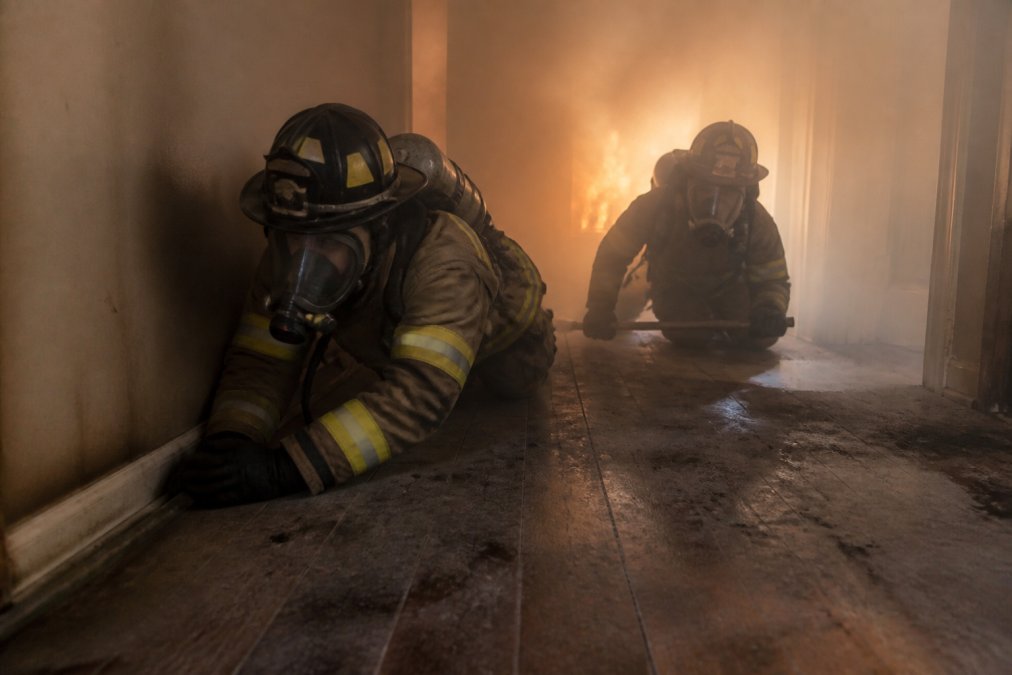
1. Oriented Search: Anchor a Wall, Then Work the Perimeter
Oriented search means maintaining continuous physical contact with a wall, hose line, or search rope so you always know your position relative to your entry point.
The method is simple to describe and brutal to execute. You pick a wall at the door, stay on it, and work the perimeter of the room in a consistent direction. Every doorway, every turn, every piece of furniture you touch tells you where you are.
What most guides miss is that orientation fails at the door, not in the room. Recruits lose their anchor in the first ten feet because they rush the entry. Slow down at the threshold. Confirm your wall. Then move.
2. Split Search: Two Teams, One Room, Faster Coverage
Split search assigns two firefighters or two teams to opposite sides of the same room, each working toward the other until they meet.
The advantage is speed. A large open floor plan that would take one team several minutes to sweep gets covered in roughly half the time. The risk is coordination. If both teams drift toward the same side, you have doubled your effort and halved your coverage.
Communication during search operations holds this pattern together. Agree on a meeting point before you enter. Left team takes the left wall, right team takes the right wall, and you both work the middle last.
This pattern suits open commercial spaces and large residential rooms. It suits narrow hallways poorly, where two teams simply get in each other's way.
3. VEIS: Vent, Enter, Isolate, Search
VEIS stands for Vent, Enter, Isolate, Search. It is a targeted rescue technique for a known or highly probable victim behind a window, not a general room-clearing method.
The sequence is unforgiving. Vent the window to relieve the thermal layer. Enter through the opening. Isolate the room by closing the door behind you to hold back fire and smoke. Search the immediate area fast.
The thing nobody tells you about VEIS is how quickly the room turns. Once you vent, you have changed the fire behavior in that space. If you cannot isolate, you should not stay.
4. Primary Search: The Initial Sweep for Lives
The primary search is the first, fast sweep for occupants, conducted during the initial fire attack when conditions allow.
Into the Heat Firefighter Notebook →
Speed and thoroughness fight each other here.
5. Secondary Search: Confirming an Empty Structure
The secondary search is a slower, more thorough sweep conducted after the fire is knocked down, confirming that no victims were missed.
The Orientated Search Method for Recruits: Why It Comes First
The orientated search method for recruits comes first because orientation is the skill every other pattern depends on.
| Pattern | Primary Use | Key Skill Tested | Main Risk |
|---|---|---|---|
| Oriented search | General room clearing | Wall and rope orientation | Losing the anchor at entry |
| Split search | Large open rooms | Team coordination | Both teams covering the same side |
| VEIS | Known victim behind a window | Speed and isolation | Fire pulled toward the opening |
| Primary search | Initial life sweep | Prioritizing likely locations | Rushing past closed doors |
| Secondary search | Post-knockdown confirmation | Thoroughness and documentation | Treating it as a formality |
Firefighter Search and Rescue Techniques That Keep You Alive
Firefighter search and rescue techniques keep you alive by managing three variables: your air, your orientation, and your visibility.
Crawl, Duck Walk, and Slide: Moving Through Zero Visibility
Zero visibility movement comes down to three techniques, and each one trades speed for control.
Thermal Imaging Cameras and the Thermal Layer
A thermal imaging camera (TIC) reads surface temperature differences and shows you shapes through smoke that your eyes cannot resolve.
Fireground Search Drills That Build Real Skill
Fireground search drills build real skill only when they include the parts that are uncomfortable: zero visibility, real air consumption, and a partner who depends on you.
Build drills around these four variables:
- Visibility: start clear, progress to full blackout
- Layout: change the floor plan every session so memorization cannot substitute for technique
- Air: run the drill on a clock tied to actual SCBA consumption
- Accountability: require a report of who entered, where they went, and when they came out
Post-Search Debriefing: Where the Learning Actually Happens
Post-search debriefing is the structured review that happens immediately after a drill or a real search, and it is where most of the actual learning occurs.
Common Mistakes Recruits Make During Search Operations
The mistakes below show up in nearly every recruit class, and every one of them traces back to the same root cause: treating speed as the goal instead of the byproduct of good technique.
- Rushing the entry. Orientation is lost in the first ten feet, not deep in the room.
- Skipping the closed door. A closed door usually means a survivable space. Open it.
- Losing the hose line. The line is your way out. Treat contact with it as non-negotiable.
- Searching high first. Victims are found low far more often than recruits expect.
- Ignoring air tracking. No one is checking your gauge for you.
- Treating the secondary search as a formality. It is the search that confirms the building is clear.
- Freezing under stress. This is a training gap, not a character flaw, and it is fixed with repetition.
Frequently Asked Questions
What does 5 5 5 mean to a firefighter?
It's a mnemonic some instructors use to frame search priorities: five essential fireground search patterns, five core techniques, and five drills to practice them. The idea is that a recruit who can name and execute all three groups without hesitating is ready to search under real conditions. Treat it as a training checklist rather than a hard rule, since every department's standard operating guidelines will set its own sequence for primary and secondary search.
What is the difference between a primary and secondary search?
A primary search happens during the initial attack, often before fire suppression is complete. It's fast, aggressive, and focused on survivable spaces near the entry point. A secondary search happens after the fire is knocked down and conditions improve. It's slower and more thorough, covering closets, under beds, and behind furniture. Both are required before a structure can be declared clear, and skipping the secondary search is one of the most common failures in recruit training.
How does the orientated search method work for new firefighters?
The orientated search method for recruits starts with one rule: stay connected to a wall. You anchor a shoulder or hand on a wall, follow it to a corner, then work the perimeter of the room before cutting across the middle. This keeps you oriented when visibility is zero, prevents you from getting spun around, and gives you a reliable path back to your entry point. Practice it in a dark room with furniture before you ever do it on a fireground.
What are some effective fireground search drills for firefighters?
Start with a mask-on, blacked-out room walk using the oriented search pattern. Add a downed victim dummy and time the rescue. Then run split search drills with two-person teams entering the same room from opposite sides. Finish with VEIS drills from a ground ladder into a second-floor window. Log every run in a notebook so you can track times and see where your technique breaks down under fatigue.
Why is systematic searching critical for recruit training?
Panic and zero visibility cause recruits to default to random movement. A systematic pattern replaces that instinct with a repeatable sequence: anchor, sweep the perimeter, cover the center, mark your exit. Departments that drill patterns consistently see fewer missed rooms and faster victim removal. The pattern also gives incident command a predictable timeline, which matters when they're deciding whether to keep crews inside or pull them out.
