

Eco-Friendly Fire Retardant Materials Research: What the Science Says
Last Updated: November 13, 2026
Quick Summary
Research on eco-friendly fire retardant materials focuses on bio-based additives such as chitosan, phytic acid, and plant polyphenols, which slow ignition mainly through char formation rather than gas-phase inhibition. Most published results come from laboratory-scale tests on small samples, not full-scale product performance, and fire performance alone does not prove a material is environmentally preferable.
- Chitosan from shellfish waste and phosphorus-rich phytic acid are the two most studied bio-based flame retardant candidates.
- A University of Portsmouth review (2024) examined bio-based flame retardants for natural-fiber composites and their testing techniques.
- Intumescent systems combine an acid source, a carbon source, and a blowing agent to swell into protective char.
- Cone calorimetry (ASTM E1354) is the closest bench-scale proxy for real fire behavior, reporting heat release rate and smoke.
- A UL 94 V-0 rating on a 3 mm specimen can still fail ASTM E84 or a full-scale assembly test.
Table of Contents
- Why Eco-Friendly Fire Retardant Materials Research Matters Now
- Bio-Based Flame Retardants: Chitosan, Phytic Acid, and Plant Polyphenols
- Natural Fiber Fire Retardant Treatment for Composites and Textiles
- How Eco-Friendly Flame Retardants Actually Work: Char Formation and Intumescence
- Sustainable Fire-Retardant Coatings and Layer-by-Layer Assembly
- Testing, Certification, and the Gaps in the Evidence
- Reading an Environmentally Friendly Fire Retardant Materials Research Paper
- What Firefighters Should Know Before Trusting a Green Claim
- Frequently Asked Questions
Why Eco-Friendly Fire Retardant Materials Research Matters Now
Interest in eco-friendly fire retardant materials research has moved from academic curiosity to a serious materials-science priority.
The central question driving the field is simple: can a material resist ignition, slow burning rate, and cut heat release without the environmental and health baggage of conventional halogenated additives? Researchers are answering with bio-based chemistry, waste-derived feedstocks, and surface treatments rather than bulk additives. Below, we break down what the science actually shows, where the evidence is thin, and what it means for the people who depend on flame-resistant materials every shift.
Bio-Based Flame Retardants: Chitosan, Phytic Acid, and Plant Polyphenols
Bio-based flame retardants are additives and coatings derived from renewable biological sources that slow ignition and burning. Chitosan, a polysaccharide from shellfish waste, and phytic acid, a phosphorus-rich plant compound, are the two most studied candidates.
A review in Environmental Materials and Sustainability (2023) examined polysaccharides and secondary metabolites as fire retardants for textiles, noting that these materials often work through char formation rather than gas-phase inhibition. Plant-derived polyphenols are also under investigation, with a Chemistry, Methods review (2025) comparing their mechanisms and synergistic effects when combined with other additives.
The appeal is practical: chitosan and phytic acid are abundant, non-halogenated, and often derived from agricultural waste. Most published results come from laboratory-scale tests on small samples, not full-scale textile performance. Bio-based does not automatically mean benign, and the research is still working out which formulations hold up outside the lab.
Natural Fiber Fire Retardant Treatment for Composites and Textiles
Natural fiber fire retardant treatment is the process of modifying plant-based fibers, such as flax, hemp, and jute, so they resist ignition when used in composites and fabrics. Untreated natural fibers burn readily, which is why researchers pair them with phosphorus-, nitrogen-, or silicon-based treatments.
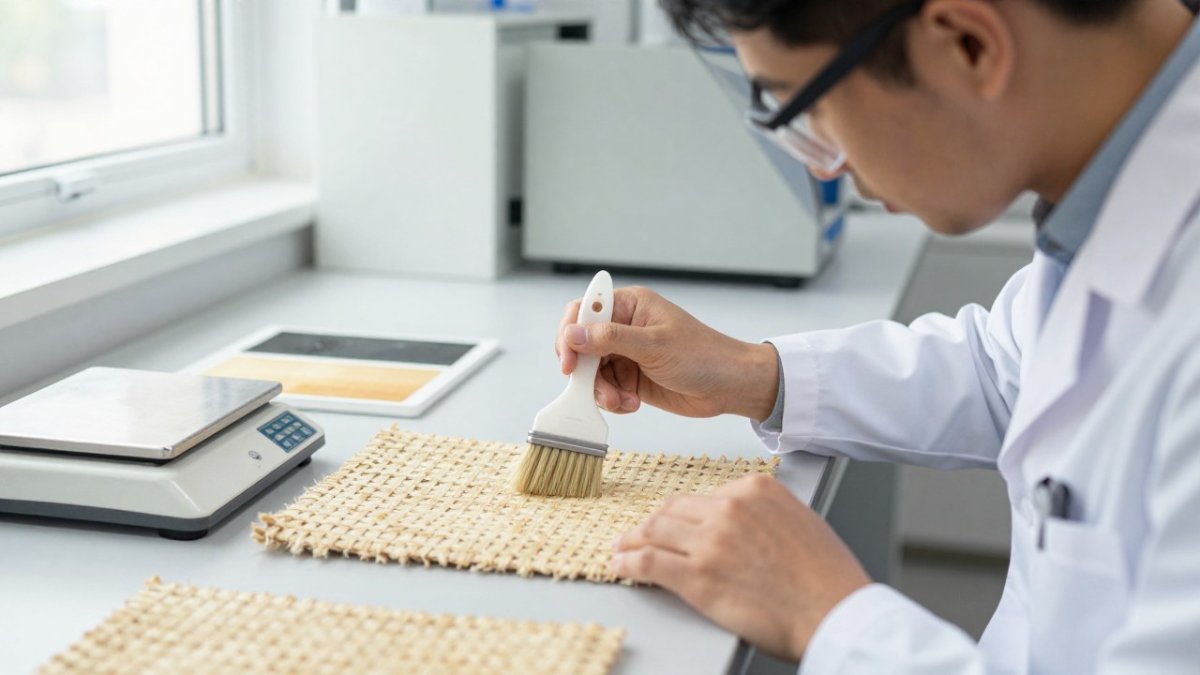
A University of Portsmouth review (2024) examined bio-based and eco-friendly flame retardants for natural-fiber composites, including their mechanisms and the laboratory flammability-testing techniques used to evaluate them. The work highlights a trade-off that shows up repeatedly: treatments that improve fire resistance can change the mechanical properties of the composite, and the balance depends heavily on the fiber, the matrix polymer, and the treatment method.
For textiles, the treatment often takes the form of a surface coating or a finishing bath. For composites, it may be a fiber pretreatment before the polymer is added. Neither approach is one-size-fits-all, and the research literature is clear that results transfer poorly between fiber types.
How Eco-Friendly Flame Retardants Actually Work: Char Formation and Intumescence
Eco-friendly flame retardants generally work through three mechanisms: char formation, intumescence, and gas-phase dilution. The mechanisms are not interchangeable, and which one dominates depends on the chemistry, the host material, and the processing temperature.
Char formation is the conversion of material into a carbon-rich layer that insulates the underlying material from heat and slows fuel transfer to the flame. Phosphorus-based chemistries are the workhorses here. When a phosphorus compound such as phytic acid or a phosphate ester is heated, it decomposes to phosphoric acid and polyphosphoric acid, which catalyze dehydration and cross-linking of the polymer into a carbonaceous char rather than volatile fuel.
Intumescence is a related process in which the material swells into a thick, porous char that blocks heat and flame. A classic intumescent system combines three roles: an acid source (often ammonium polyphosphate), a carbon source (pentaerythritol, or in bio-based systems a polysaccharide such as starch or chitosan), and a blowing agent (melamine).
Gas-phase dilution is the third route. Nitrogen-rich compounds and some phosphorus volatiles release inert gases or radical scavengers that interfere with the flame chemistry in the gas phase, reducing heat release without building a char layer. This mechanism is less durable than char formation because it depends on the additive being present and volatile at the right temperature, but it can be effective at low loading.
| Mechanism | How It Works | Typical Materials |
|---|---|---|
| Char formation | Carbon-rich layer insulates material from heat | Phosphorus acids, biomass-derived polyphenols, silicon compounds |
| Intumescence | Material swells into protective char | Ammonium polyphosphate, chitosan or starch carbon source, melamine blowing agent |
| Gas-phase dilution | Releases inert gases or radical scavengers to reduce flame chemistry | Nitrogen-rich compounds, some phosphorus volatiles |
Understanding these mechanisms matters because it explains why bio-based additives are not simple drop-in replacements. Each mechanism depends on the host material, the processing temperature, and the application method. A phosphorus acid that works well in a cotton fabric may be neutralized by an alkaline matrix or volatilized during polymer extrusion. An intumescent system tuned for a rigid polyurethane foam may collapse in a thin textile coating where there is not enough material to build a thick char.
Sustainable Fire-Retardant Coatings and Layer-by-Layer Assembly
Sustainable fire-retardant coatings apply the flame-retardant chemistry to the surface of a material rather than dispersing it throughout. Layer-by-layer assembly is one of the most studied coating methods: alternating layers of oppositely charged materials, often chitosan and phytic acid, build up a thin film that promotes char formation.
A review in Polymer Degradation and Stability (2022) surveyed sustainable and environment-friendly flame retardants, describing approaches that use green or biodegradable chemicals or waste-derived materials to reduce environmental impact. The layer-by-layer approach fits this description well because it uses water-based processing and small quantities of active material.
The trade-off is durability. Thin coatings can be washed off or abraded, and the research literature acknowledges that real-world performance depends on how the coated material is used and maintained. For textiles that see repeated laundering, coating durability is a genuine open question rather than a settled result.
Testing, Certification, and the Gaps in the Evidence
Standardized testing is where the eco-friendly fire retardant field is weakest, and it is also where the gap between a promising paper and a usable product is widest. Most published studies rely on bench-scale flammability tests, and those tests answer narrower questions than the standards that govern real products.
The most common bench-scale methods in the bio-based literature are the limiting oxygen index (LOI, per ASTM D2863), UL 94 vertical and horizontal burn tests, and cone calorimetry (ASTM E1354). Each measures something different. LOI reports the minimum oxygen concentration that sustains candle-like burning and is useful for ranking formulations, but it says little about heat release under a growing fire.
Building codes and product standards sit above these bench tests. For construction materials, ASTM E84 (the Steiner tunnel test) reports flame spread and smoke developed index, and NFPA 285 evaluates exterior wall assemblies for fire propagation. For upholstered furniture and mattresses, California's TB 117-2013 and 16 CFR Part 1633 set smolder and open-flame performance requirements that a bio-based treatment must meet before it reaches the market.
For firefighters, the practical benchmark is NFPA 1851, which governs the selection, care, and maintenance of structural firefighting protective ensembles, and NFPA 1971, which sets the design and performance requirements for those ensembles. Readers who want to see how formal inspection standards are applied can review our NFPA 1851 inspection checklist for fire chiefs.
Watch out: a formulation that earns a V-0 rating under UL 94 on a 3 mm specimen can still fail ASTM E84 or a full-scale assembly test, because specimen size, heat flux, and mounting all change the outcome. Treat bench-scale results as screening data, not certification.
Chemical & Engineering News (2025) raised a related concern: flame retardants can have serious unintended health and environmental impacts, and toxicity information is often inadequate. Fire performance alone does not establish that a material is environmentally preferable.
Reading an Environmentally Friendly Fire Retardant Materials Research Paper
An environmentally friendly fire retardant materials research paper should be read with three questions in mind: what was tested, how was it tested, and what was left out. Most papers report on small samples under laboratory conditions, and the abstract rarely states the limitations clearly.
Start with the material system. A result on a specific fiber-polymer combination does not generalize to another. Next, check the test method and the metrics reported: heat release rate, smoke generation, and dripping resistance tell you different things, and a paper that reports only one metric is telling a partial story. Finally, look for the durability data. If the paper does not address washing, abrasion, or aging, treat the result as a starting point rather than a finished material.
What Firefighters Should Know Before Trusting a Green Claim
Green claims about flame-resistant materials deserve scrutiny, because the word "eco-friendly" has no standardized definition in this field.
The most useful question is not whether a material is natural, but whether it has been tested against the standards that govern your gear. For firefighters, that means understanding how flame-resistant clothing is maintained so it keeps performing. Our guide on how to maintain flame resistant firefighter clothing covers washing, drying, inspection, and repair practices that protect FR garment lifespan.
The research on eco-friendly fire retardants is advancing quickly, and the firefighters who understand it will be better equipped to ask the right questions about their gear. Black Helmet builds firefighter apparel and accessories, including shirts, hoodies, hats, socks, wallets, drinkware, and gifts that honor the brotherhood and tradition of the fire service. The brand has served more than 100,000 firefighters. Get started with Black Helmet and wear gear that reflects who you are on and off duty.
Frequently Asked Questions
What materials are used as eco-friendly fire retardants?
The research literature centers on a few material families. Plant-derived polyphenols, chitosan from shellfish shells, and phytic acid from seeds and grains are the most studied bio-based options. Biomass-derived materials bring carbon-forming, nitrogen-releasing, and phosphorus-rich properties that support char formation. Intumescent systems are also described as among the promising eco-friendly approaches.
Are natural fire retardants as effective as conventional flame retardants?
The research does not support a blanket yes. Reviews describe bio-based and eco-friendly systems as promising, but the supplied literature gives no head-to-head performance figures against conventional halogenated products. Effectiveness depends on the polymer, the fiber, the loading level, and the test method used. Treat any claim of equal performance as unproven until you see results from a standardized test on the exact material you plan to use. Fire performance alone also does not settle the question, since Chemical & Engineering News notes that unintended health and environmental impacts are a separate concern.
Can natural fibers be made fire resistant?
Yes, through treatment rather than through the fiber itself. Natural fiber fire retardant treatment typically applies a coating or surface treatment that changes how the material burns, encouraging char formation and reducing heat release. Layer-by-layer assembly is one route under study, building thin alternating layers on the fiber surface. The catch is durability: a treatment that works in a lab sample may wear, wash, or abrade away in service, and the supplied research does not provide long-term performance figures. Ask for test data on the treated finished part, not just the treated fiber.
What are the environmental concerns with traditional flame retardants?
Chemical & Engineering News reported serious unintended human-health and environmental impacts from flame retardants and flagged inadequate toxicity information as a core problem. That means a product can meet a flammability standard while its broader environmental footprint stays unclear. Fidra argues for a safer-by-design approach that reduces reliance on chemical additives altogether rather than swapping one additive for another. When you compare materials, ask for toxicity data and lifecycle evidence alongside fire test results, and be skeptical of green claims that rest on fire performance alone.

