

How to Donate Used Firefighter Station Apparel
Last Updated: November 11, 2026
Quick Summary
Donating used firefighter station apparel starts with sorting clothing from protective turnout gear, since station apparel like T-shirts, crew shirts, hoodies, hats, and socks can often be donated while turnout gear usually cannot. Clean each item, handle insignia, and contact a verified recipient before shipping.
- Sort items into three piles: donate, reuse locally, and retire.
- Wash everything and inspect seams, collars, cuffs, and prints before donating.
- Confirm the program is active and ask what items they accept.
- Remove department patches, names, and rank markings or get recipient consent.
- Never donate torn, contaminated, or heavily smoke-odored items; use textile recycling instead.
Table of Contents
- What Counts as Firefighter Station Apparel vs. Turnout Gear
- What to Do With Old Firefighter Gear: Sort Before You Donate
- How to Donate Used Fire Department Uniforms and Crew Shirts
- Where to Donate Firefighter Shirts: Finding a Verified Recipient
- Donating Crew Shirts to Charity: Acceptance Criteria and Condition
- Preparing, Packing, and Shipping Your Donation
- When Donation Is Not the Answer: Responsible Disposal and Reuse
- Start Your Station's Donation Box This Shift
- Frequently Asked Questions
What Counts as Firefighter Station Apparel vs. Turnout Gear
Donating used firefighter station apparel starts with one sorting decision: is this clothing or is it protective equipment? Station apparel is the everyday clothing firefighters wear around the firehouse and off duty. That means department T-shirts, crew shirts, hoodies, uniforms, hats, and socks.
Turnout gear is different. Coats, pants, boots, gloves, hoods, and helmets are protective equipment built to a standard, and they carry a defined service life.
That distinction controls everything else. Station apparel can often be donated, reused, or recycled. Turnout gear usually cannot. Once structural gear reaches the end of its NFPA 1850 lifespan, it is no longer compliant for active firefighting, which complicates donation efforts.
If you are weighing which turnout gear is safe to keep in service and which must retire, our guide to PFAS-free turnout gear and buying criteria breaks down the materials and standards to check.
What to Do With Old Firefighter Gear: Sort Before You Donate
The biggest mistake is bagging everything together and calling it a donation. Sort first, and the rest gets easy.
Start with three piles:
- Donate: clean crew shirts, department T-shirts, hoodies, hats, and socks in good shape
- Reuse locally: reserve equipment and spare apparel still fit for station use
- Retire: worn-out items, torn fabric, and anything past its service life
Donation works when the items are sorted with a recipient in mind.
How to Donate Used Fire Department Uniforms and Crew Shirts
Donating used fire department uniforms and crew shirts takes four steps: clean the items, remove or cover insignia, confirm the recipient accepts apparel, and pack and ship.
Here is the process we recommend:
- Wash everything. No smoke smell, no stains, no mystery.
- Inspect each item. Check seams, collars, cuffs, and prints.
- Handle insignia. Remove department patches, names, and rank markings, or confirm the recipient is fine with them staying.
- Contact the recipient first. Ask what they accept and how they want it shipped.
- Box and label. Include an itemized list inside the box.
A common mistake is shipping first and asking later. Most programs turn down unsolicited boxes, and you pay the freight twice.
Once the old shirts are gone, many crews order replacements. Our guide to designing custom firefighter station shirts covers fabrics and printing options.
The donation process comes down to five steps, in this order.
| Step | What to do |
|---|---|
| 1 | Wash everything; no smoke smell, stains, or mystery |
| 2 | Inspect seams, collars, cuffs, and prints |
| 3 | Remove department patches, names, rank markings, or confirm recipient is fine |
| 4 | Contact the recipient first; ask what they accept and shipping method |
| 5 | Box and label; include an itemized list inside |
Where to Donate Firefighter Shirts: Finding a Verified Recipient
Verified recipients fall into four groups: local fire stations, national gear donation programs, international aid organizations, and textile reuse charities. The category matters less than the verification. A program that was active two years ago may have stopped accepting apparel, changed its shipping address, or narrowed what it takes to protective gear only.
Run every candidate through this verification sequence before you box anything:
- Confirm the program is active. Look for a current date on the program page, a recent post, or a working phone number. A page with no update in over a year is a yellow flag.
- Ask what they accept by item type. "Used firefighter gear" often means turnout gear only. Ask specifically whether they take department T-shirts, crew shirts, hoodies, hats, and socks.
- Ask about condition. Confirm whether they accept faded prints, small stains, or items missing buttons. Get the answer in writing if you can.
- Ask about insignia. Some programs want department patches removed; others want them left on so the receiving department can see the source. Confirm before you cut anything off.
- Get a named contact and a shipping address. A street address with a contact person beats a PO box with no name. If the only contact is a social media handle, keep looking.
- Ask what happens to unusable items. A serious program has an answer: textile recycling, rag sales, or approved disposal. If the answer is "we figure it out," your box may become someone else's problem.
- Confirm shipping or drop-off logistics. Ask whether they reimburse freight, whether they prefer a specific carrier, and whether international shipments need customs paperwork prepared a certain way.
Departments that place gear successfully usually have a named partner on the other end, not a random address.
Watch out: a social media post asking for gear is not a verified recipient. Call or email before you box anything, and keep a record of who told you what. If the program cannot answer the seven questions above, it is not ready to receive your donation.
Once you have a verified recipient, the rest of the process is preparation and shipping. Once the apparel is sorted for donation, IGIT Apparel can help keep the same careful approach in mind when preparing other clothes for charity.
Donating Crew Shirts to Charity: Acceptance Criteria and Condition
Donating crew shirts to charity works best when the shirts are clean, intact, and free of anything that identifies a person or a department. Most charities apply similar criteria, but the details decide whether your box is accepted or returned.
What most programs accept:
- Clean shirts with intact seams, collars, and cuffs
- Readable prints and graphics with no cracking or peeling
- Working zippers, buttons, and snaps
- Minor fading that does not obscure a logo or text
What usually gets reviewed case by case:
- Small stains that survived a normal wash
- Faded graphics that are still legible
- Missing buttons or a single loose seam that can be repaired
What gets declined:
- Torn fabric, holes, or split seams
- Heavy smoke odor that persists after washing
- Mold, mildew, or chemical contamination
- Items with personal names, badge numbers, or active department insignia that the recipient did not agree to keep
That last point matters more than people expect. A shirt with someone's name and rank on it is not anonymous clothing. Before a shirt leaves the station, decide which of three paths it takes:
- Strip the identifiers. Remove name tapes, rank patches, and department logos. This is the safest path for general charity donation.
- Keep the identifiers with recipient consent. Some department-to-department programs want the source visible. Confirm in writing before you ship.
- Retire the shirt from donation. If the identifiers cannot be removed without damaging the garment, keep it, frame it, or route it to textile recycling.
A related distinction is decommissioning. Station apparel is not protective equipment, so it does not carry an NFPA service-life expiration the way turnout gear does. But a shirt that has been worn hard for years may still be too far gone to donate.
Crew shirts carry meaning, and that is exactly why some are worth keeping. Our piece on why authentic brotherhood gear matters for fire crews explains the difference between a shirt with history and a shirt that has just worn out.
Watch out: cutting a patch off a synthetic shirt can leave a hole or a frayed edge that turns an acceptable item into a rejected one. Test on one shirt before you process a whole box.
Preparing, Packing, and Shipping Your Donation
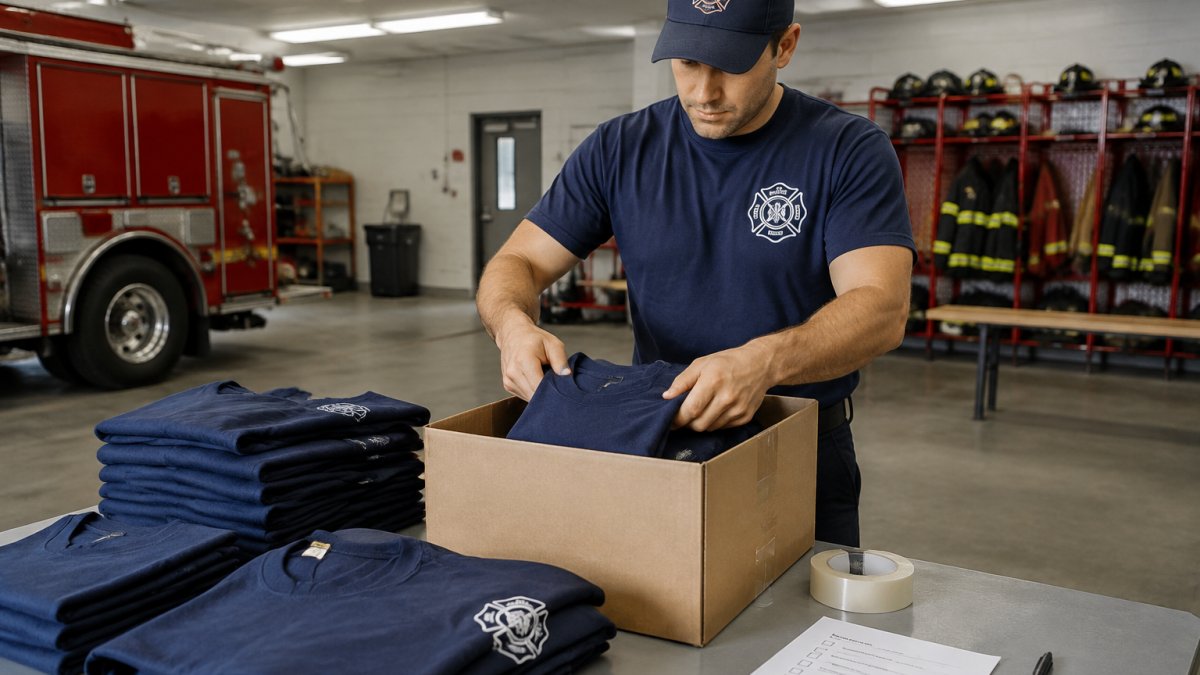
Clean, dry, folded, and boxed is the standard. Anything less invites rejection or damage in transit.
Follow this checklist:
- Wash and fully dry every item
- Fold flat, no hangers
- Place in a sturdy cardboard box or plastic tote
- Add a packing list with item counts and sizes
- Seal with tape on all seams
- Label the box with the recipient's contact name
- Photograph the contents before sealing
- Keep the tracking number
Use a shipping method with tracking. Send the recipient the tracking number the same day. If you are shipping internationally, confirm customs paperwork with the recipient first, because rules vary by country and by organization.
When Donation Is Not the Answer: Responsible Disposal and Reuse
Some items should never be donated. Torn shirts, contaminated fabric, and gear past its service life belong in a different channel.
Your options:
- Textile recycling: worn cotton and cotton blends can become wiping rags or fiber
- Municipal textile programs: many curbside and drop-off programs accept any condition
- Deconstruction for craft use: decommissioned bunker gear has a second life in products made from it
There is a real safety reason to keep contaminated items out of donation boxes. Research from the National Institute of Standards and Technology found that firefighter gear textiles release more PFAS after simulated wear and tear. Worn gear is not a gift.
When old shirts are too far gone to donate, the smarter move is buying replacements built to last. Our guide to durable fabrics for firefighter station shirts covers what holds up wash after wash.
Start Your Station's Donation Box This Shift
The whole process comes down to one box in the apparatus bay and one rule: sort before you donate.
Set up a labeled bin this shift. Post a short list above it: clean only, no turnout gear, no names. Assign one person to make the call to a recipient each month. That is the entire program.
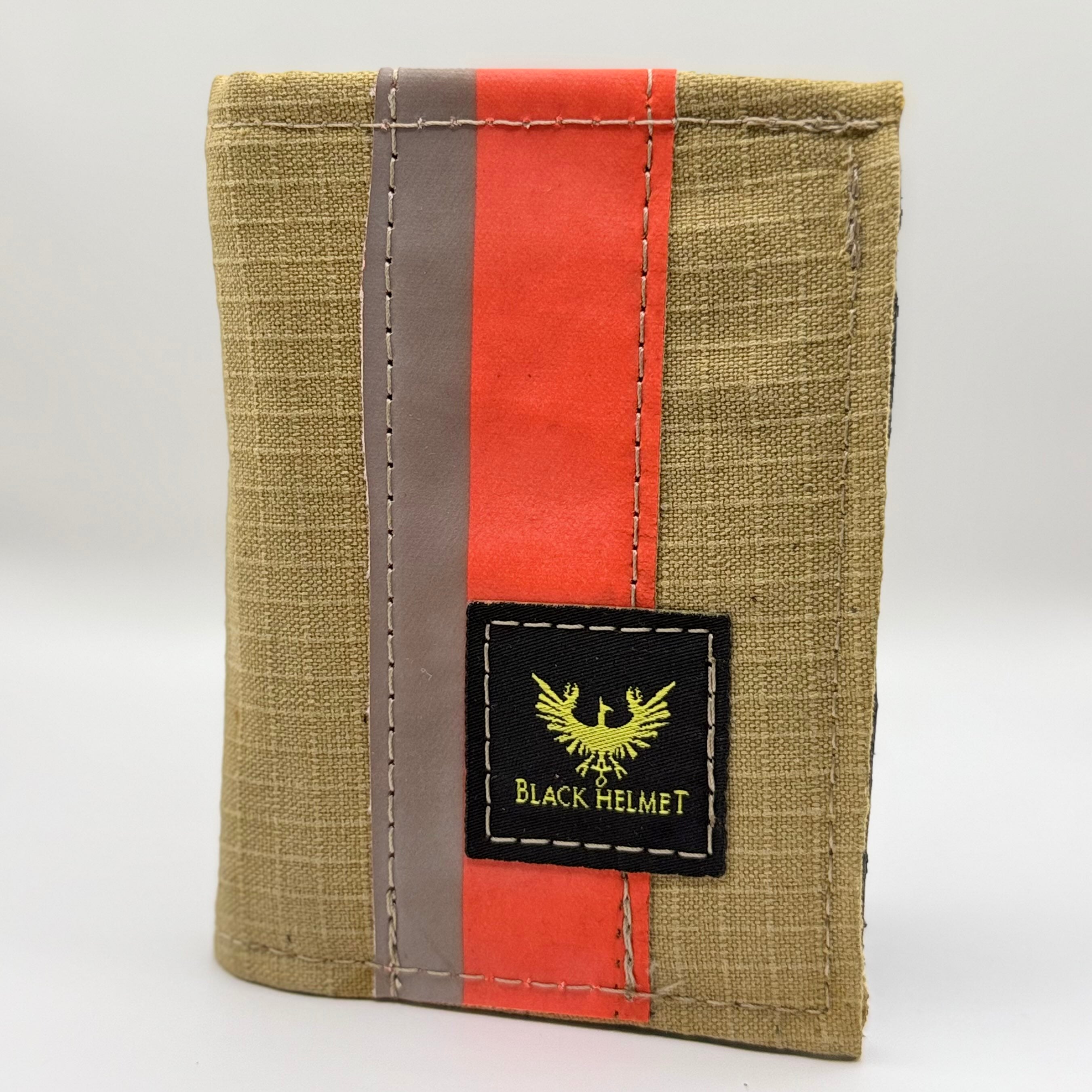
At Black Helmet, we have served more than 100,000 firefighters since 2008, and we know station culture from the inside. Design custom station apparel for fire department morale. And if you want to give retired turnout gear a second life, our Badge Bifold Used Bunker Gear Wallet is made in the USA from real, decommissioned bunker gear, decontaminated and one of a kind.
Get started with Black Helmet and gear your crew in apparel that honors the job.
Your station has old shirts in a closet and a crew that wants to do right by them. Black Helmet helps you replace what you donate with firefighter shirts, hoodies, and accessories made for the brotherhood, backed by a satisfaction guarantee and more than 100,000 firefighters served. Get started with Black Helmet and wear the tradition with pride.
Frequently Asked Questions
Where can I donate used firefighter station apparel?
Start with your own department's exchange or reserve program, then look at local fire stations that accept community donations, volunteer fire departments in need, and international aid groups that ship gear abroad. Before you hand anything over, confirm the recipient actually wants apparel and ask what condition they require. Verify the program first, then box and ship.
Can fire department shirts and uniforms be donated?
Yes, department T-shirts, crew shirts, and station wear are commonly donated, but remove or cover department names, logos, and insignia first. A shirt carrying another department's identity can create confusion or liability for the recipient. Check with your chief or union on any policy about releasing branded apparel. Plain or de-branded station apparel is far easier to place with a charity, a firefighter in need, or a bereavement uniform program.
What should I do with damaged or contaminated firefighter clothing?
Do not donate damaged or contaminated items. Turnout gear that has reached its NFPA 1850 expiration date is no longer compliant for structural firefighting, and worn textiles can release more PFAS. Retire that gear through your department's documented process, and route unusable textiles to a textile recycling program rather than a donation box.
How should I prepare used station apparel before donating it?
Wash everything according to the care label, dry it fully, and inspect each piece for tears, stains, or missing buttons. Pull out anything with department insignia unless the recipient has approved it. Fold items flat, bag them by type, and label the box with sizes and contents. Include a short inventory list so the receiving station knows what arrived. A clean, sorted box gets accepted; a mixed bag of old clothing often gets turned away.

