

Custom Firefighter Shirts for Fire Departments
Table of Contents
- Why Custom Firefighter Shirts Matter for Fire Departments
- Fire Department Station Wear Design Ideas That Build Crew Identity
- The Best Fabric for Firefighter Duty Shirts: What Holds Up
- Screen Printing vs. Embroidery for Custom Firefighter Shirts
- Bulk Custom Fire Department T-Shirts: Pricing, Minimums, and Turnaround
- NFPA Standards and Compliance for Station Wear
- Sustainable Options in Firefighter Apparel
- Frequently Asked Questions
Last Updated: September 13, 2026
Why Custom Firefighter Shirts Matter for Fire Departments
Custom firefighter shirts for fire departments do more than dress a crew, they turn a shift into a unit. Walk into any station bay and you can spot the difference between generic tees and a department wearing its own name across the chest.
At Black Helmet, we've outfitted fire service crews since 2008 and watched that shift happen repeatedly. A firefighter pulling on a shirt with their company's identity is signaling who they run with.
The numbers back up the culture argument. Station wear has become a genuine part of how departments build morale, mark milestones, and give recruits something to earn. NFPA 1975 Standard on Emergency Services Work Clothing sets the baseline for what counts as safe station wear, which matters the moment you start printing on garments your crew wears around the house and on scene.
Most departments treat apparel as a one-time purchase instead of a system. The crews that get it right think about fabric, printing method, logo placement, and turnaround before ordering.
Fire Department Station Wear Design Ideas That Build Crew Identity
Strong station wear design starts with one question: what should a stranger understand about this crew in three seconds? Everything else, colors, fonts, placement, flows from that answer.
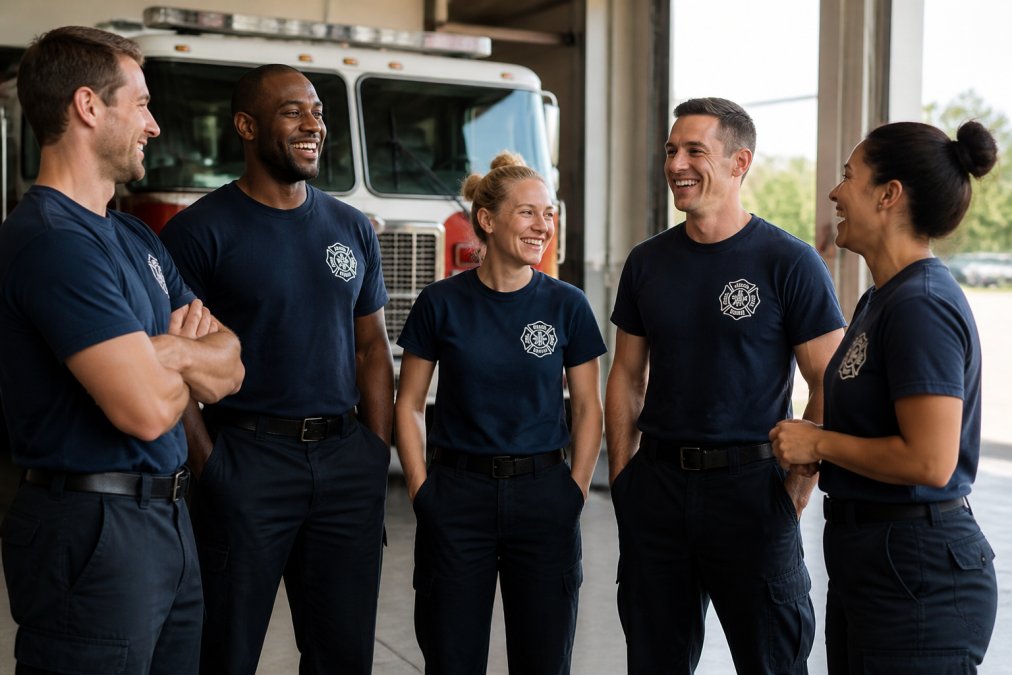
The best fire department station wear design ideas fall into a few patterns: company name across the chest with a founding year, a station number large on the back, or a shift nickname only insiders understand. Each works because it says something specific.
Logo Placement and Department Identity
Logo placement is where department identity lands or gets lost. The chest is the workhorse: left-chest prints read professional and pair with a name or rank. Full back prints carry the big statement. Sleeve prints handle details like a station number or founding date.
A common mistake is crowding all three onto one shirt. Pick a primary placement and let the others support it. If the back carries the message, keep the chest small and clean.
Design Best Practices for Visibility on Scene
Visibility on scene follows different rules than in the station. High-contrast color combinations matter more than clever artwork, light ink on dark garments, or the reverse, reads from a distance. Reflective printing belongs on outerwear and safety garments, not cotton station tees.
Thin, detailed linework disappears on fabric. Bold shapes and heavy lettering survive printing and washing; if a design needs a magnifying glass, it won't work on a duty shirt.
The Best Fabric for Firefighter Duty Shirts: What Holds Up
The best fabric for firefighter duty shirts balances breathability, durability, printability, and industrial washing. No single fabric wins every category, so the answer depends on how your crew wears the shirt, station only, training, wildland, or public events.
Most guides stop at "100% cotton." The four fabric families below behave very differently over a long shift, and the differences show up in comfort, print life, and reorder frequency.
The Four Fabric Families, Compared
100% cotton (typically 5.5-6.5 oz ringspun). Soft, breathable, and the best surface for full-color screen printing. Trade-offs: it holds sweat against the body, shrinks unless pre-shrunk, and fades faster than blends under hot washing. Best for station wear, fundraisers, and event shirts where comfort and print quality beat moisture management.
Cotton/poly blends (commonly 50/50 or 60/40). The workhorse of department apparel: synthetic fiber resists shrinking and fading, cotton keeps it comfortable, and it prints almost as well as pure cotton. A 50/50 blend outlasts a 100% cotton tee under weekly washing, the best all-around choice for daily station wear.
Tri-blend and poly-rich performance knits (often 65/35 poly/cotton or higher). These move moisture away from the skin, dry faster, and resist pilling when yarn quality is good, right for training, wildland, summer shifts, and sustained heat. Some are harder to screen print, and low-grade versions pill within a season, so ask your vendor which decoration method suits the style.
Flame-resistant (FR) and arc-rated fabrics. A different category entirely. FR station wear self-extinguishes and resists melting, and is typically required where a hazard assessment identifies thermal or arc exposure. FR garments are heavier, costlier, and need specific laundering, fabric softener and dryer sheets degrade FR properties. FR is not NFPA 1975 compliant station wear, and neither equals NFPA 1971 structural PPE. Confirm the standard and rating before ordering.
How to Match Fabric to the Assignment
Many departments stock two or three fabric types rather than one:
- Cotton blend crew tees for everyday station wear and public events.
- Performance poly-rich knits for training, fitness, and summer or wildland use.
- FR station wear only where the hazard assessment calls for it.
This lets firefighters choose by shift and keeps expensive FR garments out of rotation where they aren't needed.
Three Questions to Ask Before You Commit
- What's the fabric weight and blend percentage? A 5.5 oz 100% cotton tee and a 6.1 oz 50/50 blend wear very differently. Get the spec, not the marketing name.
- What decoration method does the vendor recommend? Performance knits and FR fabrics often need different inks, curing temperatures, or application methods than cotton.
- What's the expected wash life? Ask how many industrial wash cycles the garment and print are rated for. A properly cured print on a quality blend should outlast the garment.
Fabric decides whether your crew reaches for a shirt on a hot shift or leaves it in the locker. Get it right and everything downstream, print, fit, and reorder cycle, gets easier.
Screen Printing vs. Embroidery for Custom Firefighter Shirts
Screen printing and embroidery solve different problems; the right pick comes down to design complexity, garment type, and how the shirt will be worn.
Screen printing handles bold graphics, full-color artwork, and large back prints at a lower cost per piece, the standard choice for custom fire department t-shirts with detailed designs. Embroidery produces a raised, durable logo that survives years of washing and looks sharp on polos, jackets, and hats, but struggles with fine detail and gradients.
| Method | Best For | Detail Level | Durability | Typical Use |
|---|---|---|---|---|
| Screen printing | Bold graphics, full-color art, back prints | High | Good with proper curing | Crew tees, event shirts |
| Embroidery | Simple logos, left-chest marks | Limited | Excellent | Polos, jackets, hats |
| Heat transfer | Small runs, names, numbers | Medium | Moderate | Personalized name adds |
Many departments combine both: screen-printed crew shirts plus embroidered polos for public events and inspections, covering daily wear and dressier occasions without two separate design sets.
Bulk Custom Fire Department T-Shirts: Pricing, Minimums, and Turnaround
Bulk custom fire department t-shirts live or die on four variables: minimum order quantity, per-unit price, decoration cost, and whether the vendor hits your deadline before an event, graduation, or retirement.
How Per-Unit Pricing Scales
Custom apparel pricing is driven by setup costs spread across the run. Screen printing requires a separate screen per ink color, each with a one-time setup charge, which is why a single shirt costs far more per unit than a run of fifty.
A typical pattern looks like this:
- 1-11 pieces: highest per-unit cost; setup is spread across very few shirts. Often better suited to heat transfer or direct-to-garment than screen printing.
- 12-23 pieces: the first real price break. Most vendors' minimum for screen printing sits in this range.
- 24-47 pieces: per-unit price drops again; this is where most single-station orders land.
- 48-99 pieces: meaningful per-unit savings; common for multi-station or full-department orders.
- 100+ pieces: best per-unit pricing; setup cost becomes negligible per shirt.
The exact breakpoints vary by vendor, so always ask for the tier table in writing before you commit.
What Drives the Decoration Cost
Two levers move the price more than anything else:
Number of ink colors. Each color adds a screen and setup charge. A one-color chest print is cheapest; a four-color back print with a separate left-chest logo can double or triple setup cost. If budget is tight, simplify colors before shrinking the order.
Number of print locations. Chest, back, and sleeve are three separate setups. A common cost-saving move is the main design on the back with a small one-color mark on the chest.
Embroidery is priced by stitch count, not ink colors. A simple left-chest logo runs in the low thousands of stitches; a large detailed back embroidery can run into the tens of thousands. For most department logos, left-chest embroidery is the most cost-effective dress option.
Minimums and Personalization
Screen printing minimums commonly start around 12 pieces per design. Heat transfer and direct-to-garment can go lower, sometimes to a single piece, making them useful for name-and-number personalization on top of a screen-printed run. Individual names on the back are usually a separate decoration step priced per piece.
Turnaround: What Actually Determines Your Ship Date
Turnaround depends on three things, in this order:
- Artwork readiness. The biggest cause of missed deadlines is artwork that isn't print-ready. Vector files (AI, EPS, or high-resolution PDF) with clean edges and separated colors move fastest; a low-resolution JPEG pulled from a website must be redrawn, adding days.
- Order size and decoration complexity. A 24-piece one-color run moves faster than a 200-piece four-color run with personalization.
- Production queue. Vendors quote turnaround in business days from proof approval, not inquiry. Ask when the clock starts.
For an event or graduation, work backward from the date you need shirts, adding shipping, production, and a buffer for proof revisions. Start the conversation four to six weeks out and place the order no later than three weeks before.
A Pre-Order Checklist That Prevents Most Problems
- Finalize artwork in a print-ready vector format
- Confirm garment style, fabric, color, and the full size range you need
- Get the per-unit price, setup charges, and total in writing
- Confirm the tier breakpoint you're ordering at, and whether adding a few more pieces drops the per-unit price
- Confirm the ship date in writing and whether it's guaranteed
- Approve a physical or digital proof before production starts
- Confirm the return or reprint policy for misprints and sizing errors
Bulk ordering rewards planning. Departments that get the best per-unit price and hit deadlines finalize artwork early, order at the right tier, and get the ship date in writing before production starts.
NFPA Standards and Compliance for Station Wear
NFPA 1975 governs emergency services work clothing and separates compliant station wear from ordinary apparel. If your department issues shirts as part of a uniform program, this is the line to understand.
NFPA 1975 Standard on Emergency Services Work Clothing covers garments worn in station and non-fireground settings. It is not the same as NFPA 1971, which covers structural firefighting protective ensembles, or NFPA 1951, which covers technical rescue. Those are protective standards with very different requirements.
The practical distinction: a printed cotton crew shirt is station wear, not protective equipment. It should never be treated as PPE or worn as a substitute for turnout gear. Departments that blur that line create real safety and liability exposure.
Compliant station wear vendors label garments clearly. If a shirt carries no compliance marking, assume it's decorative apparel and keep it off the fireground.
Sustainable Options in Firefighter Apparel
Sustainability in firefighter apparel comes down to two levers: lower-impact materials and garments that last long enough to stay out of a landfill.
Departments can move on both. Organic cotton and recycled polyester blends are increasingly available and perform comparably when the blend is right. The bigger lever is durability: a shirt that survives five years of weekly washing beats three cheap shirts that pill and fade in a year, environmentally and on the budget line.
U.S. Environmental Protection Agency data on textile waste shows textiles make up a significant share of municipal solid waste, and extending garment life is one of the most effective ways to cut that impact. For departments, that means prioritizing print quality and fabric weight over the lowest bid.
Ask your vendor two questions: what the fabric is made of, and how the print is cured. A properly cured print outlasts the garment; a cheaply cured one cracks within months, turning a "sustainable" purchase into a disposable one.
Custom firefighter shirts for fire departments aren't a one-time purchase. They're a running part of how your crew looks, feels, and represents the job, and the details, fabric, printing method, compliance, and turnaround, decide whether that representation holds up. Get those right and your station wear earns its place in the firehouse tradition.
Black Helmet has outfitted the fire service since 2008, with more than 100,000 firefighters served. Our premium tees, including the Firehouse Standard Premium Tee and the First In, Last Out Premium Tee, are built for crews who want apparel authentic to the job. Get started with Black Helmet and give your department gear that carries the brotherhood, tradition, and pride of the fire service.


Frequently Asked Questions
Can I get a custom fire department shirt with our station logo?
Yes. Most custom firefighter shirts for fire departments allow full personalization, including department logos, station numbers, and crew names. The key is providing a high-resolution logo file (vector format works best) and specifying exact placement: left chest, full back, or sleeve.
What is the best fabric for firefighter duty shirts?
The best fabric for firefighter duty shirts depends on how you wear them. For station wear and everyday comfort, a cotton blend offers breathability and durability. For training or warm climates, moisture-wicking performance fabrics move sweat away from your skin and dry faster.
What is the typical turnaround time for bulk custom firefighter apparel orders?
Turnaround varies by order size and decoration method. Always confirm the timeline before ordering, especially for events like retirements or academy graduations. Black Helmet handles group orders and can confirm current lead times when you place your order.
Should fire departments choose screen printing or embroidery for duty shirts?
Screen printing works best for large, full-color designs on short-sleeve tees and crew shirts, especially when ordering in bulk. It's cost-effective per piece and handles detailed artwork well. Embroidery suits polo shirts, jackets, and hats where a raised, professional look is wanted. Many departments use both: screen-printed tees for station wear and embroidered polos for public events. Consider how the shirt will be worn and how many colors your logo needs.
