

Durable Firefighter Shirts That Last: A 2026 Review
Table of Contents
- Why Most Firefighter Shirts Fail Within a Year
- What Makes a Firefighter Shirt Durable?
- The Top Durable Firefighter Shirts We Reviewed
- Understanding Fire Resistant Station Wear vs. Standard Tees
- How to Care for Firefighter Apparel to Extend Its Life
- Pairing Your Tee with the Best Firefighter Hoodies
- Our Verdict: Which Durable Shirt Should You Choose?
- Conclusion
- Frequently Asked Questions
Last Updated: September 5, 2026
Structural firefighting is one of the most demanding professions for clothing, and a standard cotton tee rarely survives a full year of station life, training evolutions, and repeated industrial washing. At Black Helmet, we build premium firefighter apparel for crews who expect their off-duty gear to match the toughness of their job, and this review breaks down exactly which shirts hold up and why.
Most guides focus on brand loyalty rather than fabric science. We evaluate construction details, wash longevity, and real-world comfort to help you buy once and wear for years.
Why Most Firefighter Shirts Fail Within a Year
The biggest mistake is assuming all cotton is created equal. Conventional tees use basic knit constructions that lose shape after the first few hot washes, and aggressive detergents accelerate the breakdown of cheap dyes and threads.
Shrinkage pulls graphics and distorts fit; pre-shrunk fabric addresses this only if the manufacturer specs it. Side seams that twist after repeated drying cycles ruin the professional appearance station wear demands.
Fabric weight matters. Lightweight shirts around 4.2 oz per square yard offer breathability but require higher-quality ring-spun cotton to maintain tensile strength; cheap fabric pills and thins under bunker gear straps and SCBA harnesses.
What Makes a Firefighter Shirt Durable?
Durability comes down to fiber quality, knit density, reinforcement, and pre-treatment. Fiber quality starts with 100% combed and ring-spun cotton, which removes short fibers that cause pilling. Heather colors typically contain polyester, which adds stretch but changes the moisture-wicking profile.
Reinforcement matters most at stress points. Side-seamed construction prevents twisting, while shoulder-to-shoulder taping stops neckline stretching under a radio strap or hood. Rib knit cuffs on long-sleeve options add durability where abrasion is highest.
Pre-treatment separates a shirt that fits forever from one that shrinks after two washes. Pre-shrunk fabric maintains dimensions, and the best blanks feature taped necks for a clean look that survives industrial laundering.
The Top Durable Firefighter Shirts We Reviewed
After evaluating fabric specs, print quality, and construction details, three Black Helmet premium tees stand out as the most durable options for active firefighters.
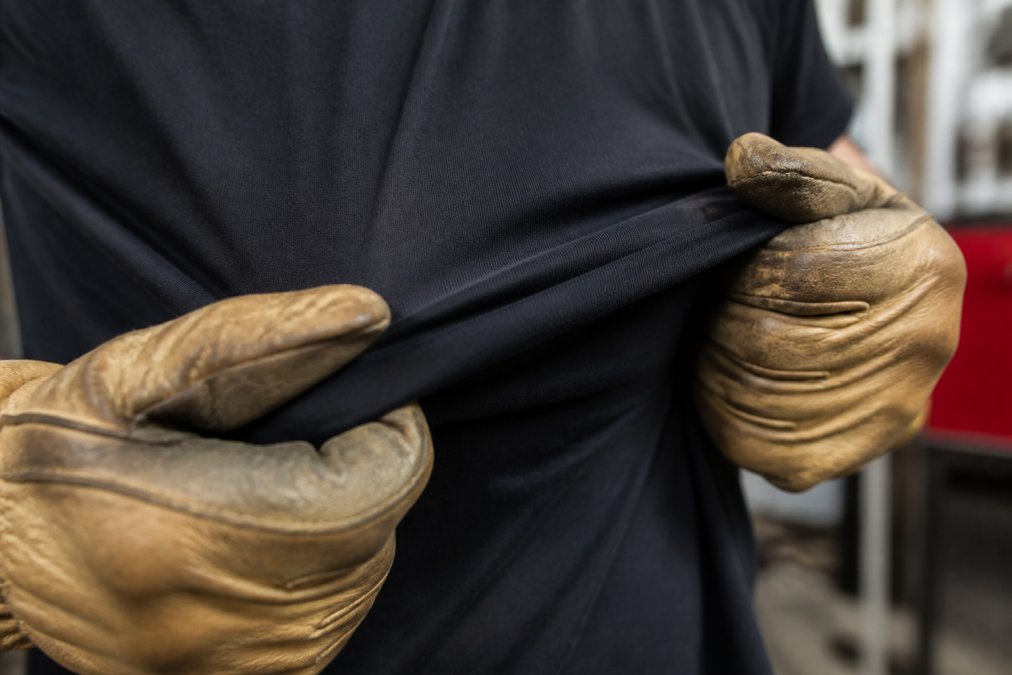
Firehouse Standard Premium Tee: The All-Around Workhorse
The Firehouse Standard Premium Tee is our top pick for most firefighters. At $34.50, it delivers the softness of 100% combed and ring-spun cotton with pre-shrunk fabric that maintains its fit through repeated wash cycles.
This is the shirt for the firefighter who wants one reliable option for station wear, the gym, and off-duty life. The design is understated, comfortable and flattering for all body types, with just the right amount of stretch for mobility during training.
The one drawback is that lighter colors can appear slightly sheer under certain lighting; consider the heather options, which contain a small percentage of polyester for added structure.
Wildland Fireline Premium Tee: Built for the Line
Wildland firefighters have different durability requirements than structural crews. Priced at $34.50, this shirt features a 4.2 oz per square yard fabric weight that balances breathability with abrasion resistance for long days on the line.
Side-seamed tailoring and shoulder-to-shoulder taping prevent the twisting and neckline stretching that plague cheaper wildland tees. The distressed fireline-inspired graphics are designed to age well.
This is the best option for crews who need a shirt that performs under a pack strap and stands up to the grit of fireline work while still looking sharp at the end of a 16-hour shift.
Never Go Gently (Restored) Premium Tee: A Legacy Reborn
The Never Go Gently tee carries the same 4.2 oz fabric weight and premium construction as the Wildland option, but with a design pulled from the Black Helmet archives. This restored original honors the mindset that built the fire service: show up, put in the work, and do not back off.

At $34.50, you are paying for a shirt that delivers both durability and meaning. The 100% combed and ring-spun cotton, pre-shrunk treatment, and side-seamed construction ensure this tee holds up for years, making it a strong choice for retirement gifts or crew orders.
Understanding Fire Resistant Station Wear vs. Standard Tees
The line between a durable cotton tee and fire resistant (FR) station wear is a matter of fabric chemistry and thermal physics. NFPA 1975 governs FR station wear performance in the United States (nfpa.org). Garments certified to this standard must pass vertical flame tests, heat and thermal shrinkage limits, and must not melt or drip when exposed to intense heat, a fundamentally different engineering goal than surviving 100 industrial wash cycles.
FR fabrics achieve protection through inherent flame resistance or treated finishes. Inherently FR fibers, such as meta-aramid (Nomex) or para-aramid (Kevlar), have flame resistance built into the polymer chain, it cannot wash out. Treated fabrics, often 100% cotton treated with a phosphonium salt (Indura or Westex), rely on a chemical finish that degrades with chlorine bleach, strong oxidizers, and repeated industrial laundering. Treated FR cotton typically loses its protective rating after roughly 50 to 75 industrial wash cycles if the care label is ignored, whereas inherent FR fabrics hold their rating for the life of the garment (the CDC).
The trade-off is comfort and care complexity. Inherent FR fabrics are often stiffer and less breathable than a 4.2 oz ring-spun cotton tee, and they retain heat. Treated FR cotton feels closer to regular cotton but requires strict wash protocols: no chlorine bleach, no fabric softeners, and low-temperature drying. Many departments outsource to industrial facilities using high-heat, high-agitation cycles, which is why FR station wear often fails from a comfort or appearance standpoint long before it loses its protective rating.
A durable cotton tee is engineered for a different failure mode: resist abrasion, maintain shape, and keep color through repeated washing, not to protect against flash fire. The 100% combed and ring-spun cotton in the shirts reviewed here has no FR treatment and will ignite and burn if exposed to flame. That is not a defect; it is a design boundary. Cotton ignites at roughly 400°C (750°F) and continues to burn, whereas FR-treated cotton self-extinguishes when the heat source is removed (faa.gov).
NFPA 1975 compliance is required only where the risk of flash fire or electric arc is present, typically in training environments, live-fire evolutions, or certain industrial response scenarios. For routine station duties, administrative work, physical training, and off-duty wear, a premium cotton tee is the appropriate and safer choice because it does not retain heat and does not require specialized laundering. Verify your department's standard operating procedures: if your station requires NFPA 1975-compliant station wear, a cotton tee, no matter how durable, is not a substitute.
How to Care for Firefighter Apparel to Extend Its Life
Most guides stop at "wash cold, hang dry", but the real durability killer is the industrial laundering process station uniforms go through. If your premium tee goes into the station's commercial washer alongside bunker gear or contaminated uniforms, you are putting it through a process it was not designed to survive.

Industrial washers operate at higher temperatures (often 140°F to 160°F), use stronger alkaline detergents, and spin at higher RPMs. That combination is excellent for decontaminating turnout gear but brutal on a cotton tee: high heat accelerates shrinkage beyond what pre-shrinking can compensate for, and aggressive detergents strip natural oils from cotton fibers, leaving them brittle. A shirt may look great after 10 home washes but misshapen and faded after just 5 industrial cycles.
The single most effective habit is separation. Never wash a premium cotton tee in the same load as station uniforms that have been on a fireground or in a training evolution. Soot particles are abrasive at the microscopic level, they act like sandpaper between fibers during agitation. Even a small amount of residual ash can accelerate pilling and thin out the fabric at stress points. If your station uses a communal washer, wash your premium tees at home or in a dedicated load with other cotton garments only.
For home laundering, water temperature matters more than the cycle setting. Cold water (below 80°F) prevents thermal shrinkage and keeps dyes locked in. Warm water (90°F to 110°F) is acceptable for heavily soiled shirts but increases dye release. Hot water (above 130°F) causes cotton fibers to swell and relax, permanently distorting the knit structure. Pre-shrunk treatment compensates for one or two hot washes, but repeated hot washing will eventually overcome that protection.
Detergent chemistry is another overlooked variable. Standard detergents contain optical brighteners and bleach alternatives that can dull dark colors over time; use a detergent formulated for dark or colored garments instead. Fabric softeners are worse, they coat cotton fibers with a waxy residue that reduces moisture-wicking and attracts dirt. For softness, use a half-cup of white vinegar in the rinse cycle; it neutralizes alkaline detergent residue without coating the fibers.
Drying is where most of the damage happens. High heat shrinks cotton further and degrades the elastane or polyester content in heather blends. For 100% cotton shirts, the shrinkage risk is highest in the first three drying cycles; hang drying eliminates that risk entirely. If you must use a dryer, use the lowest heat setting and remove the shirt while still slightly damp, then lay it flat to finish.
Graphic prints have their own failure timeline. Screen-printed graphics are cured at high temperatures during manufacturing, making them wash-fast but not heat-fast. A typical graphic will start to crack after about 25 to 30 hot dryer cycles, but will last 100-plus cycles if hang-dried. Heat makes plastisol ink expand and contract at a different rate than cotton, causing micro-fractures that grow into visible cracks. Washing the shirt inside out also protects the graphic from abrasion.
Sweat and body oils are the final factor. The salts and oils in sweat are mildly acidic and break down reactive dyes in darker colors, causing a faded or yellowed appearance under the arms and around the collar. Pre-treating those areas with a gentle enzyme-based stain remover before washing, letting it sit for 10 minutes, breaks down the oils before they set. A shirt worn on a 24-hour shift should be washed within 48 hours, not left in a gym bag for a week.
| Care Variable | Home Wash | Industrial Station Wash | Impact on Longevity |
|---|---|---|---|
| Water temperature | Cold (below 80°F) | 140°F+ | High heat accelerates shrinkage and dye loss |
| Detergent type | Color-safe, no brighteners | Alkaline, heavy-duty | Brighteners dull dark colors; alkaline strips cotton oils |
| Drying method | Hang dry or low heat | High-heat tumble | Heat cracks graphics and distorts knit structure |
| Load separation | Separate from gear | Never mix with turnout | Soot particles abrade fibers |
| Stain treatment | Enzyme pre-treater | Industrial pre-spotter | Sweat salts break down reactive dyes |
Pairing Your Tee with the Best Firefighter Hoodies
Durable firefighter shirts work best as part of a layering system. When you wear a hoodie over your premium tee during cooler months, the hoodie takes the wear from pack straps and tool belts, keeping the tee in better condition underneath.

A quality hoodie also provides insulation that reduces sweat buildup on your tee, minimizing dye breakdown and odor retention. For station work in colder climates, pairing a durable tee with a heavyweight hoodie creates a system where both garments last longer than either would alone.
Black Helmet's hoodie lineup is designed to complement the premium tees, using the same attention to fabric quality and construction, protecting your investment in both pieces.
Our Verdict: Which Durable Shirt Should You Choose?
The Firehouse Standard Premium Tee is the best overall choice for most firefighters. At $34.50, it combines the softness of ring-spun cotton with the construction features that prevent premature failure, delivering the best balance of comfort, durability, and versatility.
Choose the Wildland Fireline Premium Tee if you work the line and need a shirt that handles pack abrasion and long shifts in the field. Select the Never Go Gently tee when the design message matters as much as the material, particularly for legacy pieces or meaningful gifts.
| Shirt | Fabric | Best For | Price |
|---|---|---|---|
| Firehouse Standard | 100% combed cotton | All-around station wear | $34.50 |
| Wildland Fireline | 4.2 oz combed cotton | Wildland crews | $34.50 |
| Never Go Gently | 4.2 oz combed cotton | Legacy and meaning | $34.50 |
Conclusion
Finding durable firefighter shirts that last requires looking past the graphic and examining the fabric, construction, and care requirements. Pre-shrunk ring-spun cotton, side-seamed tailoring, and proper washing habits will keep a quality shirt in rotation for years, not months. Black Helmet builds every premium tee with these durability standards in mind, backed by a firefighter-owned brand serving over 100,000 firefighters. Get started with Black Helmet and outfit your crew with shirts built for the brotherhood.
Frequently Asked Questions
What is the most durable material for a firefighter shirt?
For non-FR station wear, 100% combed and ring-spun cotton offers the best balance of durability and comfort. The ring-spun process creates a stronger, smoother yarn that resists pilling and tearing better than standard cotton. For durable firefighter shirts that last, look for pre-shrunk fabric to prevent fit changes and a fabric weight around 4.2 oz. per square yard for a sturdy feel. Heather colors often include polyester, which adds strength and helps with moisture-wicking.
What does 5 5 5 mean to a firefighter?
The 5-5-5 rule refers to NFPA 1851, the standard for the care and maintenance of structural firefighting gear. It states that turnout gear should be retired after five years from the in-service date, five years from the manufacture date, or after five years of use, whichever comes first. This rule applies to your protective turnout gear, not your everyday station wear t-shirts.
How do I keep my firefighter t-shirts from shrinking?
Proper care is key to making durable firefighter shirts last. Always wash in cold water with a mild detergent and avoid fabric softeners, which can break down fibers. Tumble dry on low heat or, ideally, hang them to dry. High heat is the main cause of shrinkage, even in pre-shrunk fabrics. Turning the shirt inside out before washing protects the print and reduces friction on the exterior fabric.
Are cotton or synthetic blends better for long-lasting firefighter apparel?
For general station wear and off-duty shirts, a high-quality 100% combed ring-spun cotton is often the best choice for longevity. It is breathable, comfortable, and when pre-shrunk, holds its shape well. Synthetic blends, like cotton-polyester, are more moisture-wicking and may be slightly more abrasion-resistant, but they can retain odors and may not feel as comfortable for all-day wear. For durable firefighter shirts that last, the construction quality and fabric weight matter more than just the fiber content.
This article was written using GrandRanker
