

Why Premium Firefighter Hoodies Last Longer
Table of Contents
- Why Premium Firefighter Hoodies Last Longer: The Engineering Behind Durability
- Fabric Weight and Construction: The Foundation of Longevity
- Flame-Resistant Fabric Technology and Service Life
- NFPA 1975 Standards and Compliance: Why They Matter for Durability
- Firefighter Apparel Care: Home Laundry vs. Industrial Cleaning Impact
- Material Blends vs. Natural Fibers: Durability Comparison
- Cost-Effectiveness of Premium Firefighter Hoodies: Long-Term Investment Value
- Layering Science and Thermal Regulation: Extended Wearability
Last Updated: July 23, 2026
Why Premium Firefighter Hoodies Last Longer
Premium firefighter hoodies outlast budget alternatives because of engineering, material science, and construction standards that casual apparel doesn't employ. The difference comes down to fabric weight, flame-resistant technology, reinforced construction at stress points, and compliance with rigorous safety standards.
At Black Helmet, we've worked directly with firefighters and understand what separates gear that performs under real conditions from gear that looks good in a catalog. Premium hoodies withstand physical demands, repeated washing, high heat exposure, constant movement, and snags against sharp equipment.
Fabric Weight and Construction: The Foundation of Longevity
Fabric weight, measured in grams per square meter (GSM), directly correlates with durability. Premium firefighter hoodies typically use fabrics in the 280-400 GSM range, while budget alternatives fall below 250 GSM. Heavier fabric resists pilling, maintains shape through repeated wear and washing, and provides better protection against abrasion.
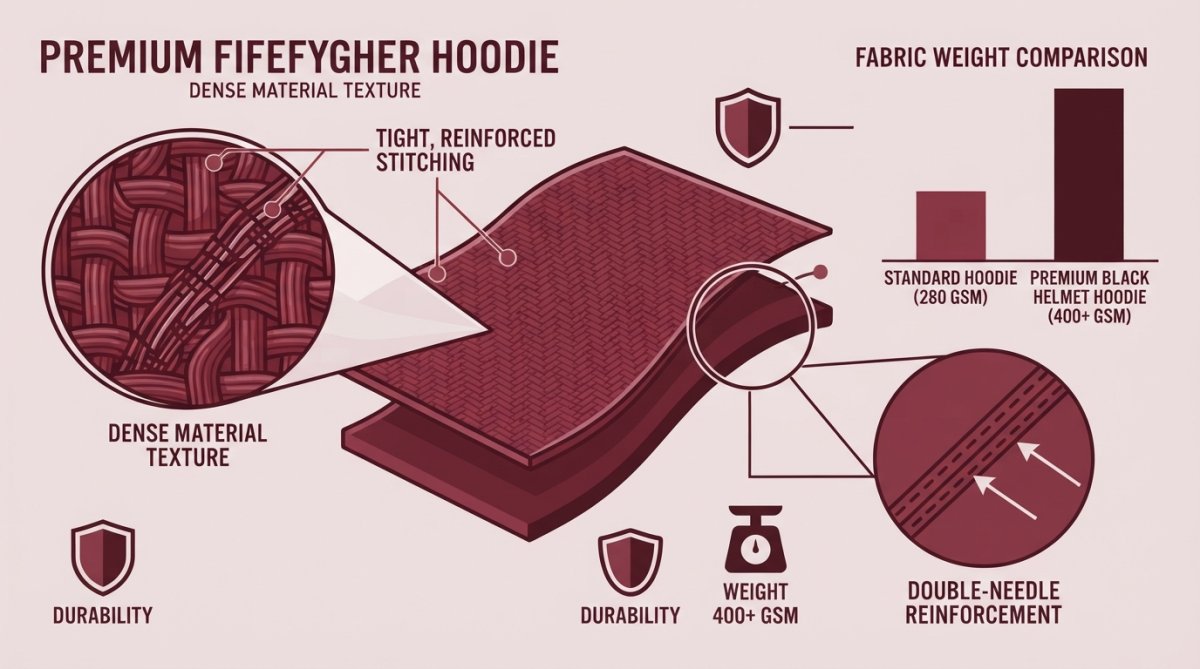
GSM Weight Standards and Durability Testing
Fabrics below 250 GSM show visible wear within 30-40 wash cycles. Fabrics in the 300-350 GSM range maintain integrity through 100+ wash cycles with minimal degradation. Premium firefighter hoodies typically exceed 300 GSM because the cost difference is minimal compared to the durability gain.
Testing protocols for premium gear include accelerated wear tests simulating months of use in weeks. A premium hoodie passes 150 wash cycles at high temperature without significant shrinkage or fading, while a budget option shows measurable wear by cycle 50.
The relationship between GSM and service life is exponential. Doubling fabric weight can extend service life by 3-5 times because the fabric resists the micro-damage that accumulates with every wash and wear cycle.
Reinforced Seams and Stress-Point Engineering
Seams are where garments fail first. Premium firefighter hoodies use flatlock stitching or reinforced double-stitching at critical stress points: shoulders, underarms, pocket corners, and hood attachment. Flatlock stitching lies flat against the skin, reducing chafing and creating a seam that flexes without tearing.
Premium manufacturers also reinforce stress points with additional fabric layers or bar tacks that distribute stress across a wider area. These details extend garment life by preventing the seam separation that causes most premature failures.
Flame-Resistant Fabric Technology and Service Life
Flame-resistant (FR) technology is non-negotiable for firefighter apparel, but the type of FR treatment directly affects durability.
Inherent FR vs. Treated FR: Which Lasts Longer
Inherent FR fabrics are made from fibers naturally flame-resistant at the molecular level. Common inherent FR fibers include modacrylic, aramid (Nomex), and polybenzimidazole (PBI). These fibers maintain FR properties through their entire lifespan; washing doesn't degrade them.
Treated FR fabrics start as conventional fibers and have a flame-retardant chemical coating applied. This coating provides initial FR protection but degrades with washing, heat exposure, and UV light. After 50-100 wash cycles, treated FR fabrics lose measurable protective properties.
Premium firefighter hoodies use inherent FR fibers because the durability of the garment aligns with the durability of its protective properties. A premium hoodie made from inherent FR modacrylic or aramid blend maintains both structural integrity and flame-resistant protection for years.
How FR Properties Survive Industrial Laundering
Industrial laundering involves high temperatures, strong detergents, and mechanical agitation. Premium FR fabrics are engineered to withstand this process without degradation. Inherent FR fibers can actually improve with industrial laundering; the high heat and mechanical action tighten the weave and enhance resistance to pilling and wear.
Research from NFPA standards documentation on FR fabric durability shows that inherent FR fabrics maintain flame-resistant properties after 100+ industrial wash cycles, while treated FR fabrics show measurable degradation by cycle 25.
NFPA 1975 Standards and Compliance: Why They Matter for Durability
NFPA 1975 is the standard for firefighter protective apparel. Compliance tests for shrinkage, tensile strength, abrasion resistance, and performance after repeated washing. Premium firefighter hoodies that meet or exceed NFPA 1975 requirements have proven they maintain protective properties and structural integrity through extended use.
The standard requires garments maintain at least 90% of original tensile strength after 100 wash cycles. This means seams don't weaken significantly, fabric doesn't tear easily, and overall structure remains sound. Compliance indicates the manufacturer has invested in quality control and testing infrastructure.
Firefighter Apparel Care: Home Laundry vs. Industrial Cleaning Impact
How a hoodie is washed dramatically affects its lifespan. Premium firefighter hoodies are engineered to withstand industrial laundering, but home laundry can extend or shorten service life depending on method.
How Washing Methods Affect Garment Integrity
Industrial laundering uses high temperatures (160-180°F) and strong detergents specifically formulated for FR fabrics. Home laundry with cold water, mild detergent, and air-drying is gentler on seams and structure. Premium hoodies survive both approaches because seams are reinforced and fabrics are durable.
Budget hoodies often fail in home laundry because seams are weak. A single hot-water wash can cause seam separation that cascades into complete failure.
Shrinkage Resistance and Performance After Repeated Washing
Shrinkage is a common complaint about firefighter hoodies. Premium hoodies use pre-shrunk fabrics and specialized finishing processes that lock in dimensions. A quality hoodie should shrink less than 2% after 10 wash cycles, even at high temperatures. Budget hoodies often shrink 5-10% after the first wash.
Material Blends vs. Natural Fibers: Durability Comparison
The choice between pure natural fibers, pure synthetic FR fibers, and blended fabrics significantly affects durability. Premium manufacturers choose blends that optimize for firefighter use.
Cotton-Nylon Blends and Synthetic FR Performance
Pure cotton is comfortable but not flame-resistant and degrades quickly under high heat. Pure synthetic FR fibers are durable and protective but can feel stiff. Premium firefighter hoodies use blends balancing comfort and durability.
A common premium blend is 88% modacrylic / 12% nylon, providing inherent FR protection, excellent durability, and acceptable comfort. Cotton-nylon blends without FR fibers are used for off-duty apparel, where FR protection isn't required but durability is important. These blends last 5-7 years with proper care.
Abrasion Resistance and Tensile Strength in Premium Blends
A 100% cotton hoodie has tensile strength of 40-50 pounds per linear inch. A modacrylic-nylon blend achieves 80-100+ pounds per linear inch. This 2-3x difference translates to a hoodie resisting tearing and maintaining integrity through years of use.
Premium FR blends withstand 10,000+ abrasion cycles before showing wear, while budget alternatives fail around 2,000-3,000 cycles.
Cost-Effectiveness of Premium Firefighter Hoodies: Long-Term Investment Value
A budget hoodie priced at $30 lasts 1-2 years. A premium hoodie priced at $50-60 lasts 4-6 years. Cost per year drops from $15-30 annually to $8-12 annually for the premium option.
For fire departments buying gear for entire crews, the economics are compelling. A department equipping 30 firefighters with budget hoodies at $30 each spends $900 annually. The same department buying premium hoodies at $50 each spends $1,500 once, then replaces approximately 6 hoodies per year for five years, totaling less than $400 annually.
Layering Science and Thermal Regulation: Extended Wearability
A premium firefighter hoodie works as part of a layering system extending wearability across seasons and conditions. This versatility means the hoodie gets worn more often and still lasts longer than a single-purpose budget option.
Premium hoodies are engineered with moisture-wicking properties that move sweat away from skin, keeping the wearer dry and comfortable. This reduces washing frequency and decreases stress on fibers from sweat exposure. Inherent FR fibers like modacrylic and aramid have better breathability than treated FR fabrics, meaning they don't trap heat as much.
Premium hoodies designed for off-duty wear use cotton-nylon blends providing excellent moisture-wicking without stiffness. These hoodies can be worn year-round, yet their durability ensures they last 5-7 years.
Premium firefighter hoodies last longer because every element, from fabric weight to seam construction to flame-resistant fiber choice, is engineered for durability under the specific demands of firefighter work. The difference between a hoodie lasting one season and one serving five years comes down to decisions made during design and manufacturing.
Black Helmet creates premium firefighter apparel built on these principles. Our hoodies are designed by people who understand the job, tested for real-world conditions, and backed by a satisfaction guarantee. When you invest in a Black Helmet hoodie, you're investing in apparel that will be part of your station culture for years to come.
NFPA 1975 Standard on Protective Apparel for Firefighters
Textile durability testing standards and fabric weight specifications
Flame-resistant fabric technology and inherent vs. treated FR comparison
Frequently Asked Questions
What materials make premium firefighter hoodies more durable than budget alternatives?
Premium firefighter hoodies typically use higher fabric weights (measured in GSM, grams per square meter), reinforced seams with flatlock or safety-stitch construction, and synthetic blends or cotton-nylon combinations that resist abrasion better than single-fiber materials. These construction methods improve tensile strength and reduce wear at stress points, extending the garment's service life significantly. Budget hoodies often use lighter fabrics and standard stitching that fails faster under duty wear.
How do NFPA 1975 standards affect firefighter hoodie longevity?
NFPA 1975 standards establish requirements for flame-resistant protective apparel, including durability testing that ensures seams, fabric, and closures maintain integrity through repeated washing and heat exposure. Premium hoodies engineered to exceed these standards undergo rigorous durability testing for wash cycles, heat transfer, and garment integrity, all factors that directly correlate to longer service life. Compliance signals that a hoodie has been designed for sustained performance, not just initial sale.
Can proper firefighter apparel care really extend the life of a premium hoodie?
Yes. Industrial laundering preserves FR properties and fabric structure better than home washing, which can compromise flame-resistant treatments and cause shrinkage. Premium hoodies designed for industrial cleaning maintain their thermal protection, breathability, and fit longer than those subjected to standard home laundry. However, even premium hoodies benefit from proper care: following manufacturer guidelines on water temperature, detergent type, and drying methods prevents premature degradation and extends service life by months or years.
Why are premium firefighter hoodies more cost-effective than cheaper alternatives?
Premium hoodies cost more upfront but deliver lower lifetime cost-per-wear. A premium hoodie rated for 100+ wash cycles at $45-$56 costs roughly $0.45-$0.56 per wear, while a $20 budget hoodie lasting 30 cycles costs $0.67 per wear. Premium materials resist shrinkage, maintain fit, and resist pilling and fading longer. For firefighters in duty wear or frequent off-duty use, premium hoodies eliminate the need for frequent replacement, making them a genuine long-term investment in both durability and authentic representation of the fire service.
This article was written using GrandRanker
