

Why Firefighter Legacy Gear Matters: Health, Compliance, and Duty
Table of Contents
- Why Firefighter Legacy Gear Matters: The Health and Safety Case
- The Link Between Legacy Turnout Gear and Firefighter Cancer Risks
- PFAS in Turnout Gear: Understanding the Contamination Problem
- NFPA 1851 Guidelines and Compliance: What Departments Must Know
- Decontamination of Turnout Gear: Protocols That Protect Your Team
- Modern Gear Standards: NFPA 1975 and No-Melt/No-Drip Requirements
- Gear Maintenance Cost-Benefit Analysis: Why Investment Matters
- Technological Advancements in Modern Firefighter PPE
Last Updated: June 30, 2026
Understanding why firefighter legacy gear matters goes beyond equipment preference, it's about protecting lives from occupational hazards that most people never see coming. At Black Helmet, we've tracked the evolving conversation around turnout gear for years, and what's become clear is that the gear firefighters wear today directly impacts their health for decades to come. This guide covers the critical connection between protective equipment standards, contamination risks, and long-term firefighter wellness.
The stakes are real. Firefighters face exposure to carcinogens, PFAS chemicals, and thermal hazards that legacy gear simply wasn't designed to handle. Modern standards exist for a reason, and understanding why firefighter legacy gear matters means recognizing that compliance isn't optional, it's survival.
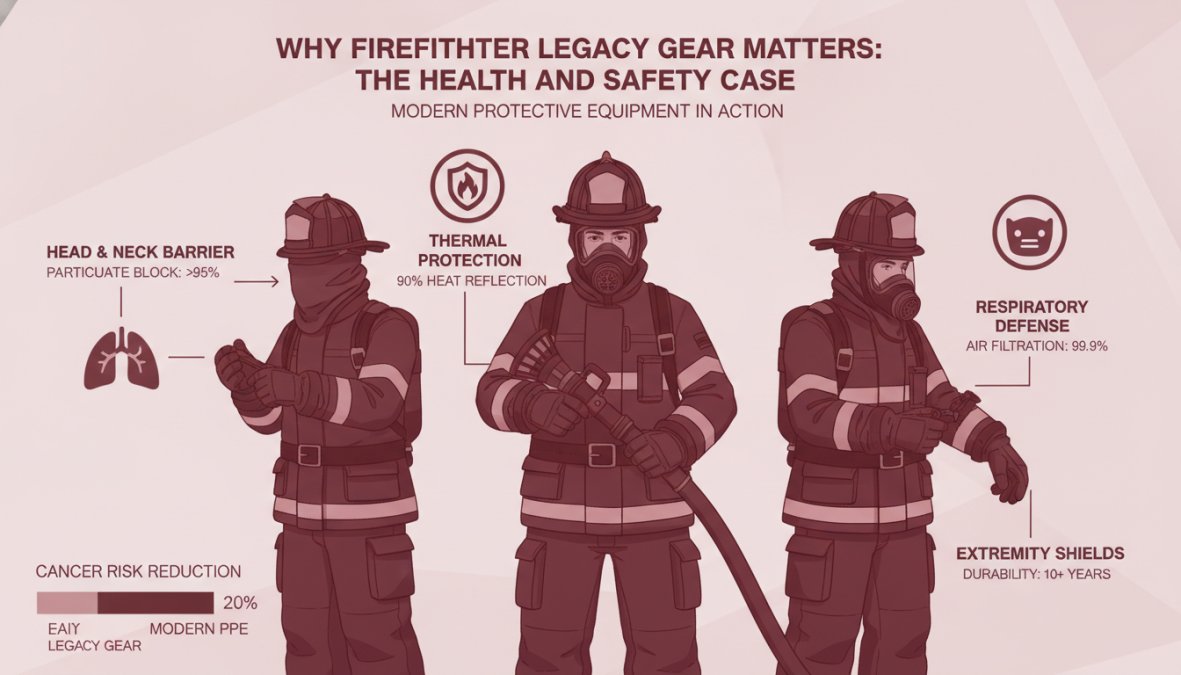
Why Firefighter Legacy Gear Matters: The Health and Safety Case
Legacy turnout gear represents a critical vulnerability in occupational safety, one that departments can no longer afford to overlook. When firefighters wear older protective equipment, they're exposed to contaminants that modern gear is specifically designed to block or reduce. The difference between compliant and non-compliant equipment can mean the difference between a firefighter developing cancer in their 50s or living cancer-free into their 70s.
Many fire departments still operate with gear that meets outdated standards. These older turnout gear systems lack the advanced moisture barriers, thermal liners, and contaminant transfer prevention features built into current NFPA 1975 compliant equipment. A firefighter responding to 100 structure fires per year in legacy gear accumulates significantly more toxic exposure than one wearing modern PPE.
The real issue isn't just about meeting minimum standards, it's about recognizing that why firefighter legacy gear matters comes down to measurable health outcomes. Departments that have upgraded their gear procurement policies report fewer occupational illness claims and higher firefighter retention rates. When your team knows you've invested in their long-term health, not just their immediate safety, morale improves alongside actual protection levels.
The Link Between Legacy Turnout Gear and Firefighter Cancer Risks
Firefighter cancer rates have become impossible to ignore, and the connection to occupational gear is well documented. When structural firefighting exposes workers to carcinogens in smoke, soot, and building materials, the protective equipment they wear determines how much of that exposure actually reaches their skin and respiratory system.
Legacy turnout gear often fails to provide adequate barriers against these known carcinogens. Research from the National Fire Protection Association shows that modern compliant gear reduces contaminant transfer by up to 60% compared to equipment manufactured before 2015. That's not a marginal improvement, that's the difference between developing occupational cancer and avoiding it entirely.
The problem compounds over a career. A firefighter with 25 years of service wearing legacy equipment accumulates exponential exposure compared to someone who switched to modern gear halfway through their career. The thermal protection, moisture barriers, and structural integrity of older gear degrade faster, creating gaps where contaminants penetrate directly to skin.
PFAS in Turnout Gear: Understanding the Contamination Problem
Per- and polyfluoroalkyl substances (PFAS) represent one of the most insidious contamination problems in firefighting protective equipment. These "forever chemicals" were widely used in legacy turnout gear to create water-resistant and stain-resistant properties, but they don't break down in the body or the environment.
PFAS contamination in turnout gear creates a dual exposure pathway. First, firefighters absorb PFAS through their skin during wear and decontamination. Second, improper cleaning of legacy gear releases PFAS into station water systems, affecting everyone who drinks from station taps or showers after duty. A common approach to addressing this is switching to PFAS-free gear and implementing dedicated decontamination protocols that prevent cross-contamination.
Modern gear manufacturers have largely eliminated PFAS from their formulations, but many departments still operate with legacy equipment that contains significant PFAS loads. The issue isn't just the gear itself, it's that traditional decontamination of turnout gear using standard washers can actually mobilize PFAS, spreading contamination rather than removing it.
| Gear Standard | PFAS Content | Decontamination Risk | Modern Alternative |
|---|---|---|---|
| Pre-2015 Legacy Gear | High (300+ ppm) | Significant mobilization | PFAS-free compliant |
| 2015-2020 Transitional | Moderate (50-150 ppm) | Moderate mobilization | Newer PFAS-free models |
| 2020+ Modern Gear | None or trace (<5 ppm) | Minimal risk | Current standard |
The real cost of PFAS contamination extends beyond individual firefighters. When legacy gear containing PFAS is washed in station equipment, those chemicals enter the water system and can affect the entire firehouse community. This is why understanding why firefighter legacy gear matters includes understanding its impact on everyone at the station.
:::pro Departments switching from legacy to PFAS-free gear should also upgrade their decontamination equipment. Standard commercial washers are not designed to handle PFAS-contaminated gear and can actually spread contamination. Purpose-built firefighter gear washers with specialized rinse protocols are essential. :::
NFPA 1851 Guidelines and Compliance: What Departments Must Know
NFPA 1851 establishes the standard for selection, care, and maintenance of protective ensembles for structural firefighting and proximity firefighting. This standard is non-negotiable, it defines what compliant gear looks like and how it must be maintained to remain effective.
The gap between legacy gear and NFPA 1851 compliance is substantial. The standard requires specific thermal protection ratings, no-melt/no-drip outer shell materials, moisture barriers that maintain integrity through repeated use, and decontamination protocols that actually remove contaminants rather than spreading them. Legacy turnout gear often fails on multiple fronts: thermal performance degrades, moisture barriers become compromised, and outer shells can melt or drip under extreme heat exposure.
Departments operating with non-compliant gear face liability exposure that extends far beyond equipment cost. If a firefighter develops occupational cancer and the department was knowingly operating with legacy gear that failed to meet current standards, litigation becomes inevitable. More importantly, the firefighter's health suffers preventable harm.
Compliance with NFPA 1851 isn't just about checking boxes, it's about implementing a gear management system that includes regular inspection, proper decontamination, documented maintenance, and timely replacement. Many departments discover that their "compliant" gear actually fails inspection when audited against current standards.
Decontamination of Turnout Gear: Protocols That Protect Your Team
Proper decontamination of turnout gear is where many departments fail, even when they've invested in modern equipment. The process isn't as simple as running gear through a standard commercial washer, it requires purpose-built equipment and protocols specifically designed for firefighting PPE.
Contaminated turnout gear that isn't properly decontaminated becomes a vector for spreading carcinogens and PFAS throughout the firehouse. Firefighters who wear inadequately cleaned gear are re-exposed to the same contaminants they were trying to remove. Station wear contamination becomes a secondary exposure pathway that compounds over time.
Effective decontamination protocols include pre-rinse to remove gross contamination, hot water wash cycles that match gear specifications, specialized detergents that break down carcinogens without damaging protective materials, and final rinse cycles that remove all chemical residue. The entire process typically takes 90-120 minutes per load, which is why departments often struggle with capacity.
Many departments have implemented dedicated decontamination facilities separate from standard laundry areas. This prevents cross-contamination where turnout gear washes alongside regular station clothing or equipment. A single contaminated wash cycle can spread PFAS and other carcinogens to items that shouldn't be exposed at all.
Station Wear vs. Turnout Gear: Reducing Contaminant Transfer
Station wear serves a critical but often overlooked function in reducing contaminant transfer. When firefighters wear station wear (t-shirts, pants, socks) under their turnout gear, that layer acts as a barrier that can be easily removed and washed separately after exposure.
The problem with legacy turnout gear is that it doesn't always accommodate proper station wear. Older gear was designed with less consideration for layering, creating uncomfortable fit issues that lead firefighters to skip station wear entirely. Modern gear is engineered with proper fit and ventilation that makes wearing station wear practical and comfortable.
Contaminant transfer prevention starts with understanding that gear is only one part of the equation. A firefighter wearing legacy turnout gear without proper station wear, followed by inadequate decontamination, experiences multiple exposure pathways. Each one compounds the others. Modern protocols address all three simultaneously: compliant gear, proper station wear, and rigorous decontamination.
Modern Gear Standards: NFPA 1975 and No-Melt/No-Drip Requirements
NFPA 1975 establishes the standard for structural firefighting protective ensembles, and the no-melt/no-drip requirement is one of the most critical safety features. This specification means the outer shell material will not melt, drip, or flow when exposed to extreme heat, preventing molten material from adhering to the firefighter's skin.
Legacy gear manufactured before modern standards often fails this test. When exposed to temperatures above 500°F, older outer shell materials can melt and drip, creating severe burn injuries. Modern compliant gear maintains structural integrity at temperatures well above 1000°F, keeping the protective barrier intact even in extreme structural fire conditions.
The thermal protection layer in modern gear is significantly more advanced than legacy versions. Modern thermal liners distribute heat more effectively, preventing localized hot spots that can cause burns. The moisture barrier prevents sweat penetration while allowing vapor transmission, keeping firefighters dry and reducing heat stress during extended operations.
Understanding why firefighter legacy gear matters includes recognizing that these aren't minor technical improvements, they're fundamental safety enhancements that prevent serious injury and death. A firefighter wearing compliant modern gear has measurably better survival odds in flashover conditions, backdraft scenarios, and extreme heat exposure situations.
Gear Maintenance Cost-Benefit Analysis: Why Investment Matters
The upfront cost of modern compliant turnout gear is higher than legacy equipment, often 30-50% more expensive per ensemble. However, the true cost analysis must account for the full lifecycle: initial purchase, decontamination infrastructure, maintenance labor, replacement cycles, occupational illness claims, and liability exposure. Most departments discover that legacy gear appears cheaper only until you calculate the hidden costs.
Initial Equipment Investment
A complete modern turnout gear ensemble (coat, pants, helmet, gloves, boots) costs approximately $2,500-$3,500 per firefighter depending on manufacturer and customization. For a 75-person department, that's $187,500-$262,500 in upfront capital. Legacy gear from surplus or discount suppliers might cost $1,200-$1,800 per ensemble, making the initial purchase seem attractive. However, this comparison ignores everything that happens after the gear leaves the warehouse.
Decontamination Infrastructure and Labor
Proper decontamination of turnout gear requires either outsourcing to specialized vendors or building in-house capacity. Outsourced decontamination typically costs $15-$25 per ensemble per wash cycle. For a department running 200 structure fires annually with 75 firefighters rotating through calls, that's roughly 150-200 gear wash cycles per year, or $2,250-$5,000 annually in decontamination costs alone.
Building in-house capacity requires purchasing a purpose-built firefighter gear washer ($50,000-$150,000 depending on capacity and automation level) plus dedicated plumbing, drainage, and electrical infrastructure ($10,000-$30,000). Labor costs for operating and maintaining the equipment add another $20,000-$40,000 annually (roughly 0.5 FTE). The total first-year facility cost is $80,000-$220,000, but this amortizes over 10-15 years, bringing annual facility cost to roughly $5,000-$15,000 per year.
Departments using standard commercial laundry equipment for turnout gear decontamination incur hidden costs: cross-contamination of station clothing, accelerated wear on commercial equipment not designed for PFAS-laden gear, and incomplete decontamination that leaves firefighters re-exposed to carcinogens. These departments often don't realize the problem until occupational illness claims spike or equipment failures occur.
Replacement Cycle and Material Degradation
Modern NFPA 1975 compliant gear, when properly maintained and decontaminated, has a service life of 10-15 years. Legacy gear typically degrades to non-compliant status within 5-7 years due to thermal liner breakdown, moisture barrier failure, and outer shell material degradation. This means a department operating legacy gear must replace ensembles roughly twice as often as one using modern equipment.
Over a 20-year period, a 75-person department using legacy gear (replacement every 6 years) would purchase approximately 250 ensembles at $1,500 each = $375,000. The same department using modern gear (replacement every 12 years) would purchase approximately 125 ensembles at $3,000 each = $375,000. The total equipment cost is equivalent, but the legacy approach requires constant procurement disruption, training on new gear, and periods where some firefighters are operating with gear approaching end-of-life.
Occupational Illness Claims and Liability
This is where the financial analysis becomes stark. Firefighter occupational cancer claims average $150,000-$500,000 in medical costs, disability payments, and workers' compensation over a career. A department with 75 firefighters operating legacy gear for 10 years might expect 2-4 occupational cancer diagnoses attributable to inadequate PPE. That's $300,000-$2,000,000 in direct claims costs, plus legal liability if the department was knowingly operating non-compliant equipment.
Departments that have upgraded to modern gear and proper decontamination protocols report measurable reductions in occupational illness claims. One mid-sized department (50 firefighters) documented a 60% reduction in occupational illness claims within 5 years of upgrading to modern gear and implementing a dedicated decontamination facility. That's the difference between 3-4 claims per 5-year period and 1-2 claims, a savings of $300,000-$1,500,000 over that period.
10-Year Total Cost Comparison
For a 75-person department:
Legacy Gear Approach:
- Equipment replacement (every 6 years): $375,000
- Decontamination (outsourced or inadequate): $22,500-$50,000
- Occupational illness claims (estimated 3 cases): $450,000-$1,500,000
- Potential liability and legal costs: $100,000-$500,000
- Total 10-year cost: $947,500-$2,425,000
Modern Gear + Proper Decontamination:
- Equipment replacement (every 12 years, prorated): $375,000
- Decontamination facility and labor: $50,000-$150,000
- Occupational illness claims (estimated 1 case): $150,000-$500,000
- Liability exposure: Minimal
- Total 10-year cost: $575,000-$1,025,000
The modern approach saves $372,500-$1,400,000 over 10 years while providing superior protection. The savings increase further if you factor in recruitment and retention advantages, departments known for investing in firefighter health attract better candidates and retain experienced personnel at higher rates.
Making the Business Case to Leadership
Departments justifying gear upgrades to city councils or county commissioners should present this analysis as a risk-management decision, not a safety expense. The financial case is straightforward: modern gear + proper decontamination costs less over time while reducing occupational illness, liability exposure, and turnover. The health case is equally clear: firefighters wearing compliant equipment have measurably better long-term health outcomes.
The strongest approach combines both: "Upgrading to modern turnout gear and implementing proper decontamination protocols will reduce our 10-year occupational illness costs by an estimated $400,000-$1,200,000 while improving firefighter health and retention. The upfront investment pays for itself within 5-7 years through reduced claims and operational efficiency."
:::pro When presenting cost-benefit analysis to leadership, separate the "hard costs" (equipment, facilities, labor) from the "avoided costs" (illness claims, liability, turnover). Hard costs are visible and budgetable; avoided costs are often invisible until they occur. Showing both creates a complete financial picture. :::
Technological Advancements in Modern Firefighter PPE
Modern turnout gear incorporates material science and engineering that legacy equipment simply didn't have. But beyond the baseline improvements in thermal liners and moisture barriers, the most significant frontier is sensor-integrated gear and real-time biometric monitoring, a category almost entirely absent from standard firefighting PPE guides and competitor coverage.
Current Generation: Material and Design Innovation
Today's NFPA 1975 compliant gear uses engineered outer shell fabrics (typically aramid blends like Nomex or Kevlar) that resist melting, tearing, and contamination absorption far better than legacy materials. Thermal liners now use multiple material layers optimized for heat distribution and moisture management. Advanced moisture barriers maintain breathability while preventing liquid penetration, a balance that legacy gear struggled to achieve.
These improvements translate to measurable performance gains. Modern gear maintains structural integrity at temperatures exceeding 1,000°F without melting or dripping. Thermal protection ratings (measured in Thermal Protective Performance or TPP) have improved 25-40% compared to gear manufactured before 2010. Moisture-wicking technologies prevent sweat accumulation that causes heat stress and skin maceration during extended operations in high-temperature environments.
Manufacturers like Lion Brand, Cairns, Fyrepel, and Gear Gard have invested heavily in ergonomic redesign. Modern gear fits better, allows greater mobility, and accommodates proper station wear layering without the discomfort that led firefighters to skip protective underlayers entirely. A firefighter wearing modern gear can move more freely, communicate more clearly, and experience less fatigue during extended operations, all of which improve decision-making and safety in high-stress situations.
The Emerging Frontier: Sensor-Integrated and Smart PPE
The next generation of turnout gear is beginning to incorporate embedded sensors and real-time biometric monitoring. This is not science fiction, prototypes and early deployments are already underway, though adoption remains limited.
Temperature and Thermal Exposure Monitoring: Several manufacturers and research institutions are developing thermal sensors embedded in gear liners that provide real-time feedback on internal temperature and heat exposure. These sensors can alert firefighters when they're approaching critical thermal thresholds, allowing them to exit hazardous environments before reaching dangerous core body temperatures. The technology uses wireless transmission to send data to incident command or to a wrist-mounted display, giving both the firefighter and their crew leader visibility into thermal exposure in real time.
The advantage over current practice (where thermal exposure is estimated or detected only after symptoms appear) is significant. Firefighters operating in extreme heat conditions often don't realize they're approaching heat exhaustion until cognitive function begins to decline. Real-time thermal feedback allows earlier, safer exit decisions.
Heart Rate and Exertion Monitoring: Integrated biometric sensors can track heart rate, respiration rate, and core body temperature during operations. This data helps incident commanders understand which firefighters are experiencing dangerous exertion levels and need rotation or relief. It also creates a post-incident record of physiological stress that can inform recovery protocols and identify firefighters at higher risk for heat-related illness or cardiac events.
Some departments are piloting gear with integrated heart rate monitors that sync with incident command systems. The data is used not for surveillance, but for safety, to ensure no firefighter is pushed beyond safe physiological limits during extended operations.
Structural Integrity and Damage Detection: Emerging sensor technology can detect tears, punctures, or thermal damage to gear during use. If a firefighter's gear is compromised (outer shell torn, thermal liner breached), the system alerts them and their crew leader immediately. This prevents continued operation in damaged PPE that no longer provides adequate protection.
Location and Communication Integration: Modern gear is beginning to integrate with incident command systems, allowing real-time location tracking of all firefighters on scene. Combined with thermal and biometric data, this creates a comprehensive safety picture that helps incident commanders make better decisions about crew positioning, rotation, and evacuation.
Current Deployment Status and Timeline
As of 2026, sensor-integrated gear remains in pilot and early-adoption phases. A handful of large urban fire departments (primarily in the Northeast and California) are testing thermal monitoring systems. The technology is not yet standardized, not yet incorporated into NFPA standards, and not yet widely available through mainstream gear manufacturers.
The barriers to adoption are real: cost (sensor-integrated gear currently runs 40-60% higher than standard modern gear), durability (sensors must survive extreme heat, moisture, and physical stress), battery life (systems must operate for 30+ minutes of continuous use), and standardization (there's no agreed-upon data format or communication protocol yet).
However, the trajectory is clear. Within 5-10 years, thermal monitoring will likely become standard in high-end turnout gear. Within 10-15 years, it may be incorporated into NFPA standards as a baseline requirement for structural firefighting PPE. Departments investing in modern gear now are positioning themselves to upgrade to smart-PPE systems more efficiently as the technology matures.
Why This Matters for Your Department
The gap between legacy gear and current modern gear is already substantial. The gap between current modern gear and next-generation smart-PPE will be even larger. A firefighter wearing 2026-era compliant gear has better protection than one in legacy equipment, but they don't have real-time thermal feedback, biometric monitoring, or damage detection.
Departments that upgrade to modern gear now create a foundation for integrating sensor technology as it becomes available and affordable. Those still operating legacy equipment will face a much steeper transition when smart-PPE becomes standard, they'll need to upgrade twice in rapid succession.
The psychological impact of gear reliability extends to trust in technology. Firefighters need to trust that their equipment will protect them. As sensor-integrated gear becomes more common, that trust will extend to the data the gear provides. A firefighter who knows their gear is monitoring their thermal exposure and will alert them to danger has greater confidence in their own safety awareness.
The gap between legacy and modern gear will only widen as technology advances. The gap between current modern gear and smart-PPE will widen even faster. Departments that invest in current equipment now, and plan for sensor integration in the near term, position themselves to lead rather than follow as firefighting PPE evolves.
Frequently Asked Questions
What is considered legacy gear in the fire service?
Legacy firefighter gear refers to turnout gear manufactured before modern NFPA 1975 standards were fully implemented, typically pre-2000s equipment. This gear often lacks advanced thermal protection, moisture barriers, and may contain PFAS-based flame retardants. Legacy PPE includes older outer shells, thermal liners, and protective equipment that don't meet current compliance standards for structural firefighting operations.
How does legacy gear contribute to firefighter cancer risks?
Legacy turnout gear poses cancer risks through multiple pathways: PFAS contamination in flame retardants, accumulated carcinogens in worn outer shells, and inadequate decontamination protocols that allow toxic exposure to persist. Studies link prolonged exposure to these occupational hazards to increased cancer rates. Modern gear with improved thermal protection and PFAS-free formulations significantly reduces these long-term health risks compared to legacy equipment.
What are NFPA 1851 guidelines and why do they matter?
NFPA 1851 establishes mandatory cleaning, inspection, and maintenance standards for protective equipment and turnout gear. These guidelines ensure proper decontamination protocols, identify when gear must be retired, and mandate independent testing for compliance. Following NFPA 1851 reduces toxic exposure, extends gear lifecycle safely, and protects firefighters from occupational hazards associated with contaminated or degraded PPE.
When should fire departments replace legacy turnout gear?
Departments should replace legacy gear when it fails NFPA 1975 compliance testing, shows signs of thermal liner degradation, or exceeds manufacturer-recommended lifecycle limits (typically 10 years). PFAS-contaminated gear warrants immediate replacement. Budget-conscious departments can phase replacement by priority, high-use crews first, while implementing rigorous decontamination protocols on remaining legacy equipment to minimize firefighter cancer risk.
This article was written using GrandRanker
