

Significance of the Thin Red Line: History, Meaning & Fire Service
Table of Contents
- Understanding the Significance of the Thin Red Line
- Origin of the Thin Red Line Phrase in Rudyard Kipling's Work
- Thin Red Line Firefighter Meaning and Modern Fire Service Identity
- Thin Red Line Movie Meaning: Terrence Malick's Philosophical Vision
- Thin Blue Line Meaning: How It Differs From the Thin Red Line
- Why the Thin Red Line Matters to Firefighters and First Responders
- Symbolism of the Color Red in Fire Service Culture
- Conclusion: The Enduring Power of the Thin Red Line
Last Updated: July 30, 2026
Understanding the Significance of the Thin Red Line
The thin red line is one of the fire service's most meaningful traditions, representing the brave men and women who stand between chaos and civilization. At Black Helmet, we recognize this phrase as embodying sacrifice, duty, and the unbreakable bond of brotherhood that defines emergency services. This article explores what the thin red line means: from its literary origins in Rudyard Kipling's poetry to its role in Terrence Malick's philosophical film, and most importantly, its living significance in the hearts and gear of firefighters today.
Origin of the Thin Red Line Phrase in Rudyard Kipling's Work
Rudyard Kipling's 1888 collection Barrack-Room Ballads gave voice to British foot soldiers with raw authenticity. The phrase "thin red line" refers to infantry soldiers standing shoulder to shoulder on the battlefield, the only barrier between enemy advance and everything behind it: civilians, homes, loved ones. British soldiers wore red coats, making their formation literally a red line when viewed from a distance. This visual imagery combined with the metaphorical weight of their position created something unforgettable.
Barrack-Room Ballads and British Infantry History
Kipling's Barrack-Room Ballads captured soldier life as soldiers themselves experienced it, not as distant observers imagined it. These poems gave voice to ordinary men facing disease, poor conditions, and constant death threats in distant lands. Yet they persisted, forming bonds of loyalty that transcended rank. The thin red line became synonymous with this sacrifice, necessary, performed by ordinary men doing extraordinary things.
Etymological Evolution Beyond the Poem
The phrase evolved significantly beyond Kipling's original context. While Kipling used it to describe British soldiers, the term became genericized to represent any thin line of defenders standing against overwhelming odds. The color red took on additional meaning: the blood spilled by those who serve, the passion of commitment, the warmth of brotherhood. By the 20th century, the phrase had transcended its military origins, appearing in historical accounts, military doctrine, and eventually in emergency services. This semantic evolution shows how powerful metaphors survive and transform across generations.
Thin Red Line Firefighter Meaning and Modern Fire Service Identity
For firefighters, the thin red line holds meaning that rivals its military significance. The phrase has become the central symbol of fire service identity, worn on patches, displayed on trucks, and carried in the hearts of those who dedicate their lives to rescue and protection. When firefighters respond to a call, they cross that line, moving toward what others are running from. The thin red line acknowledges and honors this daily choice to serve.
Symbol of Brotherhood and Sacrifice
The thin red line is first and foremost a symbol of brotherhood. Firefighters understand that the person next to them might be the difference between going home to their family or not. This creates bonds that civilians rarely experience. Sacrifice is inseparable from this brotherhood. Every year, firefighters die in the line of duty, in structure fires, vehicle accidents, or from occupational illnesses developed over years of exposure. The thin red line honors these fallen. When firefighters wear thin red line gear from Black Helmet, they're carrying forward the legacy of those who didn't come home.
Representing the Line Between Chaos and Order
At its core, the thin red line represents the boundary between chaos and order. Fires spread, consume, and destroy indiscriminately. When a structure fire occurs, firefighters are the thin red line that separates those inside the fire from those outside. This boundary extends beyond physical fires to medical emergencies, vehicle accidents, and hazardous material incidents. In each case, firefighters are the trained professionals who stand between panic and control, between injury and survival. The thin red line acknowledges that civilization itself is held in place by those brave enough to do the job.
Thin Red Line Movie Meaning: Terrence Malick's Philosophical Vision
Terrence Malick's 1998 film The Thin Red Line represents one of cinema's most ambitious attempts to explore the nature of war, morality, and human existence. The film is not a traditional war movie but a philosophical meditation on the human condition set against the Battle of Guadalcanal during World War II. Malick's directorial style emphasizes visual poetry over plot mechanics, creating a film that lingers long after the credits roll.
The film explores existentialism and human morality, elevating the thin red line beyond its historical meaning. Malick asks: What separates us from savagery? What does it mean to kill? How do we maintain our humanity when surrounded by dehumanization? These questions give the thin red line new philosophical weight, the line isn't just between safety and danger, but between civilization and barbarism, between conscience and numbness.
1998 Film vs. 1964 Adaptation: A Comparative Analysis
Terrence Malick's 1998 The Thin Red Line differs dramatically from Sidney Lumet's 1964 film of the same name. The 1964 version is a conventional war film following a clearer narrative structure. Malick's 1998 version abandons conventional narrative almost entirely, jumping between characters, timelines, and philosophical voiceovers. The cinematography of seemingly untouched natural landscapes contrasts with human conflict. Malick understood that the thin red line wasn't really about the military battle but about the internal battle each soldier wages against his own capacity for violence, his fear, and his search for meaning.
Cinematography, Existentialism, and Human Morality
Malick's cinematography uses natural light, long lenses, and an impressionistic approach to filming the jungle and battlefield. This visual language prioritizes beauty and strangeness over clarity, making viewers feel the alienation of war and how violence disrupts the natural order. The film's existentialism emerges through voice-over narration and internal struggles as characters question whether their actions have meaning, whether survival justifies the cost, and whether they can maintain their moral compass in an immoral situation. War forces soldiers to commit acts they would never commit in civilian life. Malick explores the psychological toll this takes. The thin red line represents the struggle to remain human in an inhuman situation.
Private Witt as the Meaning-Seeking Soldier
Private Witt, portrayed by James Caviezel, is the film's emotional and philosophical center. Unlike other soldiers, Witt actively searches for meaning. His character embodies the existential crisis at the heart of war. He begins with idealism, believing the war serves a purpose, but witnesses casual cruelty, random death, and the military machine grinding individuals into components. His search for meaning becomes increasingly desperate. Witt represents every soldier who has asked: Why am I here? Does this matter? Can I maintain my humanity? Malick uses Witt to explore the thin red line as a psychological boundary, the line between the person a soldier was before war and who they become during it.
Thin Blue Line Meaning: How It Differs From the Thin Red Line
The thin blue line emerged later than the thin red line, becoming the primary symbol of law enforcement in America. Like the thin red line, it represents a boundary between order and chaos, but the context differs significantly. Police officers maintain order during peacetime, responding to crime within civilian society. Firefighters respond to natural disasters and accidents that threaten life indiscriminately.
The thin blue line has become politically charged in recent years, particularly following high-profile incidents of police violence and the Black Lives Matter movement. This politicization distinguishes it from the thin red line, which has remained relatively nonpartisan. Firefighters are universally respected; police officers have become figures of political debate. The thin red line represents sacrifice in service of rescue and protection, while the thin blue line has become entangled with debates about authority, accountability, and justice.
Why the Thin Red Line Matters to Firefighters and First Responders
Every firefighter understands something civilians often miss: the job is inherently dangerous. Even routine calls can turn fatal in seconds. A structure fire can collapse. A vehicle accident victim can have unanticipated injuries. A medical emergency can escalate unexpectedly. The thin red line acknowledges this reality. It says: "I know the risks. I'm going anyway." This commitment separates firefighting from other professions. Firefighters don't choose the conditions of their work; they respond to emergencies in the worst possible circumstances and are expected to function with precision and courage.
Expressing Professional Identity and Legacy
For firefighters, the thin red line is a statement of professional identity. When a firefighter wears thin red line apparel, whether it's a Black Helmet premium tee, a challenge coin, or a cross pendant, they're claiming membership in a profession with centuries of history and tradition. The thin red line also expresses legacy. Every firefighter who wears the symbol carries forward the memory of those who came before. Stories of heroic rescues, tragic losses, and everyday acts of courage are passed down through generations.
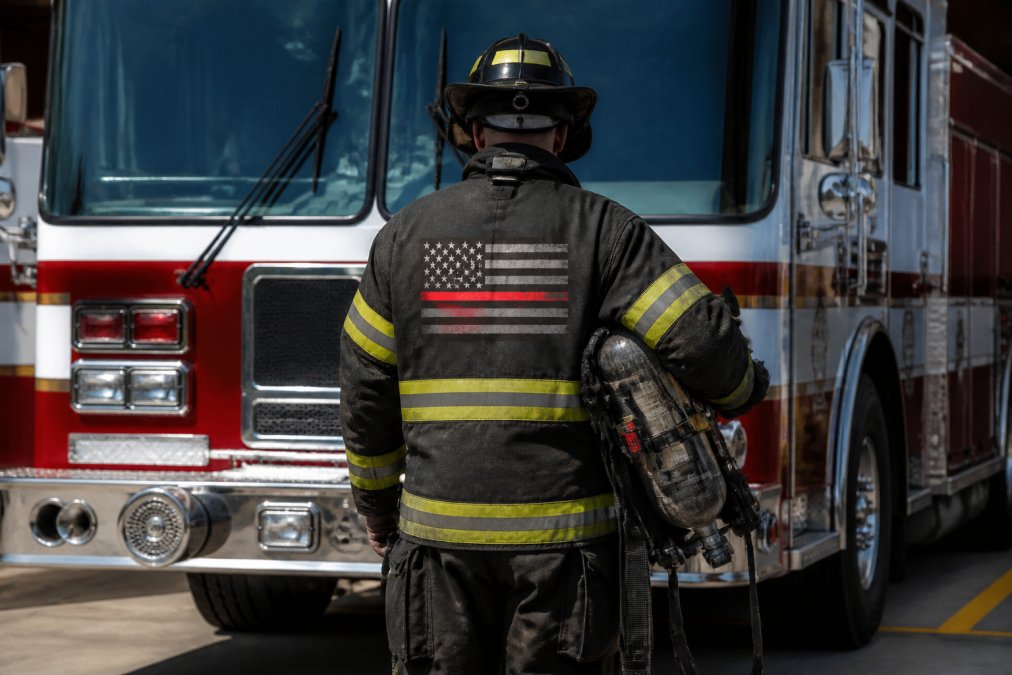
Retired firefighters wear the thin red line to maintain connection to the brotherhood they served. After decades in the fire service, retirement doesn't sever the bonds formed through shared danger and shared purpose. The thin red line allows retirees to say: "I was part of this. I still am."
Honoring Those Who Serve and Sacrifice
The thin red line is fundamentally an act of remembrance. Every year, firefighters die in the line of duty, some in dramatic rescues, others from occupational illnesses that develop silently over years. The thin red line honors both the dramatic and quiet sacrifices. When firefighters wear thin red line gear, they're honoring fallen colleagues by keeping their memory alive. This continuity ensures that sacrifices won't be forgotten.
Symbolism of the Color Red in Fire Service Culture
The color red carries deep significance in fire service culture. Historically, fire trucks were painted red because it was the cheapest paint option in the early days of motorized fire engines. But the color took on symbolic meaning over time. Red became the color of urgency, warning, and danger. It became the color of the fire service itself.
In the context of the thin red line, red represents blood, the ultimate sacrifice, passion, the commitment that drives people to run into burning buildings, and visibility, the need to be recognized for vital work. The thin red line uses this color symbolism to maximum effect. A thin red line is more striking than alternatives. The red demands attention and says: "Look at this. Remember this. This matters."
Conclusion: The Enduring Power of the Thin Red Line
The significance of the thin red line transcends its origins in Kipling's poetry and its exploration in Malick's cinema. The symbol has become the living embodiment of fire service values: courage, sacrifice, brotherhood, and service. For active firefighters, retirees, families, and supporters of the fire service, the thin red line represents a commitment to something larger than oneself.
When firefighters choose apparel that displays the thin red line, whether it's the Fire Rescue Thin Red Line Premium Tee or the Thin Red Line USA Flag Premium Tee, they're making a statement about their values and identity. Black Helmet creates gear designed specifically for those who understand the weight of this symbol. Every shirt, every challenge coin, every piece of gear is made to honor the thin red line and everyone who stands behind it.


The fire service depends on people willing to make the ultimate sacrifice. The thin red line exists to ensure their commitment, courage, and memory are never forgotten. Wear it proudly. Wear it with respect. Wear it knowing you're part of a tradition that stretches back centuries and will continue for centuries more.
| Aspect | Significance | Representation |
|---|---|---|
| Literary Origin | Rudyard Kipling's Barrack-Room Ballads (1888) | British foot soldiers standing against enemy advance |
| Fire Service Meaning | Symbol of brotherhood and sacrifice | Boundary between order and chaos, safety and danger |
| Philosophical Dimension | Terrence Malick's 1998 film exploration | Human morality and existential struggle in crisis |
| Color Symbolism | Red represents blood, passion, and visibility | Demands attention and recognition for fire service work |
| Modern Identity | Professional and personal commitment | Living connection to fire service legacy and fallen members |
| Community Function | Unites active, retired, and civilian supporters | Shared values of courage, duty, and service |
Frequently Asked Questions
What is the origin of the phrase 'the thin red line'?
The phrase originates from Rudyard Kipling's 1888 poem 'Tommy' in his Barrack-Room Ballads collection, which referenced British foot soldiers as a 'thin red line' defending the empire. Kipling used the metaphor to describe the fragile but resolute barrier soldiers represented between civilization and chaos. The phrase has since evolved beyond its historical military context to represent any small group standing between order and disorder, making it particularly relevant to modern firefighting and first responder culture.
What does the thin red line firefighter meaning represent?
In the fire service, the thin red line symbolizes firefighters as the critical barrier between community safety and danger. It represents the brotherhood, sacrifice, and duty of those who answer emergency calls. The symbol honors both active firefighters and those who have fallen in service, embodying the fire service's core values of courage, accountability, and legacy. For many firefighters, wearing thin red line apparel, like the Fire Rescue Thin Red Line Premium Tee, expresses professional identity and connection to the firehouse brotherhood.
How does Terrence Malick's 1998 film differ from the 1964 adaptation in its thin red line movie meaning?
Malick's 1998 film reimagines the thin red line as a philosophical meditation on human morality, existentialism, and the fragility of life during World War II on Guadalcanal. Unlike the 1964 version, Malick employs visual poetry, voice-over narration, and an ensemble cast to explore meaning-seeking and dehumanization in warfare. His cinematography emphasizes nature versus violence, creating an art house cinema experience that examines the chaos of battle and soldiers' internal struggle for purpose, positioning the thin red line as a metaphor for humanity itself amid warfare.
What is the difference between the thin red line and the thin blue line?
The thin red line represents firefighters and fire rescue personnel, symbolizing their role protecting communities from fire and disaster. The thin blue line represents law enforcement and police officers, symbolizing their role maintaining order and public safety. Both symbols emerged from the same historical and cultural tradition of honoring first responders, but each is specific to its profession. Understanding this distinction is important when choosing apparel or gifts that accurately reflect the specific service branch being honored.
[EXTERNAL_LINK: Oxford's literary analysis of Kipling's military poetry | oxford.edu]
[EXTERNAL_LINK: The Thin Red Line film analysis and cinematography study | criterion.com]
[EXTERNAL_LINK: National Fire Protection Association history of fire service symbols and traditions | nfpa.org]
This article was written using GrandRanker
