

How to Organize a Firefighter Apparel Fundraiser
Table of Contents
- Step 1: Set Your Fundraising Goal and Build a Budget
- Step 2: Choose Fire Department Fundraising Ideas That Fit Your Crew
- Step 3: Design Custom Firefighter Shirts With Fundraiser Templates
- Step 4: Pick Online Fundraising Platforms for Fire Departments
- Step 5: Promote the Campaign Through Social Media and Local Residents
- Best Practices for Fire Department Apparel Sales
- Step 6: Launch, Track, and Report Your Proceeds
- Conclusion
- Frequently Asked Questions
Last Updated: October 21, 2026
Step 1: Set Your Fundraising Goal and Build a Budget
A firefighter apparel fundraiser works best when you know the number you need before you pick a shirt. Skip this step and you'll either overcharge and scare off supporters or undercharge and lose money.
Start with a real goal, a thermal imaging camera, a training scholarship, a family support fund, or turnout gear upgrades, then work backward.
Here's the budget math that matters:
- Blank shirt cost plus printing, from your supplier
- Shipping per order, or a flat rate you absorb
- Platform fees on online sales
Write every line down. A fundraiser without a written budget is a hope, not a plan.
Break-Even Math for Shirt Sales
Break-even is the number of shirts you must sell before you make a dollar:
Break-even units = Total fixed costs ÷ (Sale price per shirt - Cost per shirt)
Divide fixed costs, setup fees and promotion, by profit per shirt to find the minimum you must move.
Two levers change everything:
- Raise the price and you break even faster, but fewer people buy
- Lower the cost and you protect your margin without touching price
Keep a simple break-even sheet in a spreadsheet. Update it as quotes come in. This one habit separates fundraisers that hit their goal from ones that quietly fizzle.
Step 2: Choose Fire Department Fundraising Ideas That Fit Your Crew
Not every fire department fundraising idea fits every station. A career house with a big social following can move custom apparel fast; a small volunteer department may do better with a booth at the county fair. Match the idea to your people and community. Ask three questions:
- Who will actually sell? Line firefighters, the auxiliary, or family members?
- Where is your audience? Local residents, a station open house, or an online crowd?
- How much time do you have? A weekend push or a month-long campaign?
The strongest fire department fundraising ideas give supporters something they want to wear or keep. Shirt sales, race-day shirts for a memorial 5K, and apparel bundles for a charity event all work because people get value back. Skip anything that feels like a gimmick.
Step 3: Design Custom Firefighter Shirts With Fundraiser Templates
Custom firefighter shirt fundraiser templates save you from a blank canvas. Most online platforms offer ready-made layouts where you drop in your department name, a seal, and a short line of text.
Here's how to build a design that sells:
- Pick one clear focal point, like a station seal or a maltese cross
- Add your department name in a clean, readable font
- Include a short tagline tied to the cause
- Keep the color count low to control print cost
- Order a single sample before you commit
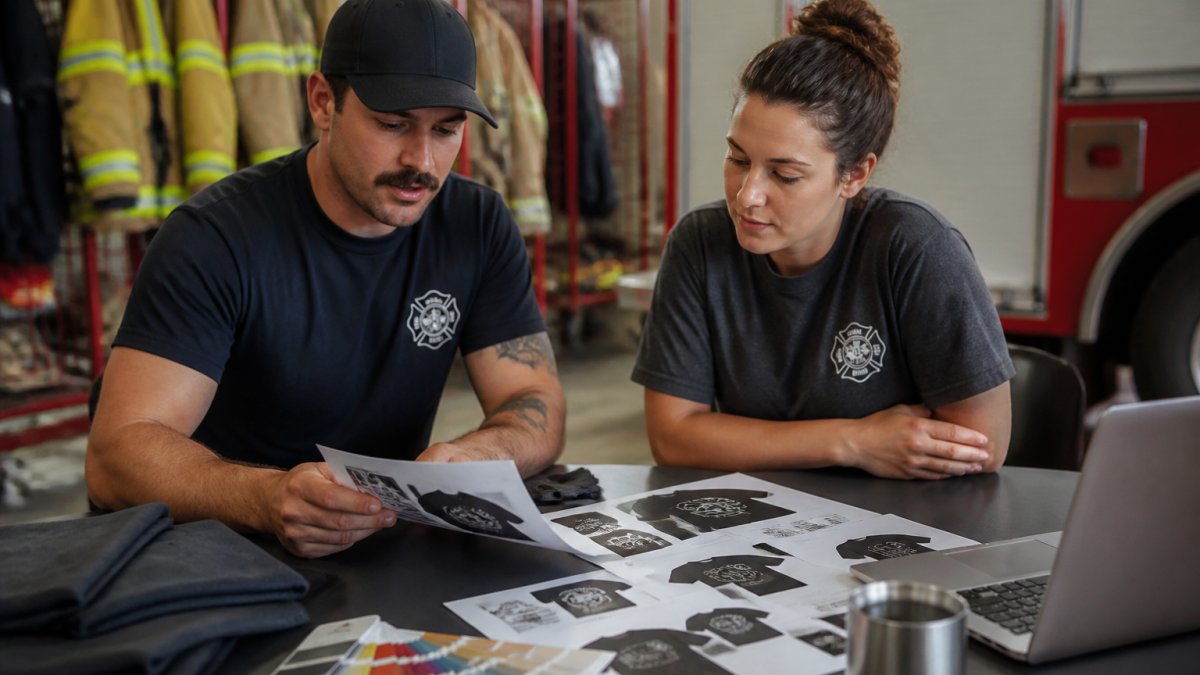
A common mistake is cramming too much onto the front. For a proven starting point, our Fire Rescue Thin Red Line Premium Tee shows how a seal, axes, and a thin line work together without noise.

Logo, Artwork, and Text Rules for Fire-Service Designs
Fire-service branding carries weight, so treat it with respect. Follow these rules before anything goes to print:
- Get written permission to use a department logo, seal, or patch
- Never alter official insignia in ways that misrepresent the department
- Confirm trademark rights on any charity or event name you print
A department seal is often protected, and using it without approval can force you to pull a whole print run. Get sign-off in writing and keep it on file.
Step 4: Pick Online Fundraising Platforms for Fire Departments
Online fundraising platforms for fire departments collect orders and handle payment; some also manage printing and shipping through print-on-demand, meaning no upfront inventory. The right pick depends on how much control you want over fulfillment and how much per-shirt margin you'll trade for convenience. Compare on these points:
| Feature | Why It Matters | What to Ask the Platform |
|---|---|---|
| Upfront cost | Print-on-demand avoids buying stock you can't sell | Is there a setup fee, a campaign fee, or a monthly charge? |
| Per-item fees | Fees eat into your net proceeds | What percentage plus flat fee comes out of each order? |
| Payment processing | Card fees stack on top of platform fees | Who holds the money, and when is it paid out? |
| Shipping options | Local pickup saves supporters money | Can you offer a pickup code or a flat local rate? |
| Campaign length | Longer windows give more people time to order | Is there a maximum campaign length or a hard close date? |
| Reporting tools | Clean sales reports make payout easy | Can you export orders by size, color, and buyer? |
| Refund and swap policy | Sizing swaps can sink a small campaign | Who eats the cost of a reprint or a return? |
Print-on-demand suits most departments: open a campaign, share a link, and shirts ship as orders come in, no boxes stacked in the apparatus bay. The trade-off is a higher per-shirt cost, so price accordingly and re-run your Step 1 break-even sheet with the platform's actual per-item fee.
If you'd rather sell in person, order in bulk and handle cash sales at events, it needs storage and a volunteer, but nets more per shirt.
Fee Math That Changes Your Break-Even
Platform fees are easy to ignore and hard to recover. Before launch, plug the real numbers into your break-even sheet:
- Per-item platform fee, a percentage plus a flat amount per order
- Payment processing, a percentage plus a flat amount per transaction
- Shipping charged to the buyer, if you absorb it, it comes out of proceeds
Run the math on one shirt before you run it on a thousand.
Payout Timing and Money Handling
Know when the money lands. Some platforms pay out on a rolling basis as orders ship; others hold funds until the campaign closes and a fulfillment window passes, a difference that matters for a department buying equipment on a timeline. Confirm the payout schedule in writing, and confirm who is authorized to receive funds, typically the department's treasurer or the auxiliary's designated account holder, not an individual firefighter's personal account.
Fire Rescue Thin Red Line Premium Tee →
Step 5: Promote the Campaign Through Social Media and Local Residents
Social media does the heavy lifting for most apparel campaigns, get your link in front of people who care about the department.
Push your campaign on these channels:
- Department Facebook and Instagram with a clear product photo
- Local community groups and neighborhood pages
- Station email lists and text alerts
Reach local residents beyond your followers: ask nearby businesses to post your link, put a QR code on a flyer at the station, and mention the campaign at every community event. Post more than once, share progress updates, a countdown near the deadline, and a thank-you when orders close.
Best Practices for Fire Department Apparel Sales
Best practices for fire department apparel sales come down to trust and follow-through. Supporters buy because they believe in the crew. Don't make them regret it.
Keep these habits:
- Show real photos of the actual shirt, not just a mockup
- Publish a clear size chart to cut down on swaps
- Offer inclusive sizing so every supporter can order
Offer a range of fits and sizes, a supporter who can't find their size won't buy at all. Include youth sizes if families are a big part of your audience. Our Firehouse Standard Premium Tee runs XS to 4XL, keeping more buyers in the funnel.

Order Fulfillment and Delivery Choices
Fulfillment is where good campaigns get tripped up. Pick your delivery model before launch:
- Print-on-demand shipping: each buyer gets their shirt at home, no volunteer labor
- Bulk order plus local pickup: lower per-shirt cost, but you need storage and a pickup day
- Event handoff: sell at a station open house and hand shirts out on the spot
Print-on-demand is easiest for a first campaign; bulk pickup nets more per shirt but demands a crew to sort and distribute.
Step 6: Launch, Track, and Report Your Proceeds
Launch day is not the finish line. Campaigns that hit their goal treat the live window as a working period: watch the numbers, adjust promotion, and close with a clean report. Most organizers skip this step, and it's the one that builds trust for the next campaign.
The Numbers to Watch While the Campaign Is Live
Track a small set of metrics daily, a shared spreadsheet updated once a day is enough.
- Units sold, total shirts ordered, broken out by size and color
- Average order value, total sales divided by number of orders; bundles and multi-shirt orders lift this
- Conversion rate, orders divided by link clicks; a low rate usually means the design or the price needs a second look
Watch the traffic source column closely. If one channel drives most orders, put more effort there and drop the rest. If conversion is low but clicks are high, the problem is usually the product page, a mockup instead of a real photo, a missing size chart, or a price that feels high for the cause.
A Week-by-Week Operating Rhythm
A simple cadence keeps the campaign from stalling:
- Week 1, Launch push. Announce on every channel, post the real shirt photo, and ask the crew to share. Goal: first orders in the door and social proof to show.
- Week 2, Mid-campaign update. Share a progress number ("we're a third of the way to our goal"), answer size questions publicly, and ask local businesses to reshare.
- Week 3, Urgency push. Post the countdown, remind supporters of the close date, and highlight the cause the proceeds support.
Post at least three times a week, supporters who meant to order need a reminder before the window shuts.
Closing the Campaign: Reconcile, Report, Document
When orders close, do three things.
- Reconcile the numbers. Total sales minus every cost, shirts, printing, shipping you absorbed, platform fees, payment processing, promotion, and refunds, equals net proceeds. Use the same break-even sheet from Step 1.
- Report to your crew and supporters. Share the real net total, not the gross. A short post with the final number, a crew photo, and a line about what the money buys does more than any ad. Ask to post the result on the department's page or newsletter too.
- Document what worked. Note the best-performing channel, the best-selling shirt, the sizes that ran out first, and any snags, late shipments, sizing swaps, an unexpected platform fee. That note becomes next year's starting brief.
A Simple Reporting Template
Keep the final report to one page. Include:
- Goal, what the fundraiser was for and the target amount
- Gross sales, total dollars collected
- Total costs, itemized by category
A one-page report is easy to share, defend, and repeat. When supporters see where the money went, they buy again, and the crew knows what to do differently next campaign.
Conclusion
Running a firefighter apparel fundraiser takes planning, but the payoff is real: money for your department and a community that feels part of the mission. The crews that succeed treat it like a job, budget, deadline, and a clear report at the end.
At Black Helmet, we've served over 100,000 firefighters and know what gear the brotherhood actually wants to wear. Our firefighter-owned, family-run shop builds premium shirts and hoodies designed by firefighters, for firefighters.
Frequently Asked Questions
How do you start a fundraiser for a fire department?
Start by setting a clear fundraising goal tied to a specific department need, such as new equipment or a community program. Build a simple budget that covers shirt cost, printing, and shipping, then choose a design and an online platform. Get approval from your chief or association before using any department logo. From there, set a two-to-three week campaign window, promote it through social media and local residents, and report proceeds back to supporters when the campaign closes.
What are the most profitable items for a firefighter apparel fundraiser?
T-shirts and hoodies usually carry the best margin because they appeal to both firefighters and community supporters. Race-day shirts and event-specific designs sell well around 5K runs, open houses, and charity events. Add higher-margin accessories like hats or drinkware as upsells. Keep your catalog small so you do not tie up cash in inventory that does not move, and price each item so the shirt sales cover production plus a clear donation per unit.
What are the legal considerations for fire department fundraising?
Confirm whether your department or its auxiliary is a registered 501(c)(3) and follow your state's charitable solicitation rules, which may require registration before you ask the public for donations. Get written permission before using any department logo, patch, or artwork. Follow sales tax rules for apparel sold in your state, and check that designs do not copy trademarked logos or artwork. Keep records of every sale and expense so you can report proceeds accurately.
How do you handle order fulfillment for a department fundraiser?
Choose print-on-demand or bulk production based on your timeline and volume. Print-on-demand avoids unsold inventory but takes longer per item, while bulk orders lower the per-shirt cost if you are confident about sizes and quantities. Set a firm order deadline, collect sizes upfront, and designate one person to receive and distribute orders at the station. Publish a pickup date and offer local delivery for community supporters who cannot come to the firehouse.
