

How to Choose Firefighter Challenge Coins: 2026 Guide
Table of Contents
- Start With the Coin's Purpose and Your Crew
- Fire Department Challenge Coin Ideas That Reflect Station Identity
- Firefighter Challenge Coin Design: Symbols, Shape, and Size
- Firefighter Challenge Coin Materials and Finishes Compared
- Raised, Recessed, 3D Detail, and Color Selection
- Custom Challenge Coin Ordering Tips: Costs, Quantity, and Vendors
- Conclusion
- Frequently Asked Questions
Last Updated: October 17, 2026
Start With the Coin's Purpose and Your Crew
A firefighter challenge coin is a small metal token carried as proof of membership in a crew, a station, or the fire service itself. Choosing the right one starts with a single question: who is this coin for?

Answer it first and every later decision gets easier; skip it and you end up with a generic coin that sits in a drawer.
Recognition, Commemoration, or Collecting
Most firefighter challenge coins fall into three buckets. Knowing which one you need sets your budget and design.
- Recognition: handed out on the spot for a job well done, or given to a crew after a hard call
- Commemoration: marks a graduation, a promotion, a retirement, or a fallen member
- Collecting: traded between stations, departments, and services at events and gatherings
A recognition coin needs to be affordable enough to give away. A retirement coin can carry more detail and cost. A collector's coin lives or dies on its artwork.
Who Carries It and How It Gets Used
Think about the pocket it lands in: a coin carried daily takes more wear than one displayed in a case.
- Rookie class: a coin for a whole class needs a modest per-unit cost and a design that works for everyone
- Station crew: a department challenge coin should show station identity, not one person's name
- Retiree: a coin that honors service and gets displayed, not pocketed
Fire Department Challenge Coin Ideas That Reflect Station Identity
Station identity separates a real fire department challenge coin from a souvenir. The best fire department challenge coin ideas pull from what the crew already knows: the seal, the motto, the station number, the date the house opened.
Department Seal, Motto, and Station Number
Start with what already exists on the rig and the patch, these elements give a coin instant meaning to anyone in the service.
- The department seal or badge, reproduced cleanly on the front
- The motto, kept short enough to read at coin size
- The station number and company name, such as Engine or Ladder
One warning: a seal with tiny text will not survive the minting process. Simplify it before you send artwork to a vendor.
Rookie Class and Retirement Coins
Two coins do most of the emotional work in a firehouse. The rookie class coin marks the start. The retirement coin marks the end.
For a rookie class, keep the design shared and the cost low. For a retirement coin, personalize it: name, years of service, badge number, and a line that honors the career.
Firefighter Challenge Coin Design: Symbols, Shape, and Size
Firefighter challenge coin design comes down to three choices: symbols, shape, and size. Get these right and the coin reads clearly from across a table.
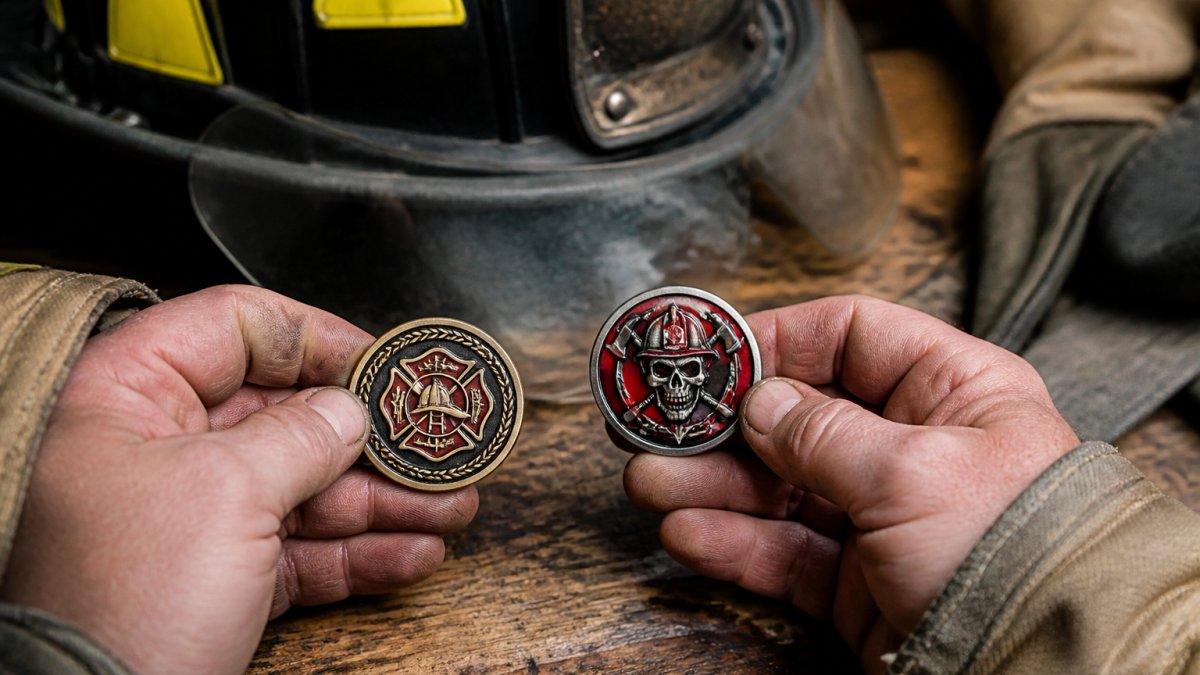
Fire-Service Symbols and Imagery
The fire service has a deep visual language, use it with restraint.
- Helmets and axes, the classic firefighter marks
- The Maltese cross, long tied to the fire service
- The thin red line, a symbol of the fallen and the sacrifice
Pick two or three. A coin crowded with symbols loses impact.

Coin Shape, Size, and Edge Options
Most challenge coins run about 1.75 inches across, fitting a palm and a pocket. Shape and edge are where you can stand out.
- Round: the standard, and the easiest to produce cleanly
- Custom shapes: cut to a helmet, a shield, or a badge
- Edges: smooth, reeded, or wavy for a distinct feel
U.S. Fire Administration resources on fire service tradition and history
Firefighter Challenge Coin Materials and Finishes Compared
Firefighter challenge coin materials and finishes decide how the coin looks on day one and how it holds up after years in a pocket. There is no single best option, only the right trade-off for how the coin will be used.

How the Base Metal and Plating Interact
Most custom challenge coins are struck or cast in a base metal, commonly brass or a zinc alloy, then plated. The plating is the visible surface and the layer that takes the wear, so two coins with the same base metal can age very differently.
- Antique finishes are deliberately darkened in the recesses and then relieved on the high points. They hide fingerprints and small scratches well, which is why they hold up on daily-carry coins.
- Bright finishes (polished brass, bright nickel, chrome) show every scuff and smudge. They look sharp in a display case but age faster in a pocket.
- Copper and bronze plating develops a patina over time. Some crews want that warm, aged look; others see it as tarnish and want it sealed.
A practical rule: match the finish to the job. A coin carried and traded should take a beating; one headed for a display case can carry more shine and detail.
Be Prepared For Anything Spartan Fight Fire Challenge Coin →
Enamel, Paint, and Color Durability
Color on a challenge coin is usually soft enamel, hard enamel (cloisonné-style), or a printed epoxy dome, they are not interchangeable.
- Soft enamel sits in the recessed areas below the metal lines. It is the most economical option and gives a textured, tactile feel, but the recessed color can collect dirt over time.
- Hard enamel is polished flush with the metal. It resists wear better and feels smooth, but it costs more and can soften very fine detail because the color is polished down.
- Printed epoxy allows photographic detail and gradients, but the dome can yellow or scratch with heavy use.
For a coin carried daily, hard enamel or a well-executed soft enamel with a protective finish is the safer bet. For a commemorative coin that lives in a case, printed detail may be worth the trade-off.
A Neutral Comparison Table
| Material / Finish | Look | Durability | Best For | Watch Out For |
|---|---|---|---|---|
| Antique nickel or antique brass | Muted, classic | High | Daily carry, trading | Less flash; darkening can look uneven if poorly done |
| Bright brass or polished nickel | Bright, bold | Medium | Display, retirement | Shows scratches and fingerprints |
| Copper plating | Warm, traditional | Medium | Recognition coins | Can tarnish; ask whether it is sealed |
| Hard enamel color | Vivid, smooth, readable | High | Logos, symbols on carried coins | Higher cost; fine detail softens |
| Soft enamel color | Textured, economical | Medium | Budget recognition runs | Recessed color can collect dirt |
| Printed epoxy dome | Photographic detail | Medium to low | Display pieces | Dome can yellow or scratch |
Maintenance and Realistic Expectations
The right call matches the coin's job: a recognition coin handed out in quantity can accept a more economical finish, while a retirement coin meant to last a career should get the more durable plating and enamel.
Raised, Recessed, 3D Detail, and Color Selection
Design detail is where a coin goes from flat to memorable. Raised versus recessed detail, plus how you use color, shapes how legible the coin stays at small size.
- Raised detail: the artwork stands up off the surface, catching light and feeling good in the hand
- Recessed detail: the artwork is cut into the coin, which protects it from wear
- 3D detail: sculpted depth for a helmet, a skull, or a seal that pops
For color, traditional red leads the fire service palette. Enamel color makes logos and symbols readable, but fine text can blur. Keep color to two or three shades and let the metal do the rest.
Custom Challenge Coin Ordering Tips: Costs, Quantity, and Vendors
Custom challenge coin ordering tips save more money than any design choice. Total cost is driven by four interacting variables, size, material and finish, design complexity, and order quantity, and understanding how they interact is the difference between a budget that holds and one that surprises you.
The Four Cost Drivers
- Size: A larger coin uses more metal and more mold area. Moving up from a standard size increases per-unit cost, and very large coins can also raise shipping weight.
- Material and finish: Plating type, enamel type, and special finishes (antique, two-tone, epoxy dome) each add cost. Hard enamel and multiple enamel colors cost more than a single-color soft enamel fill.
- Design complexity: Every additional enamel color, cutout, 3D sculpted element, or custom edge adds tooling and production time. A two-sided coin with different artwork on each face costs more than a single-face design.
A Simple Budget Worksheet
You do not need a vendor quote to sketch a budget, build it in four lines:
- Setup and tooling: one-time cost per design. Confirm exactly what it covers, die, mold, artwork prep, and any proof fees.
- Per-unit production: the quoted price at your quantity, multiplied by the number of coins.
- Add-ons: extra enamel colors, cutouts, custom packaging, individual poly bags, or display cases.
- Shipping and taxes: confirm whether shipping is included at your quantity and whether sales tax applies.
Then divide the total by the number of coins to get your true landed cost per coin. That number, not the quoted unit price, is what you compare across vendors.
Quantity Planning That Avoids Reorders
A common mistake is ordering exactly the headcount. Order a handful extra, coins get traded, lost, and requested by visiting crews.
- Plan around the crew, plus spares for trades, gifts, and visiting units.
- Ask about price breaks at higher quantities; the per-unit drop between tiers is often steepest at the first jump.
- Check whether a reorder uses the same die and at what cost. Keeping the die on file can make a future run cheaper.
Proofing, Production Timeline, and Quality Control
Proofing is the step that protects you. Approve the artwork and a physical proof before the full run.
Vendor Questions Worth Asking
If you want a fire-service coin without the custom order, our own Fight Fire Challenge Coin carries the four principles of Dedication, Tradition, Courage, and Sacrifice in translucent red enamel, and the Thin Red Line coin honors the challenge, the line, and the sacrifice.
Conclusion
Choosing the right firefighter challenge coins is a series of small, clear decisions: purpose first, then identity, design, material, and order. Get the purpose right and the rest follows. Black Helmet has served the fire service community since 2008, building coins that honor the brotherhood, tradition, and sacrifice behind the job. Start with our challenge coin collection and carry a piece of the tradition with pride.
Frequently Asked Questions
What details should a firefighter challenge coin include?
Most coins carry a department seal or badge, the station or company number, and a motto. Add the date for rookie class or retirement coins, and include fire-service symbols such as a helmet, axe, or Maltese cross. Keep the layout simple so the artwork stays legible at 1 3/4 inches, which is the size Black Helmet uses on its own firefighter challenge coins. A clear front-and-back split, with the seal on one side and the motto or principles on the other, reads well in hand and in a display case.
What materials and finishes are available for firefighter challenge coins?
Finishes range from polished to antique, and antique nickel or bronze hides scratches better on a coin that rides in a pocket. Raised and recessed detail both hold up well, while cutouts and 3D relief add cost.
How many firefighter challenge coins should a department order?
Order for everyone who will carry one plus a reserve. Count the crew, the rookie class, retirees being honored, and any coins set aside for trades with visiting companies.
How much do custom firefighter challenge coins cost?
Cost depends on quantity, size, plating, and how much detail or color you add. Setup and die charges apply once per design, and per-coin pricing falls as the order grows. Ready-made coins give you a fixed price: Black Helmet's Spartan Fight Fire coin is $12.00, and its Fight Fire, On These Principles We Stand, and Thin Red Line coins run $21.50 to $24.50. For a custom run, get quotes from at least two vendors and confirm whether setup, shipping, and proof revisions are included.
The right coin is the one your crew still carries years from now. Black Helmet builds firefighter challenge coins around the principles that matter: tradition, dedication, courage, and sacrifice. Browse our coins, including the Spartan Fight Fire coin and the Thin Red Line coin, and give your crew something worth carrying. Every order is backed by our satisfaction guarantee.
