

Why Firefighters Have Dalmatians: History & Tradition
Table of Contents
- Why Do Firefighters Have Dalmatians: The Origins
- History of Dalmatians With Firefighters
- Dalmatians and Horses in Fire Departments
- Dalmatian Breed Characteristics That Made Them Ideal
- Are Dalmatians Still Used by Firefighters Today?
- The Enduring Legacy of the Firehouse Dalmatian
- Conclusion
Last Updated: July 31, 2026
Why Do Firefighters Have Dalmatians: The Origins
Why do firefighters have dalmatians? At Black Helmet, we've explored this question because it represents one of the fire service's most enduring traditions. The answer traces back to the horse-drawn fire brigades of the 1700s and 1800s, when Dalmatians served a practical purpose that made them invaluable to firefighting operations. These spotted dogs weren't mascots, they were working members of the team, selected for specific traits that made them ideal partners in the dangerous, fast-paced world of firefighting.
The relationship between firefighters and Dalmatians runs deeper than nostalgia. Understanding this connection reveals how the fire service has always valued loyalty, speed, and the kind of steady presence that defines brotherhood. What started as a necessity in the horse-drawn era evolved into a tradition that continues today, even as the job itself has transformed completely. Below, we'll walk you through the historical reasons this bond formed, what made Dalmatians uniquely suited to the work, and why firehouses still embrace this legacy.
History of Dalmatians With Firefighters
From Fire Brigades to Modern Stations
The history of Dalmatians with firefighters begins with horses. In the 1700s and 1800s, fire brigades relied entirely on horse-drawn wagons to reach fires quickly. These wagons needed to move fast through crowded city streets, and horses naturally became anxious around the noise, commotion, and chaos of emergency scenes. Dalmatians proved to be the perfect solution, they had the natural ability to run alongside horses without spooking them, their spotted coats made them highly visible in smoke and darkness, and their even temperament kept them calm under pressure.
Fire departments discovered that Dalmatians bonded strongly with horses and the firefighters themselves. The dogs would trot beside the wagon as it raced through streets, their presence calming the team of horses while their speed kept pace with the action. In those early days, a Dalmatian wasn't a symbol, it was a functional member of the crew, as essential to the operation as the rope and ladder.
As fire departments modernized and switched from horse-drawn wagons to motorized engines in the early 1900s, the practical need for Dalmatians disappeared almost overnight. Trucks didn't spook like horses. They didn't need calming. Yet firehouses across the country kept Dalmatians anyway. The dogs had become woven into fire service culture, representing continuity, tradition, and the brotherhood that defines the job.
Today, Dalmatians remain in firehouses not because they're necessary, but because they're part of the identity. They represent the fire service's respect for history and the values that have guided the job for generations. Many departments maintain the tradition as a living connection to their roots. The dog isn't just a pet, it's a statement that the fire service remembers where it came from.
Dalmatians and Horses in Fire Departments
Speed, Stamina, and Station Life
The partnership between Dalmatians and horses in fire departments worked because of the dog's natural athleticism and temperament. Dalmatians were bred as carriage dogs in Europe, originally developed to run alongside coaches and wagons. They possessed the endurance to maintain pace over long distances, the agility to navigate crowded streets, and the calm demeanor needed around large animals and chaotic scenes.
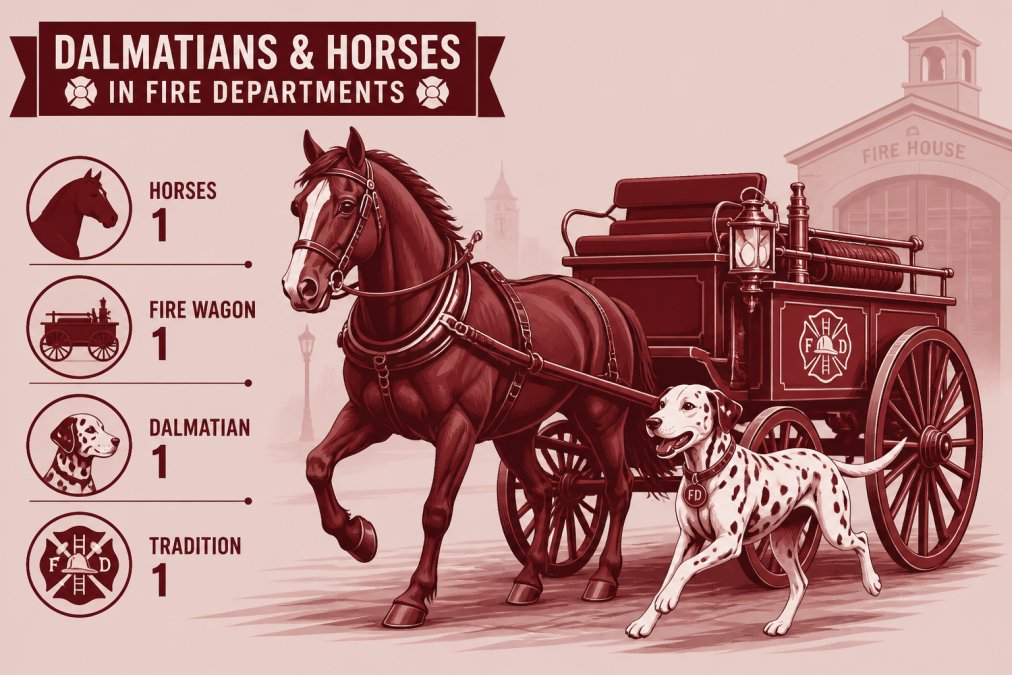
When a fire alarm sounded, the Dalmatian would run with the horses as they pulled the wagon toward the fire. The dog's presence served multiple purposes: it kept the horses steady, it warned pedestrians of the approaching wagon by drawing attention, and it protected the equipment from theft or interference. Dalmatians were territorial and protective, qualities that made them effective guardians of the firehouse and its apparatus.
Station life suited Dalmatians well. These dogs thrive in group environments and form strong bonds with their human pack. A firehouse operates like a family, firefighters live together, eat together, and depend on each other in life-or-death situations. Dalmatians adapted naturally to this structure, becoming part of the station crew. Their energy and loyalty made them ideal companions for the demanding lifestyle of firefighting.
The speed and stamina of the Dalmatian breed made them capable of keeping pace with horses running at full gallop. Unlike smaller dogs that would struggle to maintain the pace, or larger breeds that might be too heavy or stubborn, Dalmatians had the right combination of size, strength, and endurance. They could run for miles without tiring, making them reliable partners during the long journeys to fires across sprawling cities.
Dalmatian Breed Characteristics That Made Them Ideal
Temperament, Athleticism, and Loyalty
Dalmatians possess specific breed characteristics that made them perfectly suited to fire service work. Their temperament is naturally even-keeled and confident, they don't startle easily, a critical trait when working around loud noises, flashing lights, and the controlled chaos of a firehouse. This calm demeanor extends to their interactions with other animals, particularly horses, which was essential in the horse-drawn era.
Athletically, Dalmatians are built for endurance rather than short bursts of speed. Their lean, muscular frame and deep chest give them exceptional cardiovascular capacity. A Dalmatian can maintain a steady pace for extended periods, making them ideal for the long runs required when following fire wagons through city streets. Their legs are proportioned for distance running, not sprinting, which meant they could keep up with horses without excessive strain.
The loyalty of a Dalmatian is legendary in the dog world. These dogs form intense bonds with their human families and will work tirelessly to stay close to them. In a firehouse environment, this loyalty translates into a dog that stays with the crew, responds reliably to commands, and views the entire station as its pack. This trait made Dalmatians valuable not just for their physical abilities, but for their psychological stability and predictability.
Dalmatians are also highly intelligent and trainable. They respond well to structure and clear expectations, qualities that align with the disciplined environment of a fire department. A firehouse dog needs to understand its role, respond to commands instantly, and behave predictably around equipment and people. Dalmatians excel at these requirements, making them easier to manage than many other breeds.
The spotted coat of a Dalmatian serves a practical purpose beyond aesthetics. In the smoke-filled, dark environments of fires, the contrast of white fur with black spots made the dog visible to firefighters and other personnel. This visibility could be the difference between accidentally stepping on the dog in a dangerous situation or spotting it clearly and adjusting course. The coat was functional, a form of safety equipment that helped keep the dog alive during operations.
Are Dalmatians Still Used by Firefighters Today?
From Working Dogs to Beloved Mascots
Modern firehouses continue the tradition of keeping Dalmatians, though their role has shifted from working partner to beloved station mascot. Today's Dalmatians don't run alongside fire trucks or calm horses, they live in the firehouse, sleep with the crew, and represent the fire service's commitment to honoring its history and traditions.
The transition from working dog to mascot happened gradually as fire departments modernized. By the 1950s, most departments had fully transitioned to motorized equipment. The practical need for Dalmatians evaporated, but the emotional and cultural significance remained strong. Firehouses realized that keeping a Dalmatian wasn't about function, it was about identity and continuity. The dog became a symbol of the fire service's values: loyalty, courage, and an unbreakable commitment to the mission.
Today, not every firehouse has a Dalmatian, but many do. Some departments maintain the tradition as a formal part of their station culture, complete with specific protocols for the dog's care and training. Others keep Dalmatians more informally, treating them as part-time residents or frequent visitors. The presence of a Dalmatian in a firehouse is never accidental, it's a deliberate choice to honor tradition and maintain a visible connection to the fire service's past.
Research from the fire service community shows that station dogs, particularly Dalmatians, serve an important psychological function for firefighters. The presence of a calm, loyal animal provides stress relief during downtime and creates a sense of normalcy and home within the firehouse. This emotional support role has become increasingly recognized as valuable for mental health and crew cohesion, even though it wasn't the original purpose of the partnership.
Some departments have formalized the role of station dogs through training programs and guidelines. These dogs are taught to respond to fire alarms, to stay clear of apparatus during emergency responses, and to provide a grounding presence during the intense moments of station life. While they're not actively fighting fires or running alongside trucks, they remain active participants in the firehouse community.
The Enduring Legacy of the Firehouse Dalmatian
The firehouse Dalmatian endures because it represents something deeper than a dog, it's a physical embodiment of fire service values. Every spotted coat visible in a firehouse is a reminder that the fire service respects its history, maintains traditions, and values loyalty above all else. The dog serves as a conversation starter, a way for younger firefighters to learn about the origins of their profession, and a symbol that connects them to generations of firefighters who came before.
The tradition also reflects the fire service's understanding that culture matters. In an occupation defined by danger and sacrifice, the rituals and symbols that bind crews together are as important as the equipment they use. A firehouse Dalmatian is part of that cultural glue, a living reminder that firefighters are part of something larger than themselves, a brotherhood with roots stretching back centuries.
Modern firehouses that maintain Dalmatians often find that the dogs become ambassadors for the fire service. They appear in community events, in photographs that represent the department, and in the memories of children who visit the station. The Dalmatian has become so iconic in fire service imagery that many people instantly associate the breed with firefighting, even if they don't know the historical reasons for that connection.
The choice to keep a Dalmatian in a firehouse today is ultimately a choice about values. It says that this department cares about tradition, that it honors the past while serving the present, and that loyalty, both human and canine, remains central to who firefighters are. In a profession that has changed dramatically over the past century, the Dalmatian represents continuity and the enduring principles that define the fire service.
The history of why firefighters have Dalmatians reveals a profession that deeply values its traditions and the bonds that hold crews together. Whether you're a firefighter, a family member of someone in the service, or simply someone who respects the fire service, understanding this connection adds meaning to the iconic image of a spotted dog in a firehouse. At Black Helmet, we celebrate the stories and symbols that define firefighter culture. Our Firehouse Standard Onesie and Firehouse Standard Youth Tee honor these traditions with designs that respect the heritage and brotherhood of the fire service. Wear gear that represents your commitment to the legacy, because the fire service is built on more than equipment; it's built on pride, loyalty, and the stories we carry forward.


Frequently Asked Questions
What was the original role of Dalmatians in fire departments?
Dalmatians were originally working dogs in fire departments during the horse-drawn era. They ran alongside fire wagons to clear paths through crowded streets, guard equipment at fire scenes, and provide protection against theft. Their speed, stamina, and natural affinity for horses made them invaluable to firefighting operations. As motorized vehicles replaced horse-drawn wagons, Dalmatians transitioned from active workers to cherished station mascots and symbols of firefighting tradition.
Why were Dalmatians good with horses in fire departments?
Dalmatians possess natural athleticism and high energy levels that allow them to keep pace with horses at a gallop. Their breed characteristics include speed, endurance, and an instinctive ability to work alongside other animals without aggression. Historically, Dalmatians were bred for hunting and carriage work, making them naturally suited to firehouse environments. Their calm temperament and loyalty meant they could work closely with horses without startling them, which was critical during emergency responses when speed and coordination were essential.
Do fire stations still have Dalmatians today?
Yes, many fire departments across the United States still maintain Dalmatians as station mascots and symbols of firefighting heritage. However, their role has evolved significantly. Modern Dalmatians serve primarily as beloved firehouse companions and community ambassadors rather than working dogs. They participate in public outreach events, parades, and station activities, helping to strengthen the connection between fire departments and their communities. The tradition persists as a way to honor firefighting history and maintain the brotherhood and identity of the fire service.
What dalmatian breed characteristics made them suitable for firehouse work?
Dalmatians possess several breed traits that made them ideal for fire departments: exceptional speed and endurance for running alongside horses and fire wagons; a loyal, protective temperament that made them effective guards; high intelligence and trainability for responding to commands in chaotic situations; a calm demeanor around loud noises and commotion; and a strong pack instinct that aligned well with firehouse brotherhood culture. Their distinctive spotted coat also made them highly visible in crowded urban environments, helping to clear paths and warn people of approaching fire equipment.
This article was written using GrandRanker
