

Firefighter Crossed Axes Symbol: History & Meaning
Last Updated: October 23, 2026
Quick Summary
The history of the firefighter crossed axes symbol begins with the tool itself, not a formal heraldic grant. Firefighters carried axes because they needed them, and the crossed axes emblem grew out of that working reality, spreading through practical copying and stock badge designs rather than a single founding date.
- Organized fire companies in the 1700s and 1800s listed axes alongside leather buckets, hooks, and ladders as standard apparatus.
- Crossed axes usually appear as a secondary element behind a helmet, beneath a company number, or flanking a shield.
- The crossed axes emblem has no founding moment, no charter, and no single designer.
- The Maltese Cross is an eight-pointed cross, while crossed axes are a pair of tools.
- Two axes is the most common arrangement, though single-axe emblems appear on helmet fronts and company badges.
Table of Contents
- The Origins of Crossed Axes in Fire Service History
- Firefighter Crossed Axes Meaning: Protection and Readiness
- Why Do Firefighters Carry Axes? The Tool Behind the Symbol
- Fire Department Patch Symbols: Where Crossed Axes Appear Today
- Crossed Axes vs. the Maltese Cross: A Side-by-Side Comparison
- Regional Variations and Modern Use of the Crossed Axes Emblem
- Frequently Asked Questions
The Origins of Crossed Axes in Fire Service History
The history of the firefighter crossed axes symbol begins with the tool itself, not a formal heraldic grant. Firefighters carried axes because they needed them, and the emblem grew out of that working reality.
The crossed axes emblem is not the same thing as the Maltese Cross, and it never was. Historians treat them as separate symbols with separate stories, even though both appear on the same patches today.
What the record actually shows
Most of what circulates online about crossed axes is caption text on stock art, not history. The documented trail runs through four kinds of evidence:
- Working tool inventories. Organized fire companies in the 1700s and 1800s listed axes alongside leather buckets, hooks, and ladders as standard apparatus. The axe appears in company equipment rolls before it appears in any emblem.
- Helmet and badge design. Early American fire-service helmet fronts and company badges combined a shield shape with tools of the trade. Axes, ladders, and speaking trumpets were common motifs because they identified what a company did.
- Department histories and anniversary publications. Many departments published centennial or anniversary booklets in the late 1800s and 1900s that reproduced their early badges and apparatus. These booklets are often the best dated source for when a specific company adopted a crossed-axes motif.
Crossed axes usually show up as a secondary element, behind a helmet, beneath a company number, or flanking a shield, added to identify the work, not to serve as the central emblem.
Why there is no single founding date
Unlike the Maltese Cross, crossed axes have no founding moment, no charter, and no single designer. The motif spread the way working symbols usually spread: departments copied neighbors, manufacturers offered stock badge and helmet-front designs, and the two-axes-crossed arrangement became familiar shorthand.
Claims that crossed axes descend from a medieval guild, a fraternal order, or a European heraldic tradition are repeated widely but rarely supported by a dated document.
How to date a crossed-axes emblem yourself
To place a patch, helmet front, or piece of apparatus lettering in time, work through these checks in order:
- Look at the tool style. The shape of the axe head, the length of the handle, and the presence of a pick or adze on the back of the head all changed over time. A badge showing a specific head pattern can often be bracketed to the era when that pattern was common.
- Check the surrounding elements. A crossed-axes motif paired with a leather helmet suggests an earlier date than the same motif paired with a modern composite helmet. Company numbers, mottoes, and lettering styles are also dateable.
- Find the department's own records. Anniversary booklets, muster photographs, and station dedication programs are the most reliable dated sources. Many are digitized in local historical society collections and public library archives.
- Compare against manufacturer catalogs. Badge and helmet-front makers published catalogs showing stock designs. A design that appears in a catalog can be dated to at least the catalog year.
That process will not produce a single national timeline, because there isn't one. It will produce a defensible local timeline, which is what a department needs when restoring old gear or writing its own history.
The honest bottom line on origins
The crossed axes symbol is best understood as an organic working emblem. It came from the tool, spread through practical copying and stock design, and its documentation lives in department records rather than a single authoritative source, a less tidy story than the Maltese Cross legend, but the one the evidence supports.
Firefighter Crossed Axes Meaning: Protection and Readiness
What do crossed axes mean on a firefighter badge? The firefighter crossed axes meaning centers on readiness and the ability to force entry, with protection close behind.
Practically, it says the wearer is equipped to break through what stands between them and someone inside.
Many departments treat crossed axes as a badge of honor for the same reason they treat the helmet and coiled rope that way.
Why Do Firefighters Carry Axes? The Tool Behind the Symbol
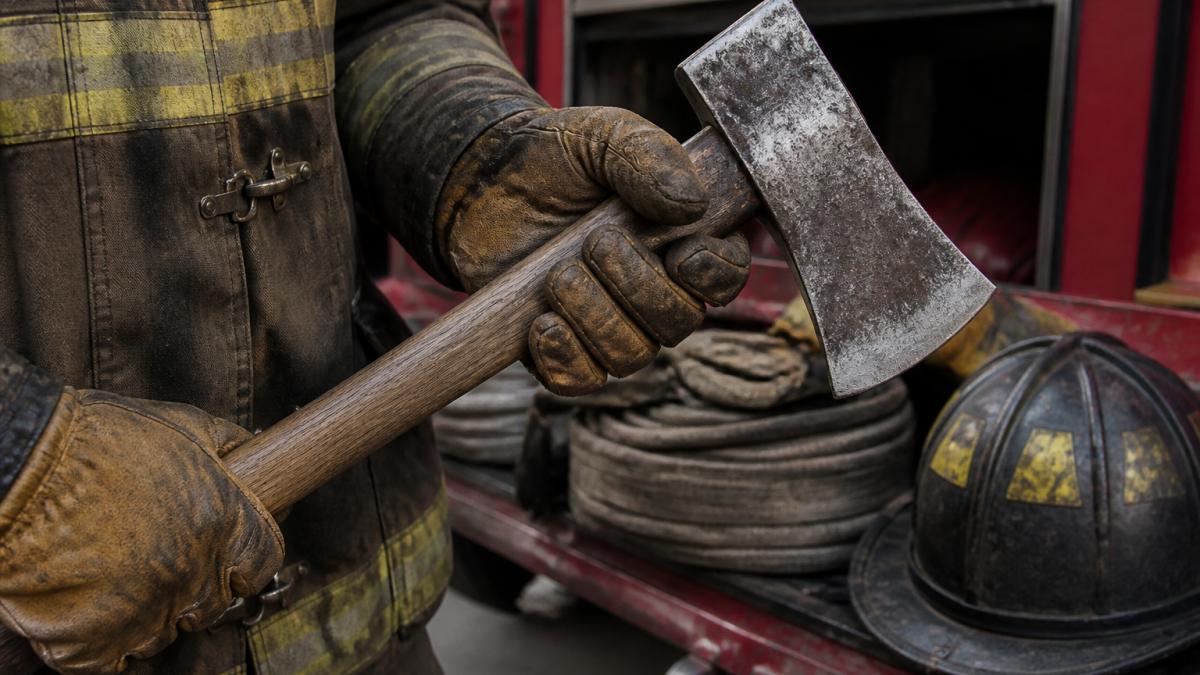
Firefighters carry axes because doors, roofs, and walls do not open themselves.
(https://www.firerescue1.com/history/articles/the-maltese-vs-florian-cross-which-one-is-correct-Xr7pnTxy1nwnHe0M/) makes the point that even the crosses get conflated with each other, so it is no wonder the axes get mixed in too.Both show up on the same badge because departments build emblems by layering, a shield, a cross, a helmet, a pair of axes, a coiled rope, a number. Readers who want the fuller story of the symbols alongside crossed axes, including the Thin Red Line meaning, will find it worth the detour.
Fire Department Patch Symbols: Where Crossed Axes Appear Today
Fire department patch symbols are where most people first meet crossed axes: a modern patch often shows two axes crossed behind a helmet, a shield, or a Maltese Cross, with a company number or motto worked in.
Black 3D Puff Maltese Flexfit Hat →
The same motif repeats on:
- Helmet fronts and shield decals
- Station signs and apparatus lettering
- Challenge coins and retirement pieces
If you are browsing Maltese Cross apparel and decals that carry these fire-service symbols, you will see how departments and wearers combine the cross, the axes, and the helmet into one identity. Anyone designing a department logo for shirts will find practical guidance in these fire department logo design tips, especially on keeping the crossed axes legible at small sizes.
Crossed Axes vs. the Maltese Cross: A Side-by-Side Comparison
The two emblems serve different jobs on a badge. The quickest way to keep them straight is to compare them directly.
| Feature | Crossed Axes | Maltese Cross |
|---|---|---|
| What it depicts | Two firefighter axes crossed | An eight-pointed cross |
| Origin | Working tool of the fire service | Fire-service tradition and fraternal heritage |
| Core meaning | Readiness, forcible entry, protection | Courage, honor, sacrifice |
| Typical placement | Behind a helmet or shield, on patches and decals | As the main badge shape or centerpiece |
| Common mix-up | Called "the firefighter cross" | Confused with the Florian cross |
The axes are about capability. The cross is about character. Good badge design uses both, and the strongest emblems make each element readable on its own.
BlazeStack's overview of firefighter symbols treats crossed axes as a separate emblem from the crosses, which matches what we see in the field.
Regional Variations and Modern Use of the Crossed Axes Emblem
Crossed axes do not look the same everywhere. Departments vary the number of axes, the angle of the cross, the head style, and whether the axes sit behind a helmet, a shield, or a cross. Some use a single axe; others pair the axes with a coiled rope or ladder. International departments adapt the motif to their own equipment and heraldry, so patches from different regions can look quite different while carrying the same idea.
What actually varies from department to department
When you compare crossed-axes emblems side by side, the variation clusters in a few predictable places:
- Number of axes. Two is the most common arrangement, but single-axe emblems appear on helmet fronts and company-specific badges, and a few designs use three axes fanned rather than crossed.
- Angle and overlap. Some designs cross the axes at a shallow angle so the heads sit wide; others cross them steeply so the handles form a narrow X. The overlap point can be centered or offset.
- Head style. Pick-head, flat-head, and adze-head axes all appear. The head style often tracks the era the design was drawn from rather than the department's current equipment.
A useful rule of thumb: the more elements an emblem carries, the later it tends to be. Early badges were simple because they were stamped or engraved by hand; later manufacturing allowed more detail.
Regional patterns worth knowing
Regional variation in the United States is real but not systematic. No national standard dictates how crossed axes must appear, so patterns emerge from department tradition, local manufacturer preference, and adoption era. A few broad observations hold up:
- Older eastern departments more often preserve helmet-front and shield-based designs with axes as a secondary element, reflecting earlier adoption of the motif.
- Departments that adopted emblems later more often use crossed axes as a prominent central element on patches, because patch design as a medium matured later.
- Company-level identity often drives variation more than geography does. A ladder company and an engine company in the same city may use different tool motifs even when they share a department patch.
Variation is practical and local, not doctrinal: there is no single official crossed-axes design, and a department using a single axe is not doing it wrong.
Modern use: from the truck to the t-shirt
Modern use has stretched the emblem well beyond the badge, onto apparel, drinkware, and commemorative pieces, and it has become part of how firefighters express identity off duty. When a symbol moves from the truck to the t-shirt, the people wearing it deserve to know what it stands for.
A few conventions are worth respecting when the emblem is used outside the job:
- Memorial use. Crossed axes on memorial pieces usually sit with a helmet, a bell, or a flag element. Combining them carelessly with unrelated symbols can read as disrespectful to the families the piece is meant to honor.
- Department identity. Using a specific department's patch design on unofficial merchandise can create confusion about whether the item is sanctioned. Generic crossed-axes designs avoid that problem.
- Rank and role. Some departments reserve certain emblem combinations for specific ranks or roles. A generic crossed-axes design is safer than a combination that mimics a rank insignia.
Readers who follow fire-service tradition will appreciate the deeper story behind the fire department bell ceremony and its meaning, another custom that carries the same weight of honor and remembrance.
Frequently Asked Questions
What do crossed axes symbolize in the fire service?
Crossed axes symbolize readiness, protection, and the physical labor at the core of firefighting. They represent the axe as a primary forcible-entry and ventilation tool, and the crossed arrangement suggests strength and unity. Unlike the Maltese cross, which carries a specific heraldic history, crossed axes are a more direct reference to the tools firefighters actually carry and use on the fireground.
Are crossed axes an official firefighter symbol?
Crossed axes are not an official national symbol like the Maltese cross in many departments, but they are widely used in fire department patches, badges, and logos. There is no single governing body that standardized the crossed axes emblem, so its use varies by department and region. It functions as a recognizable fire-service emblem rather than a formal insignia with a fixed definition.
When did firefighters start using crossed axes as a symbol?
The exact date is not documented in available sources. Crossed axes appear in fire-service imagery as a natural extension of the axe's long history as a firefighting tool, but the symbol's adoption was gradual and regional. There is no primary-source evidence establishing a single origin or standardized meaning for the crossed axes emblem.
What is the difference between crossed axes and the Maltese cross?
The Maltese cross is a distinct fire-service symbol with a specific heraldic history, often associated with protection and sacrifice. Crossed axes are a separate emblem built around the firefighter's axe and do not share the Maltese cross's origin. The two are sometimes used together in fire department patch symbols, but they should not be conflated as the same symbol.

