

Firefighter Apparel Fit and Sizing: A Comparison
Table of Contents
- Why Firefighter Apparel Fit and Sizing Matters
- How to Measure for Firefighter Shirts and Hoodies
- Firefighter Duty Wear Fit Standards and NFPA Compliance
- Comparing Black Helmet Sizing
- Best Firefighter Clothing Brands: What Sets Them Apart
- Common Fit Mistakes and How to Avoid Them
- Frequently Asked Questions
Last Updated: October 3, 2026
Why Firefighter Apparel Fit and Sizing Matters
Getting the fit right on firefighter apparel isn't just about comfort, it directly affects your safety, mobility, and ability to perform under pressure. Ill-fitting gear creates dangerous gaps in thermal protection, restricts your range of motion, and can catch on equipment or obstacles during critical operations.
At Black Helmet, we understand that firefighters need apparel that performs as hard as they do. Whether you're selecting turnout gear for your station, choosing a duty hoodie for daily wear, or finding the right fit for layering under your protective ensemble, the measurements matter.
The challenge most firefighters face is that firefighter apparel fit sizing standards vary significantly across brands. There's no single universal fit, what's a large in one brand might be an extra-large in another.
How to Measure for Firefighter Shirts and Hoodies
The only reliable way to find your correct size is to measure yourself accurately. Generic size charts help, but your actual measurements are the baseline. Start by wearing the kind of layers you'll typically wear under your apparel, usually a moisture-wicking base layer or your station t-shirt.

Key Measurements: Chest, Length, and Sleeve
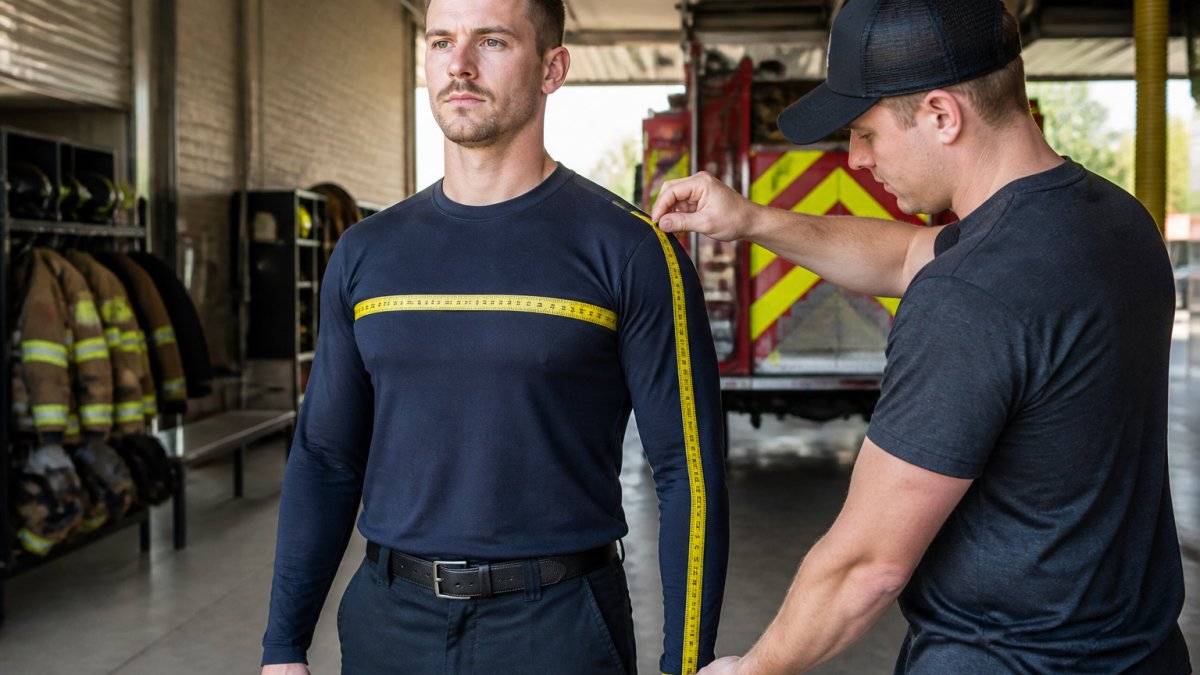
Chest width is your primary measurement. Measure around the fullest part of your chest, keeping the tape snug but not tight. This determines whether the garment will restrict your movement or create uncomfortable bunching.
Length runs from the base of your neck down to where you want the hem to sit.
Sleeve length matters more than many firefighters realize. Your sleeves should end at your wrist bone when your arms hang naturally at your sides. Too short and you'll have gaps between your sleeves and gloves.
Accounting for Layering and Gear Weight Distribution
Firefighter apparel exists within a system. You're not wearing a hoodie alone, you're layering it over base layers and potentially under heavier protective gear. This changes how fit works. A shirt that fits perfectly over bare skin might feel restrictive once you add thermal layers underneath.
When measuring, wear the layers you'll actually use. If you layer a moisture-wicking base layer under your apparel, measure with that base layer on. This gives you an accurate sense of how the finished ensemble will feel.
Gear weight distribution also affects how apparel should fit. Heavier pieces need slightly more room through the shoulders and chest to accommodate the weight without pulling or sagging. Lighter duty hoodies can fit closer to your body. Consider the total weight of your protective ensemble when selecting your size.
Firefighter Duty Wear Fit Standards and NFPA Compliance
Proper fit isn't arbitrary, it's tied to safety standards and operational requirements. The NFPA (National Fire Protection Association) establishes standards for protective apparel, and fit plays a critical role in whether gear actually meets those standards.
NFPA Standards and Protective Ensemble Requirements
NFPA 1971 and related standards specify requirements for turnout gear and protective clothing. These standards address thermal protection, moisture barriers, and structural integrity. But a standard-compliant garment only protects you if it fits correctly. A thermal liner that doesn't stay in contact with your skin due to poor fit loses much of its protective value. An outer shell that's too loose allows heat and moisture to escape unevenly.
Compliance means the gear was manufactured to standard. Proper fit means the gear actually protects you in the field. These are related but distinct requirements. A size that meets NFPA specifications for that size range might not be the right size for your body. This is why custom tailoring and brand-specific fit guidance matter, they bridge the gap between compliance and actual protection.
Range of Motion and Mobility Testing
Your protective ensemble must allow you to perform your job. That means adequate range of motion in your shoulders, arms, and torso. When evaluating fit, move through the motions you perform on duty: reaching overhead, bending at the waist, rotating your torso, climbing.
If your apparel restricts any of these movements, it's the wrong size. Firefighting demands mobility. A shirt that's technically the right size but limits your shoulder rotation becomes dangerous when you need to raise a ladder or operate equipment.
Many firefighters don't realize that proper fit actually improves mobility. A garment that's too large creates excess fabric that bunches when you move, limiting your range of motion just as much as something too tight. The goal is a fit that moves with your body, not against it.
Comparing Black Helmet Sizing
Black Helmet creates apparel designed for firefighters who demand authenticity and durability. Their sizing reflects real firefighter bodies and the layering systems you actually use.
Tailboard Rider Hoodie Fit Guide
The Tailboard Rider Hoodie ($56.50) is built for the firefighter who values heritage and durability. Here's the critical detail: this hoodie runs small. Black Helmet explicitly recommends ordering one size larger than your usual size. This isn't a manufacturing inconsistency, it's a documented characteristic that reflects the hoodie's construction and intended fit.
The Tailboard Rider uses a comfortable cut that works well over layering. The front pouch pocket and matching flat drawstrings are designed for functionality, not just aesthetics.
Black Helmet provides a detailed size guide for the Tailboard Rider:
| Size | Chest Width (inches) | Length (inches) |
|---|---|---|
| S | 20 | 27 |
| M | 21 | 28 |
| L | 23 | 29 |
| XL | 25 | 30 |
| 2XL | 26.5 | 31 |
| 3XL | 28 | 32 |
If you typically wear a large, order an extra-large in the Tailboard Rider. If you're between sizes, the generous sizing accommodates layering without excessive bulk.
Flexfit Hat Sizing and Comfort Features
Black Helmet's Flexfit hats, available in styles like the Red Skull Logo ($34.50), Black Skull Logo ($34.50), Black 3D Puff Maltese ($34.50), and 9/11 Twin Towers ($34.50), use a stretch band design that eliminates traditional sizing problems. These hats come in two sizes: S/M (21¼-22¾ inches head circumference) and L/XL (22⅜-23⅞ inches head circumference).

The stretch band construction means you don't have to guess your exact hat size. The band accommodates a range of head sizes, so the fit stays comfortable whether you're at the smaller or larger end of the range.
The 63% polyester, 34% cotton, 3% spandex twill construction provides durability and breathability. The structured 6-panel design maintains its shape, and the embroidered eyelets add ventilation. These aren't novelty hats, they're designed for actual wear.
Best Firefighter Clothing Brands: What Sets Them Apart
Not all firefighter apparel is created equal. The best brands understand firefighter culture, prioritize durability, and get the fit right from the start.
Black Helmet stands out because it's built by firefighters for firefighters. Founded in 2008, their apparel isn't generic, it's designed around the brotherhood, tradition, and authentic pride of the fire service. When you wear Black Helmet, you're wearing gear that respects the job and the people who do it.
Quality, Durability, and Shrinkage Considerations
Durability determines whether your apparel lasts through a season or falls apart after a few washes. Quality starts with materials. Black Helmet uses construction methods designed to withstand repeated wear and washing. Their products are made on demand.
Post-wash shrinkage is a real concern that many firefighters discover too late. Cotton-heavy blends can shrink 5-8% in the wash, turning a properly fitting shirt into something uncomfortably small. Black Helmet accounts for this in their sizing and material selection.
Washing instructions matter. Most firefighter apparel should be washed in cold water and dried on low heat to minimize shrinkage. Hot water and high heat accelerate both shrinkage and material degradation. Read the care label, it's not just a suggestion.
Gender-Specific Sizing and Anthropometric Fit
Firefighting isn't exclusively male, and apparel should reflect that reality. Gender-specific sizing accounts for differences in shoulder width, torso length, and chest shape. A woman's medium isn't simply a scaled-down man's medium, the proportions are different.
Black Helmet's sizing accounts for anthropometric variation. Their size ranges accommodate diverse body types, and their fit guidance helps you find your true size regardless of how other brands size.
When shopping for apparel, look for brands that offer multiple size ranges and acknowledge that firefighters have different body compositions. This is a sign the brand understands its audience.
Common Fit Mistakes and How to Avoid Them
Most firefighters make the same sizing mistakes. Knowing what to avoid saves you time and money.
Post-Wash Shrinkage and Material Degradation
The biggest mistake is not accounting for shrinkage. You order a hoodie that fits perfectly, wash it once, and suddenly it's uncomfortably tight. This happens because many firefighters don't factor shrinkage into their sizing decision.
Cotton blends shrink. This is unavoidable. The question is whether you've accounted for it. If you measure yourself and order based on that measurement alone, you're setting yourself up for disappointment.
Material degradation also happens over time. Repeated washing breaks down fibers. Heat exposure during drying accelerates this. The care label on your apparel isn't a suggestion, it's a guide to preserving durability. Wash in cold water, dry on low heat, and your gear lasts significantly longer.
Layering System Compatibility and Thermal Protection
Another common mistake is not considering your full layering system when sizing. You measure yourself in street clothes, order based on that measurement, then discover the apparel is too tight once you add your thermal layers underneath.
The solution is simple: measure wearing the layers you'll actually use. If you layer a moisture-wicking base layer under your duty hoodie, measure with that base layer on.
Thermal protection depends on proper contact between layers. If your apparel is too loose, air gaps form and thermal efficiency drops. If it's too tight, you restrict circulation and create discomfort. The right fit maintains contact without restriction.
Finding the right fit in firefighter apparel means measuring accurately, understanding your brand's specific sizing, and accounting for layering and shrinkage. Start with precise measurements, follow the brand's fit guidance, and you'll get apparel that performs as hard as you do.
Frequently Asked Questions
How do I measure myself correctly for firefighter apparel?
Measure chest width across the fullest part of your chest while wearing a t-shirt, keeping the tape parallel to the ground. For length, measure from the base of your neck down to your desired hemline. Take sleeve measurements from the center back neck across the shoulder and down to your wrist. Wear the undergarments you'll typically layer under your firefighter apparel to ensure accurate sizing that accounts for your protective ensemble.
Why is consistent sizing important for firefighter duty and off-duty wear?
Inconsistent sizing compromises both safety and comfort. Ill-fitting turnout gear or duty wear can restrict your range of motion during emergency operations, reduce thermal protection effectiveness, and create pressure points that cause fatigue. Proper fit ensures your protective ensemble functions as designed, maintains gear weight distribution across your body, and allows you to move freely during dynamic operations and rescue activities.
Does firefighter apparel sizing differ from standard retail sizing?
Yes. Firefighter apparel brands often run smaller or larger than standard retail sizes to accommodate layering systems and the bulk of protective gear. For example, the Tailboard Rider Hoodie runs small, so ordering one size larger is recommended for proper fit. Always check the brand's specific size guide and account for the thermal liner, moisture barrier, and outer shell layers you'll wear underneath.
What should I look for when choosing the right fit for firefighter hoodies and shirts?
Prioritize chest width and length that allow full range of motion without excess fabric bunching. The garment should fit comfortably over your base layers without restricting arm movement or creating gaps at the waist. Consider articulated joints and seam placement to ensure they don't dig into your shoulders or underarms during overhead movements. Test dynamic fit by simulating reaching, bending, and climbing motions before finalizing your purchase.
