

Fire Hydrant Colors Explained: What Each Color Means
Table of Contents
- Why Are Fire Hydrants Painted Colors
- NFPA 291 Fire Hydrant Color Code Standards
- Fire Hydrant Bonnet Color Meaning and Flow Capacity
- Fire Hydrant Flow Rate Testing and GPM Ratings
- Public vs. Private Water Systems and Hydrant Colors
- Historical Evolution of Fire Hydrant Color Standards
- International Color Coding Variations and Firefighter Safety
- Hydrant Maintenance and Visual Identification for First Responders
Fire Hydrant Colors Explained: What Each Color Means
Last Updated: August 4, 2026
Why Are Fire Hydrants Painted Colors
Color-coding fire hydrants is a standardized communication system that allows firefighters to instantly assess water availability, flow capacity, and operational status. When seconds matter in an emergency, visual identification saves lives. A firefighter arriving at a scene needs to know immediately whether a nearby hydrant can deliver the 500 gallons per minute (GPM) needed for a structural fire or if it's a low-flow private system. The bonnet color (the top cap) and barrel color (the main body) together tell that story at a glance.
This system has been refined over decades and is now standardized across the country through the National Fire Protection Association (NFPA) 291 standard. The color-coding system also protects public safety by preventing guesswork. Hydrants in a municipal water system are painted differently from private supply hydrants, and hydrants with adequate pressure and flow are marked distinctly from those with limitations.
The Role of Color-Coding in Emergency Response
Color-coding serves as a universal language between fire departments, water utilities, and first responders across different jurisdictions. When a mutual aid department arrives from another county to assist with a major incident, their crews can immediately understand the water supply capacity of unfamiliar hydrants using the same color standard.
During emergency response, firefighters use color-coding to make rapid decisions about water supply strategy. A crew arriving at a commercial structure fire needs to know immediately if the nearest hydrant can deliver adequate flow. If the bonnet is blue, they know it's a high-flow hydrant (1,500+ GPM). If it's red, they're looking at a standard hydrant (500-999 GPM).
How Firefighters Use Color Coding
Firefighters integrate color-coding into their pre-incident planning and tactical operations. When a crew pre-plans a building in their district, they document the locations and colors of nearby hydrants. This intelligence becomes critical if that building catches fire.
During active operations, color-coding informs the incident commander's water supply strategy. If a hydrant is red (standard flow), the commander knows that single hydrant may not be sufficient for a large structure fire. Two or more red hydrants may need to be drafted simultaneously, or a blue hydrant (high-flow) needs to be located and used. Flow testing operations also rely on color-coding. When a water utility conducts annual hydrant flow tests, they verify that the actual flow rate matches the color designation.
NFPA 291 Fire Hydrant Color Code Standards
The NFPA 291 standard establishes the official color-coding system for public fire hydrants in the United States. This standard specifies which colors correspond to which flow rates and water system types. NFPA 291 specifies that public hydrants must be painted using a two-color system: the bonnet (top) indicates flow capacity, and the barrel (main body) indicates water system type.
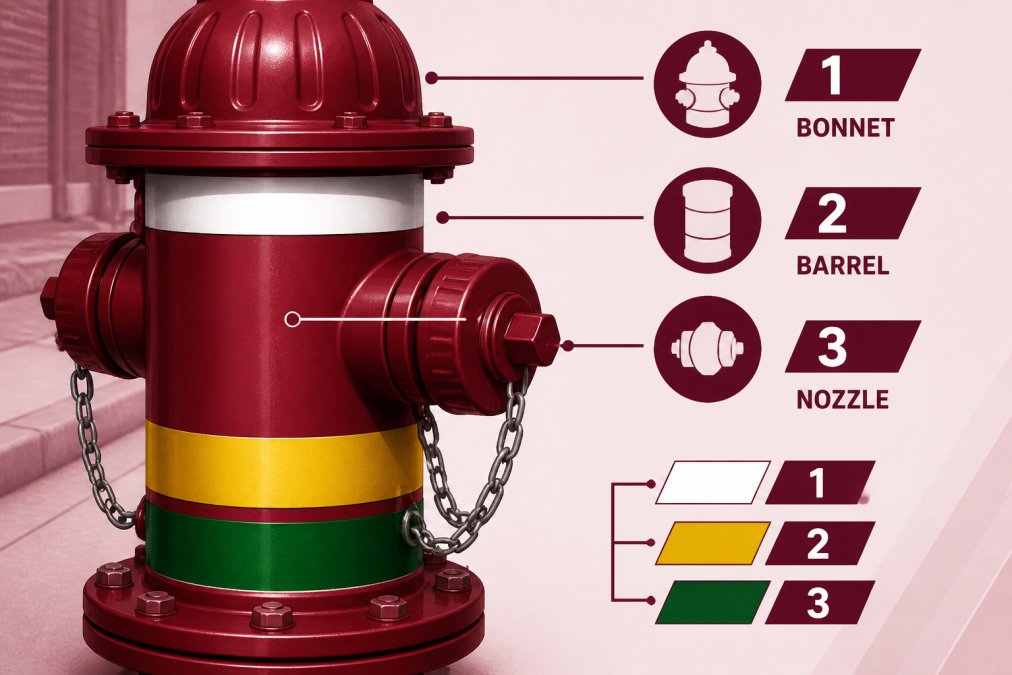
The standard was developed through a consensus process involving fire departments, water utilities, manufacturers, and safety experts. Every color choice is intentional and based on logical principles. Red is used for standard flow because it's the most common hydrant type and the most universally recognized color for fire equipment. Blue is used for high-flow hydrants because blue suggests higher capacity and is visually distinct from red.
NFPA 291 also specifies the paint quality, color durability, and maintenance requirements for hydrant markings. The paint must be reflective or highly visible in low-light conditions, since fires often occur at night or in poor visibility.
What NFPA 291 Specifies
The NFPA 291 standard defines four bonnet colors for public hydrants, each corresponding to a specific flow capacity range measured in gallons per minute (GPM):
- Red: 500-999 GPM (standard flow)
- Orange: 100-499 GPM (low flow)
- Green: 1,000-1,499 GPM (moderate-to-high flow)
- Blue: 1,500+ GPM (high flow)
These ranges are based on actual flow testing conducted by water utilities. When a hydrant is installed or tested, the utility measures the flow rate under standard pressure conditions and assigns the appropriate bonnet color. If a hydrant's flow capacity changes due to main repairs or system modifications, the bonnet color is updated to reflect the new capacity.
The barrel color for public water systems is typically painted white or left unpainted, indicating that the hydrant is part of a municipal water supply system. This distinguishes it from private hydrants, which may be painted a different color or marked with a special designation.
Bonnet and Barrel Color Meanings
The bonnet color communicates flow capacity. The barrel color communicates water system type. Together, they provide a complete picture of what the hydrant can deliver.
A red bonnet on a white barrel indicates a standard municipal hydrant (500-999 GPM from a public water system). This is the most common combination in residential and commercial areas. A blue bonnet on a white barrel indicates a high-flow municipal hydrant (1,500+ GPM), typically found in industrial areas or near large water mains.
For private hydrants, the barrel color is often different from the standard white. A red bonnet on a yellow barrel indicates a private hydrant, meaning it's connected to a private water supply system. The barrel color yellow signals that this is not part of the municipal public water system, which is critical information for firefighters planning water supply operations.
Fire Hydrant Bonnet Color Meaning and Flow Capacity
The bonnet color is the primary indicator of flow capacity. Understanding the relationship between color and GPM is essential for water supply planning. The color system is designed so that firefighters can instantly assess whether a single hydrant will meet their operational needs or if multiple hydrants or alternative sources are required.
A red bonnet hydrant delivers 500-999 GPM under standard pressure conditions. This is adequate for most residential structure fires, where attack lines typically require 250-500 GPM. However, for large commercial buildings or multiple-structure incidents, a single red hydrant may not provide sufficient flow. In these cases, firefighters draft from multiple red hydrants simultaneously or locate a blue hydrant for higher capacity.
Red Bonnets and Standard Flow Rates
Red bonnets indicate standard flow capacity of 500-999 GPM. This is the most common hydrant type and the baseline for municipal water systems. A red hydrant can support a single large-diameter attack line (2.5-inch or 3-inch) or multiple smaller lines operating simultaneously.
For tactical operations, a red hydrant is sufficient for initial attack on most residential fires. However, for a commercial structure fire requiring 1,000+ GPM total flow, a single red hydrant is insufficient. Firefighters must either locate a blue hydrant or draft from multiple red hydrants simultaneously.
Orange, Green, and Blue Bonnets
Orange bonnets indicate low flow capacity of 100-499 GPM. These hydrants are typically found in rural areas or on smaller water mains. An orange hydrant can support a single attack line or defensive operations but has limited capacity for large-scale incidents.
Green bonnets indicate moderate-to-high flow of 1,000-1,499 GPM. This flow capacity is suitable for most commercial structure fires and allows firefighters to supply multiple large-diameter lines simultaneously.
Blue bonnets indicate high flow capacity of 1,500+ GPM or greater. These hydrants are the premium water supply source and are typically located on the largest water mains or near water treatment plants. A blue hydrant can supply a master stream operation or multiple large-diameter lines.
Fire Hydrant Flow Rate Testing and GPM Ratings
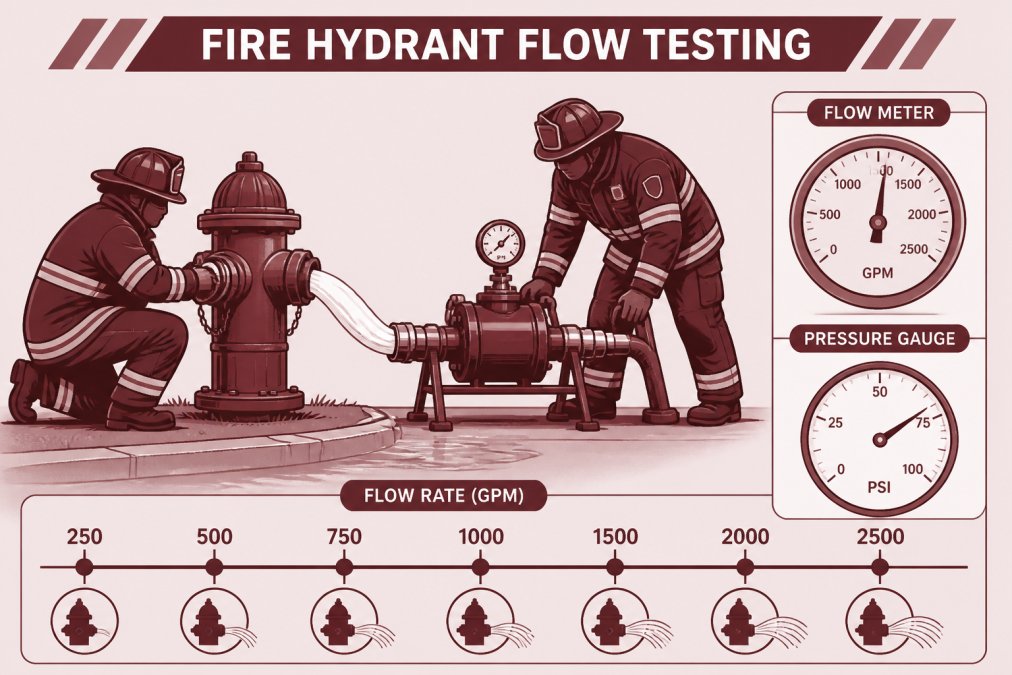
Flow rate testing is the process of measuring the actual flow capacity of a hydrant under controlled conditions. Water utilities conduct annual or biennial flow tests on all hydrants in their system to verify that actual flow matches the color designation and to identify hydrants that need maintenance.
Understanding Gallons Per Minute (GPM)
Gallons per minute (GPM) is the standard unit of measurement for water flow capacity in fire hydrants and firefighting operations. For firefighting applications, GPM is critical because it determines how quickly water can be delivered to the fire and how long a given water supply can sustain operations.
The relationship between hydrant color and GPM is linear and predictable. A red hydrant (500-999 GPM) provides roughly twice the flow of an orange hydrant (100-499 GPM). A blue hydrant (1,500+ GPM) provides roughly 1.5 times the flow of a green hydrant (1,000-1,499 GPM). This hierarchy allows firefighters to make rapid comparative assessments.
Static Pressure vs. Residual Pressure
Static pressure is the water pressure in the main when no water is flowing. Residual pressure is the pressure remaining in the main during water flow. The difference between static and residual pressure indicates how much the system pressure drops when water is being used, a key indicator of main capacity and system health.
Public vs. Private Water Systems and Hydrant Colors
Public water systems are owned and operated by municipalities or public water districts and serve residential, commercial, and industrial customers. Private water systems are owned by private entities, industrial facilities, large commercial properties, or military installations.
The color-coding system distinguishes between public and private hydrants because they operate under different regulations, pressure standards, and maintenance protocols. A firefighter encountering a hydrant needs to know immediately whether it's part of the municipal system or a private system.
Municipal Water Distribution Systems
Municipal water systems are designed and operated to serve the public and must comply with NFPA standards, local building codes, and EPA regulations. A municipal hydrant is part of the public water main network and draws water from the public supply. The water utility maintains the hydrant, conducts regular flow testing, and ensures that the hydrant's color designation is accurate.
Public hydrants are typically painted with a white or unpainted barrel, indicating that they are part of the municipal system. Because public hydrants are subject to standardized testing and maintenance, firefighters can rely on the color designation with high confidence.
Private Water Supply Hydrants
Private hydrants are connected to private water supply systems and are typically marked with a different barrel color (often red or yellow) to indicate that they are not part of the municipal public system. A private hydrant might be connected to an industrial facility's private water main, a campus water system, or a large commercial property's internal water system.
Private hydrants may follow different color-coding standards than public hydrants, depending on the system owner and local regulations. For firefighters, identifying a private hydrant is critical because it requires different operational planning.
Historical Evolution of Fire Hydrant Color Standards
The standardization of fire hydrant colors is a relatively recent development in firefighting history. In the early 20th century, fire hydrants were often painted solid red, with no indication of flow capacity or water system type.
Early Hydrant Marking Systems
By the 1950s, the need for a national standard became apparent. Large metropolitan areas were growing, and mutual aid responses across jurisdictional boundaries were becoming more common. The insurance industry, water utilities, and fire departments recognized that a standardized color-coding system would improve emergency response efficiency.
Adoption of NFPA Standards
The National Fire Protection Association (NFPA) developed the first national standard for fire hydrant color-coding in the 1960s. This standard, which evolved into the current NFPA 291, established the four-color system (red, orange, green, blue) for public hydrants. The adoption of NFPA 291 represented a major shift in how fire departments approached water supply planning. Instead of relying on local knowledge or communication with the water utility, firefighters could instantly assess hydrant capacity by looking at the bonnet color. The core four-color system has remained consistent for over 60 years, demonstrating the effectiveness of the original design.
International Color Coding Variations and Firefighter Safety
While the United States has standardized on the NFPA 291 four-color system, other countries use different color-coding systems for fire hydrants. These variations reflect different water system configurations, regulatory environments, and firefighting traditions.
Differences Across Countries
In Canada, the color-coding system is similar to the United States, with some regional variations. In the United Kingdom and many European countries, fire hydrants are often marked with a simple red or white color, without the detailed flow-capacity color-coding used in the United States. In Australia, fire hydrants are typically marked with a red color and an "H" designation, with flow capacity indicated on a nearby sign or in a database.
Why Standardization Matters
Standardization matters because it enables rapid decision-making in high-stress situations. When a firefighter can instantly assess hydrant capacity by looking at the bonnet color, they can make water supply decisions in seconds rather than minutes. Standardization also facilitates mutual aid operations. When fire departments from different jurisdictions respond to a large incident, they can work together efficiently because they all understand the same color-coding system.
Hydrant Maintenance and Visual Identification for First Responders
Fire hydrants are exposed to weather, traffic, and environmental conditions that degrade paint and reduce visibility. Regular maintenance is essential to keep hydrant colors visible and legible, ensuring that firefighters can read the color-coding system reliably.
Keeping Colors Visible and Legible
Water utilities are responsible for maintaining hydrant colors and ensuring they remain visible. This includes repainting hydrants when the paint fades, is chipped, or is covered by dirt or debris. Most utilities repaint hydrants every 5-7 years, depending on environmental conditions and traffic exposure.
Paint quality is critical for long-term visibility. NFPA 291 specifies that hydrant paint must be durable, weather-resistant, and reflective or highly visible in low-light conditions. Some utilities use reflective paint or apply reflective tape to hydrants to enhance visibility at night.
Inspection Protocols
Fire departments conduct annual or biennial hydrant inspections as part of their pre-incident planning and maintenance programs. These inspections verify that hydrant colors are visible and legible, that the hydrant is accessible and not blocked by vegetation or parked vehicles, and that the hydrant operates correctly.
During an inspection, firefighters check bonnet color visibility, barrel condition, paint condition, accessibility, and operational status. If a hydrant fails any of these checks, the fire department reports it to the water utility for maintenance or repair.
| Hydrant Color | Flow Capacity (GPM) | Typical Location | Water System Type |
|---|---|---|---|
| Red | 500-999 | Residential, commercial | Public municipal |
| Orange | 100-499 | Rural areas, small mains | Public municipal |
| Green | 1,000-1,499 | Commercial, industrial | Public municipal |
| Blue | 1,500+ | Industrial, large mains | Public municipal |
| Red/Yellow | Varies | Industrial, campus | Private system |
Fire hydrant colors aren't just paint, they're a critical communication system that allows firefighters to make instant decisions about water supply capacity and system type. Understanding the NFPA 291 standard, the meaning of each color, and the flow capacity ratings ensures that you're using your water supply strategically during emergency operations. Black Helmet is proud to serve the firefighter community with gear and resources that honor your commitment to mastering the details of your job. Visit Black Helmet to find apparel that reflects your professional pride and connection to the fire service.
Frequently Asked Questions
What do the different colors on fire hydrants mean?
Fire hydrant colors indicate water flow capacity in gallons per minute (GPM). Red bonnets typically indicate 500+ GPM, orange indicates 1,000-1,499 GPM, green indicates 1,500+ GPM, and blue indicates a private water source. The barrel color shows static pressure rating. This color-coding system helps firefighters quickly identify which hydrants supply adequate water for fire suppression during emergency response.
What does NFPA 291 specify for fire hydrant color coding?
NFPA 291 is the National Fire Protection Association standard that establishes uniform color-coding for fire hydrants across the United States. It defines bonnet colors based on flow capacity and barrel colors based on static pressure ratings. This standardization ensures firefighters can rapidly identify hydrant capabilities without guesswork, improving fire suppression effectiveness and emergency response times.
What does the fire hydrant bonnet color meaning tell firefighters?
The bonnet (top) color directly indicates available water flow in GPM. Red means 500+ GPM, orange means 1,000-1,499 GPM, green means 1,500+ GPM, and blue indicates a private water supply. Firefighters use this visual indicator to select the best hydrant for their fire suppression needs, ensuring adequate water pressure and flow rate for effective emergency operations.
How is fire hydrant flow rate testing conducted?
Fire hydrant flow rate testing measures actual GPM output and pressure ratings using specialized flow meters and pressure gauges. Testing determines static pressure (no water flowing), residual pressure (water flowing), and GPM capacity. These tests verify that hydrants meet NFPA standards and municipal water system requirements. Results inform maintenance schedules and help departments plan water supply strategies for fire suppression operations.
This article was written using GrandRanker
