

Best Tactical Pens for Firefighters: 2026 Guide
Table of Contents
- What Makes a Tactical Pen Work for Firefighters
- Top Tactical Pens for Firefighters: Quick Comparison
- Firefighter EDC Gear: Building a Practical Carry Setup
- The Best Glass Breaker Pen for First Responders
- Tactical Pen Self-Defense Laws: What Firefighters Need to Know
- Grip, Gloves, and Writing in Extreme Conditions
- Decontamination, Durability, and Field Testing
- Frequently Asked Questions
Last Updated: September 10, 2026
What Makes a Tactical Pen Work for Firefighters
The best tactical pens for firefighters break glass fast, write in brutal conditions, and survive years in a gear bag. This guide covers what matters, from tip material to glove-friendly grips.
Most "tactical pen" content treats these tools as self-defense gadgets, missing the point for the fire service. On scene, a pen is a window punch, a writing instrument, and durable gear.
A tactical pen is built from hardened materials with a metal impact tip, designed as a tool first and a pen second. Its value for firefighters shows up in emergency egress and documentation.
Below, we cover what separates a tool that survives the job from one that quits, plus the pens worth carrying.
Glass Breaker Tips and Impact Tools
A glass breaker tip is a hardened, pointed striking surface, usually tungsten carbide, mounted at the pen's tail. Tungsten carbide ranks near 9 on the Mohs scale, so it scores tempered glass instead of bouncing off (britannica.com).
Tip geometry matters as much as material. A shallow, rounded point spreads force; a sharp, replaceable carbide tip concentrates the strike into a small contact area, fracturing tempered glass.
Two more details separate working tools from decorative ones:
- Fixed vs. retractable tips: Fixed tips are stronger and simpler. Retractable tips are safer in a pocket but add a failure point.
- Threaded vs. pressed fittings: Threaded carbide inserts can be replaced when they dull. Pressed tips are disposable by design.
- Strike access: If the tip sits recessed behind a cap, you lose seconds fumbling for it. Exposed or one-twist tips win.
Materials That Survive the Job
Aircraft-grade aluminum, typically 6061-T6, is the baseline for a durable tactical pen body (matweb.com). It offers a strong weight-to-strength ratio, resists corrosion, and takes a hard-anodized finish that shrugs off scuffs.
For firefighters, the question is structural integrity under heat, impact, and abrasion. Titanium costs more but saves weight and resists corrosion. Steel is strongest but heaviest.
Finish matters more than most buyers expect. A hard-anodized coating protects the aluminum and keeps the knurled grip from wearing smooth; bare aluminum scratches and oxidizes within a season.
Top Tactical Pens for Firefighters: Quick Comparison
The pens below are judged on tip material, body construction, grip, and writing performance. Pricing varies, so check current listings before you buy.
| Pen | Body Material | Tip | Grip | Best For |
|---|---|---|---|---|
| Black Helmet EDC Pen | Hard-anodized aluminum | Tungsten carbide | Knurled | Station carry and gifts |
| Benchmade 1100 Series | Machined aluminum | Carbide | Textured | Duty belt use |
| Gerber Impromptu | Stainless steel | Carbide | Grooved | Heavy daily use |
| CRKT Williams Tactical | Aluminum | Tungsten carbide | Smooth | Lightweight carry |
| UZI Defender | Aluminum | Carbide | Knurled | Budget backup |
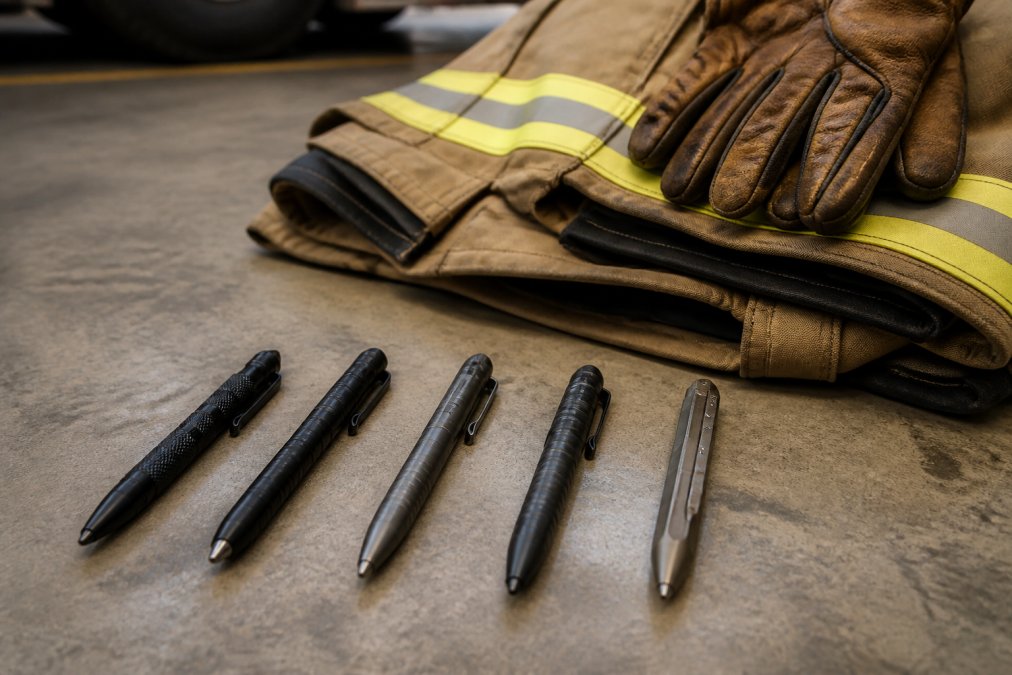
Black Helmet's apparel line has served more than 100,000 firefighters since 2008. It's a station-ready tool that doubles as a gift.
Benchmade's 1100 Series is the pen most often spotted on duty belts. Its machined aluminum body and carbide tip are proven, and the textured grip works with gloves. The trade-off is cost and weight.
The Gerber Impromptu uses stainless steel for maximum toughness. It writes reliably and strikes hard, but the weight is real, carry it in a bag, not a pocket.
CRKT's Williams design is the lightest and easiest to write with for long stretches. Its aluminum body won't take the same beating as steel, so treat it as a station pen, not a demolition tool.
The UZI Defender is the budget pick. It does the basics, but fit and finish won't match the others, and the tip is the first thing to show wear.
Firefighter EDC Gear: Building a Practical Carry Setup
Firefighter EDC gear works best when every item earns its pocket space. A tactical pen should sit alongside a light, a multi-tool, and a cutting tool, not replace any of them.
The mistake is treating EDC as a collection. On shift, you want a setup you can grab in the dark and know where everything is. Keep it to four or five items and rotate by assignment.
A practical station or duty carry setup looks like this:
- Tactical pen with a carbide tip for glass and paperwork
- Compact flashlight rated for the environment
- Multi-tool with pliers and a driver
- Folding knife or rescue cutter
- Small notepad that survives a wet glove
Where you carry matters too. A pocket clip keeps the pen accessible; for turnout gear, a small pouch or gear loop beats digging through fabric.
Black Helmet's accessories fit the same mindset: gear that reflects the job and holds up to it, whether it's a wallet or a hat.
The Best Glass Breaker Pen for First Responders
The best glass breaker pen for first responders has a fixed tungsten carbide tip, a body that won't flex on impact, and a grip you can hold with gloves on. Everything else is preference.
Deployment speed decides whether a tool is useful in an emergency. If you need two hands and a cap to expose the tip, you've lost the moment. Look for one-motion strike access.
Field testing reveals the difference. A pen that strikes cleanly on the first hit, every hit, is worth carrying; one that needs a second or third strike is a liability.
For first responders, the pen also has to survive drops on concrete, being stepped on in a rig, and soaking. That's why hard-anodized aluminum and carbide tips keep showing up at the top of the list.
Tactical Pen Self-Defense Laws: What Firefighters Need to Know
Tactical pen self-defense laws vary by state and city, and no single rule covers the country. A pen legal in one jurisdiction may be restricted in another, especially where ordinances treat impact tools differently from writing instruments.
The practical takeaway: check your department's policy and your local and state law before carrying any tool marketed for self-defense. Many departments restrict what personnel can carry on duty, and off-duty rules can differ.
Because these rules change and are enforced locally, this guide doesn't state specific statutes. For current requirements, consult your state legislature's website, your department's SOPs, or a qualified attorney.
A tactical pen is still, legally, usually a pen. But how it's marketed, carried, and used can change how it's classified.
Grip, Gloves, and Writing in Extreme Conditions
Grip and writing performance are where most tactical pens quietly fail firefighters. A pen that writes beautifully bare-handed can be nearly unusable through a structural firefighting glove: a structural glove adds roughly 3/16 to 1/4 inch of leather, moisture barrier, and thermal liner between your skin and the barrel, killing the fine motor feedback your fingers rely on to feel a smooth, polished pen body.
Knurled grips and grooved barrels give gloved fingers something to bite into, and the pattern matters as much as the presence of texture. A fine diamond knurl (think 24 to 30 lines per inch) bites into leather and stays put; a coarse, shallow knurl just polishes smooth against a glove. Smooth, polished bodies look sharp on a desk but slip the moment your hands are wet, sweaty, or gloved. Ergonomics with PPE is the most overlooked factor in the category, and the one most guides never test. tactical streetwear.
A few design details separate a pen you can actually deploy with gloves on from one you fight with:
- Barrel diameter: A barrel in the 0.4 to 0.5 inch range gives a gloved hand enough to close around. Ultra-slim pens disappear inside a glove.
- Grip length: At least 1.5 inches of textured surface, positioned where your index finger and thumb naturally land, so you are not hunting for the grip zone.
- Cap or clicker access: A one-handed clicker or a cap that posts securely to the tail beats a loose cap you have to palm while wearing gloves.
- Pocket clip tension: A stiff clip that grabs a turnout coat pocket or a radio strap without bending. A flimsy clip dumps the pen the first time you crouch.
Writing performance in extreme conditions comes down to the ink system, not the body. A pressurized ink cartridge, the kind used in space pens and all-weather pens, keeps ink flowing at any angle, in cold, and when the pen is upside down against a clipboard (howstuffworks.com). Standard ballpoint cartridges rely on gravity and capillary action, so they skip and stall when inverted or when ink thickens in cold. On a clipboard braced against a rig, or on a cold-weather or wildland assignment, the ink system is the difference between a note and a scribble.
Look for these features if you write in the field:
- Pressurized cartridge for all-weather writing and consistent ink flow at any angle
- Cap security so the cap doesn't vanish in a pocket or glove
- Sub-zero performance if you work cold-weather or wildland assignments, pressurized inks are typically rated to write well below freezing, while standard ballpoints stiffen and skip
- Retractable mechanism that won't deploy in your pocket, or a threaded cap that stays put
- Refill compatibility so you can swap in a pressurized refill if the stock cartridge disappoints
In practice, the pen you'll actually use is the one that writes the first time, every time, with gloves on and your hands full. Test that before you trust it on a call.
Decontamination, Durability, and Field Testing
Decontamination and durability are the angles most tactical pen guides ignore entirely, and they matter more in the fire service than anywhere else. After a fire, gear carries soot, ash, and residue, including the carcinogenic combustion byproducts that have driven the shift toward gross decontamination on scene. A pen that lives in your pocket and touches your hands, face, and food is a contamination vector if it can't be cleaned.
What makes a pen cleanable comes down to two things: the finish and the seals.
- Hard-anodized aluminum is the baseline. The anodized layer is a conversion coating that grows out of the aluminum itself, so it doesn't chip or flake the way paint does. It wipes down with a station wipe or a mild detergent solution and holds up to repeated cleaning.
- Type III (hard) anodizing is thicker and more abrasion-resistant than Type II cosmetic anodizing. If a listing just says "anodized" without a type, assume it's the thinner cosmetic version.
- Sealed bodies keep water, soot, and cleaning solution out of the ink chamber. A pen with an O-ring or a tight threaded joint at the tip and tail cleans faster and writes reliably after a soak.
- Smooth vs. textured surfaces is a real trade-off. Deep grooves and aggressive knurling give you grip but trap soot and are hard to wipe clean. A moderate texture with smooth flats cleans faster. There is no perfect answer, pick based on whether you prioritize grip or decon speed.
Heat is the other durability question. A pen left on a rig dashboard, in a gear bag near a running apparatus, or in a pocket during overhaul sees temperatures well above ambient. Hard-anodized aluminum and titanium handle that without deforming. Cheap plated finishes and plastic components do not. If a pen's body or mechanism is plastic, treat it as a station desk pen, not a gear-bag pen.
Durability shows up over months, not days. A pen that survives a season of drops, heat, moisture, and decon wipes is doing its job. Field testing on your own shift is the only test that counts.
Here's a simple field test you can run on any pen before you commit to carrying it:
- Strike a scrap tempered window and confirm it fractures on the first hit
- Write a full page with gloves on and check for skipping
- Submerge it in water, dry it, and confirm the ink still flows
- Drop it onto concrete from waist height and inspect the tip and body
- Wipe it down with a station wipe and check the finish holds
- Leave it in a hot rig or gear bag for a shift and confirm the mechanism still works
If a pen passes all six, it's earned a spot in your gear.
Frequently Asked Questions
What features should a firefighter look for in a tactical pen?
Prioritize a tungsten carbide glass breaker tip, aircraft-grade aluminum or titanium body, and a knurled grip that works with gloves. Look for a pressurized ink cartridge for all-weather writing and a hard-anodized finish for corrosion resistance. The retractable mechanism and cap security matter too, since you don't want the pen deploying or leaking in a pocket during a call.
Is it legal to carry a tactical pen?
Tactical pen self-defense laws vary by state and municipality. Most states treat a tactical pen as an ordinary writing instrument, but some jurisdictions classify pens with pointed striking tips as weapons. Firefighters should check their department's SOP and local ordinances before carrying one off duty. On duty, department policy usually governs what you can carry in turnout gear or station wear.
Can a tactical pen be used for glass breaking during rescue operations?
Yes, a tactical pen with a tungsten carbide tip can break tempered glass found in vehicle side windows and rear windshields. It will not break laminated glass like a front windshield. For firefighter use, treat it as a backup tool for emergency egress, not a primary glass breaker. Your halligan or dedicated window punch remains the right tool for structural fireground work.
Are tactical pens allowed through TSA checkpoints?
TSA allows standard pens but may flag tactical pens with pointed striking tips or aggressive knurling as prohibited items. The agency's rules on self-defense tools are enforced at the discretion of screening officers. If you fly to a training event or travel between stations, pack your tactical pen in checked baggage to avoid losing it at security.
