

Alternatives to Power Saws for Forcible Entry
Table of Contents
- Why Firefighters Need Alternatives to Power Saws for Forcible Entry
- Firefighter Forcible Entry Tools List: Manual and Hydraulic Options
- Irons vs Power Saw for Entry: A Direct Comparison
- Manual Forcible Entry Techniques for Inward and Outward Swinging Doors
- Noise, Stealth, and Environmental Limitations of Power Saws
- Tool Weight, Ergonomics, and Cost-Benefit for Departments
- Frequently Asked Questions
Last Updated: September 23, 2026
Why Firefighters Need Alternatives to Power Saws for Forcible Entry
Forcible entry is the craft of getting through a locked or blocked door fast, and the power saw is not always the right answer. This guide from Black Helmet covers the manual and hydraulic alternatives that crews reach for when a rotary saw would be too slow, too loud, or too much tool for the job.
A power saw earns its place on the rig. It also weighs close to 30 pounds with fuel, takes time to start, and announces your arrival to everyone inside the structure. When a door is a standard inward-swinging residential model, a Halligan bar and a flat head axe will get you through in seconds without waking the whole block.
That trade-off is the whole argument. Manual forcible entry tools are faster on the common door, quieter on the approach, and lighter on your back. Power saws win on heavy commercial doors, roll-up gates, and anything with a hardened lock or a metal skin.
Below, we break down the tool list, compare the irons against the saw directly, and cover the noise, weight, and cost factors most departments overlook.

Firefighter Forcible Entry Tools List: Manual and Hydraulic Options
The firefighter forcible entry tools list splits into two families: manual tools you swing and pry, and powered tools that drive or cut. Most crews carry both, and the skill is knowing which one the door in front of you actually needs.
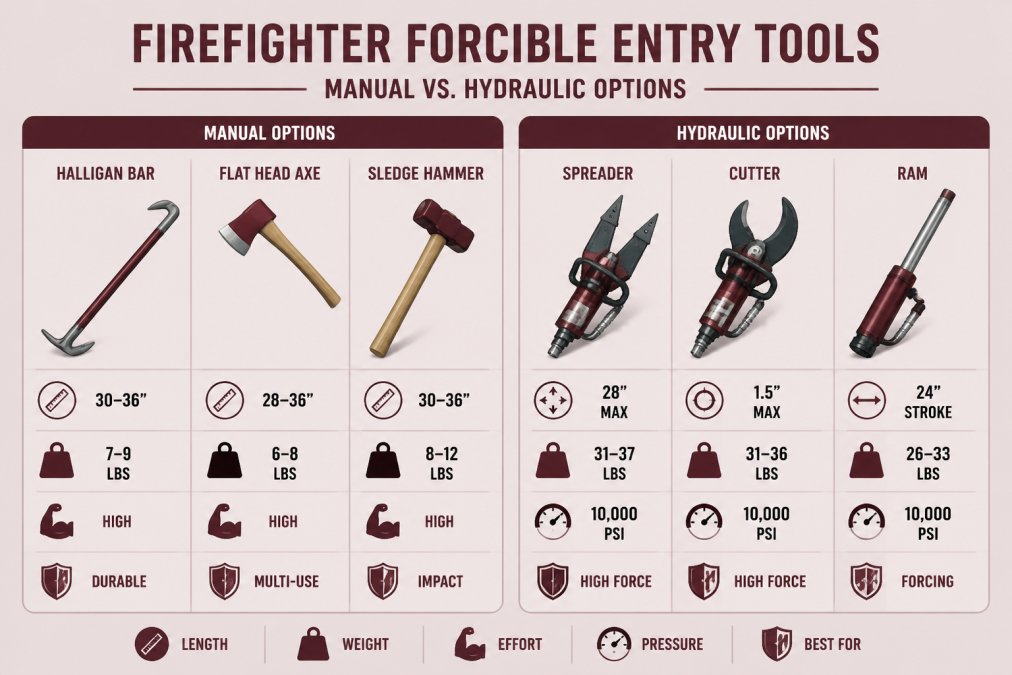
Prying and Striking Tools
The irons are the pairing of a prying tool and a striking tool, and they remain the backbone of manual forcible entry. A Halligan bar gives you a fork, an adze, and a point on one shaft. A flat head axe gives you the striking power to drive it.

- Halligan bar: fork for prying, adze for pulling, point for punching through
- Flat head axe: drives the Halligan, chops through light material, cuts hinges
- Battering ram: heavy, two-person, best for a reinforced door you cannot pry
- K-tool: pulls a lock cylinder so you can work the mechanism directly
- Pry tool: longer shaft for more mechanical advantage on stubborn frames
Hydraulic and Battery-Powered Alternatives
Hydraulic rams and spreaders do the heavy lifting when a door will not give. A hydraulic ram pushes a door open with controlled force, and battery-powered rams now run on the same packs many departments already carry for lights and saws.
Irons vs Power Saw for Entry: A Direct Comparison
The irons win on standard doors, and the power saw wins on heavy ones. That is the short version. The longer version depends on what the door is made of, how it swings, and how much time you have.
| Factor | Irons (Halligan + Axe) | Power Saw |
|---|---|---|
| Setup time | Immediate | Start and warm-up required |
| Noise level | Low | Very loud |
| Weight | Roughly 10-12 lb combined | Roughly 25-30 lb with fuel |
| Best for | Inward-swinging doors, wood frames | Metal doors, roll-up gates, heavy locks |
| Metal cutting | Limited | Carbide-tipped or masonry blade |
| Maintenance | Inspection and sharpening | Fuel, blade changes, engine care |
Manual Forcible Entry Techniques for Inward and Outward Swinging Doors
Manual forcible entry techniques change with the direction the door swings. Get the swing direction wrong and you will fight the door instead of opening it.
Inward-Swinging Doors
An inward-swinging door opens away from you, so the hinges are on your side and the latch is set into the frame. The gap between the door and the frame on the latch side is your target.
Outward-Swinging Doors
An outward-swinging door opens toward you, which puts the hinges on the far side and exposes the hinge pins. That changes everything.
Noise, Stealth, and Environmental Limitations of Power Saws
Noise is the factor most tool lists skip, and it changes the tactical picture more than any spec sheet. A gas rotary saw at full throttle is one of the loudest tools on the fireground, loud enough to drown out radio traffic at the door, loud enough to be heard through a closed commercial wall, and loud enough that on a tactical or law-enforcement-assisted entry it announces the approach before the crew reaches the threshold.
- Gas saws: A two-stroke engine is hard to start cold, harder to restart hot, and prone to flooding when the saw is tipped or the fuel mix is off. In thick smoke with poor ventilation, an engine that will not catch is dead weight on your shoulder while the irons are already through the door. Fuel also has a shelf life, and a saw that sat on the rig for months may not start when you need it.
- Battery-powered tools: No exhaust, instant start, and no fuel to manage, but runtime is finite and cold is the enemy. Lithium-ion packs lose a meaningful share of their usable capacity in freezing temperatures, and a pack that reads full in the warm apparatus bay can sag under load on a cold exterior approach. A spare pack in an inside pocket stays warmer than one on the rig's exterior.
- Hydraulic tools: Ram and spreader performance is largely independent of ambient temperature, but the pump, hose, and fluid add weight and setup steps, and a hydraulic tool is not a one-person carry on a ladder.
Tool Weight, Ergonomics, and Cost-Benefit for Departments
- Baseline every riding position with the irons. A Halligan and a flat head axe cost a fraction of a rotary saw, need no fuel or blade budget, and last for years with basic care. This is the lowest-cost way to guarantee every crew has a working forcible entry capability on every call.
- Identify the doors your district actually has. A response area dominated by wood-frame residential and light commercial does not generate the same saw demand as a district full of roll-up gates, steel doors, and hardened locks. Match the powered tool to the door inventory, not to a wish list.
- Price the powered option honestly. A rotary saw carries fuel, blade, and engine maintenance costs on top of purchase price, and carbide-tipped or masonry blades are a recurring line item. A hydraulic ram or spreader carries purchase price plus pump, hose, and fluid maintenance, and it is a two-person tool. Battery-powered rams and reciprocating saws trade fuel cost for battery and charger cost and add a pack-replacement cycle.
- Weigh the training and staffing cost. A saw or hydraulic tool requires dedicated training time to be safe and effective; the irons reward repetition that crews can do in the bay with no fuel or setup. A department that cannot fund the training hours should not buy the tool.
- Buy the multiplier, not the replacement. The smart approach is not either-or. Equip every riding position with the irons, and keep saws and hydraulic tools on the rig for the doors that demand them. That balance gives you speed on the common door and power on the heavy one without betting the whole forcible entry capability on one power source.
Tool maintenance is the quiet factor in all of this. Inspect the Halligan for cracks, keep the axe head tight on the handle, check hydraulic fluid and hose condition, and verify battery packs before every shift. A tool that fails at the door costs more than any budget line.
Frequently Asked Questions
What tools are used for forcible entry when a power saw isn't available?
The most common manual forcible entry tools are the Halligan bar, flat head axe, and battering ram. The Halligan and axe together form the 'irons,' which handle most inward and outward swinging doors. Hydraulic rams and air chisels offer powered alternatives without a rotary saw. A K-tool works for lock cylinders, and a reciprocating saw with a carbide-tipped blade can cut metal without the noise and weight of a full rotary saw.
What are the most effective manual forcible entry techniques for firefighters?
For inward-swinging doors, the gap-and-set technique with the irons is standard: drive the adz end of the Halligan into the gap, then strike it with the axe to set it, and pry. For outward-swinging doors, use the fork end to capture the latch or remove hinge pins. For residential fires, through-the-lock techniques with a K-tool often work faster than cutting. Practice each technique on a forcible entry prop until the motions are automatic.
Why should firefighters prioritize manual tools over power saws in certain scenarios?
Manual tools are quieter, lighter, and don't require fuel or batteries. In residential fires, a power saw's noise can alert occupants and reduce stealth. In tight hallways or on ladders, a Halligan bar is easier to control than a rotary saw. Manual tools also work when a saw fails to start or the blade binds in metal. For many doors, the irons are simply faster because there's no setup time.
How do you perform forcible entry without a power saw?
Start by sizing up the door: inward or outward swinging, wood or metal frame, lock type. For most doors, the irons handle it. Set the Halligan's adz in the gap, strike it with the axe to seat it, then pry. For heavy metal doors, use a hydraulic ram or battering ram on the hinge side. For lock cylinders, a K-tool or through-the-lock method works. Always check for hidden electrical wires or gas lines before prying near utilities.
