

Understanding NFPA 1975 No Melt No Drip Standards
Last Updated: November 2, 2026
Quick Summary
NFPA 1975 is a National Fire Protection Association standard for station uniforms and work apparel, and its core requirement is that fabric must not melt and drip when exposed to heat. No melt no drip describes how a fabric behaves under heat, not full fire resistance. Confirm the current edition with your authority having jurisdiction before buying.
- Molten fabric can stick to skin and deepen a burn injury, which is the hazard the standard targets.
- A no-melt, no-drip fabric can still ignite and burn for a limited time.
- NFPA 1975 does not set thermal protective performance for structural firefighting PPE.
- Flame-resistant certification is the better choice for garments that may see direct flame exposure.
- Verify the named standard, edition, test method and traceable certification before ordering.
Table of Contents
- What NFPA 1975 Covers and Why It Matters for Station Wear
- What No Melt No Drip Means in Practice
- Flame Resistant vs No Melt No Drip: Where the Protection Differs
- NFPA 1975 vs 2112: Which Standard Applies to Your Gear
- How NFPA 1975 Testing and Certification Work
- Building an NFPA 1975 Compliant Station Wear Program
- Choosing Your Next Station Wear Order
- Frequently Asked Questions
What NFPA 1975 Covers and Why It Matters for Station Wear
One question comes up often among firefighters: what does NFPA 1975 actually require of station wear? NFPA 1975 is a National Fire Protection Association standard that sets performance criteria for station uniforms and work apparel.
Why the status question keeps coming up. Standards are revised over time, and the current status of NFPA 1975 should be confirmed with NFPA and your authority having jurisdiction before you specify apparel.
A timeline to work from. The following sequence is the one to keep in mind when you are reading labels and spec sheets:
- Earlier editions of NFPA 1975 governed station uniforms and work apparel as a standalone standard, with the no-melt/no-drip requirement as its central performance criterion.
- NFPA subsequently consolidated station wear requirements into a combined emergency-services work apparel document, so the requirements and test criteria carried forward under a new standard number.
- Current editions of that combined document govern station wear, and the no-melt/no-drip requirement remains part of the performance criteria.
- Garments manufactured under the older standalone standard may still be in service, which is why edition matters when you are matching a garment to a department policy.
Because editions and consolidation dates are revised on NFPA's own cycle, confirm the specific edition and document number with your authority having jurisdiction before you write a purchase specification. NFPA standards catalog and edition history
What the standard covers. NFPA 1975 addresses station uniforms and work apparel: the shirts, trousers, and base layers worn in the station, on non-fire duties, and as the layer under structural turnout gear.
What the standard does not cover. NFPA 1975 is not structural firefighting PPE. It is not a flash-fire standard.
Why station wear matters anyway. Station wear is often the layer closest to the skin and the layer that gets worn when a firefighter is not in full structural gear, in the bay, on the apron, during overhaul support, and around apparatus. For practical guidance on keeping these garments protective over time, see how to maintain flame resistant firefighter clothing. An academic manuscript on station wear notes that NFPA 1975 mandates station-uniform fabric that does not melt and drip under heat exposure, and it discusses how undergarment choices affect that exposure. Oxford Academic accepted manuscript on station wear The molten-fabric hazard is real in exactly those settings, which is why a requirement aimed at one failure mode still earns its place in a station uniform program.
What No Melt No Drip Means in Practice
No melt no drip (often abbreviated NMND) describes a fabric's behavior under heat, not a promise that the garment is fireproof. A no-melt, no-drip fabric does not soften into a liquid that runs onto skin when it contacts heat or flame. That behavior is the reason the category appears in station wear specifications.
The distinction is easy to miss. A no-melt, no-drip material can still ignite and burn for a limited time. Testing guidance from UF PRO explains that such materials may ignite and keep burning even though they do not melt or drip. UF PRO, "Understanding Flame-Resistant Standards and Test Methods"
Practically, this means the category describes one protective property. It does not describe full flame resistance. When you evaluate a shirt, hoodie or base layer, ask whether the spec sheet names the standard it was tested against, and whether it claims no-melt/no-drip performance, flame resistance, or both.
Flame Resistant vs No Melt No Drip: Where the Protection Differs
Flame-resistant (FR) clothing is designed to self-extinguish once the ignition source is removed. No-melt, no-drip clothing is designed to avoid the molten-fabric hazard. Those are different goals, and many buyers confuse them.
Industry comparisons describe no-melt/no-drip garments as less protective than fire-resistant uniforms in fire conditions. Frontline Safety, "No Melt No Drip vs Fire Resistant Uniforms" Night Heron Gear makes the same point, describing the category as not fully flame-resistant. Night Heron Gear, "FR vs No Melt / No Drip"
Use this rule of thumb: if a garment sits under structural turnout gear or may see direct flame exposure, look for flame-resistant certification rather than relying on a no-melt/no-drip claim alone.
NFPA 1975 vs 2112: Which Standard Applies to Your Gear
Buyers often see NFPA 1975 and NFPA 2112 listed together, and the difference matters. NFPA 2112 covers flame-resistant garments for protection against flash fire, a far more severe hazard than the molten-fabric concern addressed by NFPA 1975.
Which standard applies depends on your role, your department's uniform policy, and the exposure conditions the garment will face. A station T-shirt worn in the bay has different requirements than a flame-resistant layer worn under incident gear.
Check the applicable edition against your department's written policy. Standards are revised over time, and a garment labeled to an outdated edition may not match current requirements.
How NFPA 1975 Testing and Certification Work
This section explains what a pass means under the no-melt/no-drip criteria, and what it does not.
The practical consequence is that a garment's documentation should name both the standard and the test method used to demonstrate compliance.
What a pass establishes. A passing result applies to the specific fabric, in the specific construction tested, under the specified exposure conditions. A pass does not establish flame resistance, self-extinguishing behavior, or any thermal-protective performance rating, and a fabric can pass the no-melt/no-drip criteria and still ignite and burn.
Certification versus self-declaration. Documentation from an independent certifying body is generally a stronger record than a manufacturer's own statement of compliance, if a garment's performance is ever questioned.
A practical verification checklist. When you evaluate a garment, confirm each of the following in writing:
- The standard is named, not just referenced as "NFPA compliant."
- The edition or year of the standard is stated.
- The test method used to demonstrate the no-melt/no-drip claim is identified.
- The certification is traceable to a laboratory or certifying body, not only to a marketing page.
- The documentation matches the specific fabric, weight, and construction you are ordering, not a sibling product.
- The label on the delivered garment matches the documentation you were given.
A label that says "meets NFPA" with no edition and no certification record is not verification. It is a claim. The difference matters most when a department is standardizing a whole crew's station wear and needs a defensible paper trail.
NFPA 1975 standard document and edition history
The table below summarises what a pass under the no-melt/no-drip criteria establishes and what documentation to check.
| Item | Value | Note |
|---|---|---|
| Protective property | No melt, no drip | Describes fabric behavior under heat, not full fire resistance |
| Passing result applies to | Specific fabric and construction tested | A different blend, weight or construction needs its own documentation |
| Pass does not establish | Flame resistance or self-extinguishing behavior | A fabric can pass and still ignite and burn |
| Stronger record | Independent certifying body | Generally stronger than a manufacturer's self-declaration |
| Documentation must name | Standard, edition and test method | A bare "NFPA compliant" claim is not verification |
| Label check | Matches the documentation provided | Confirm the delivered garment matches the paperwork |
Building an NFPA 1975 Compliant Station Wear Program
A compliant program starts with a written station uniform policy. Define which garments are station wear, which layers sit next to skin, and which pieces are worn only in certain duty settings. Then match each garment to its documented performance claims.
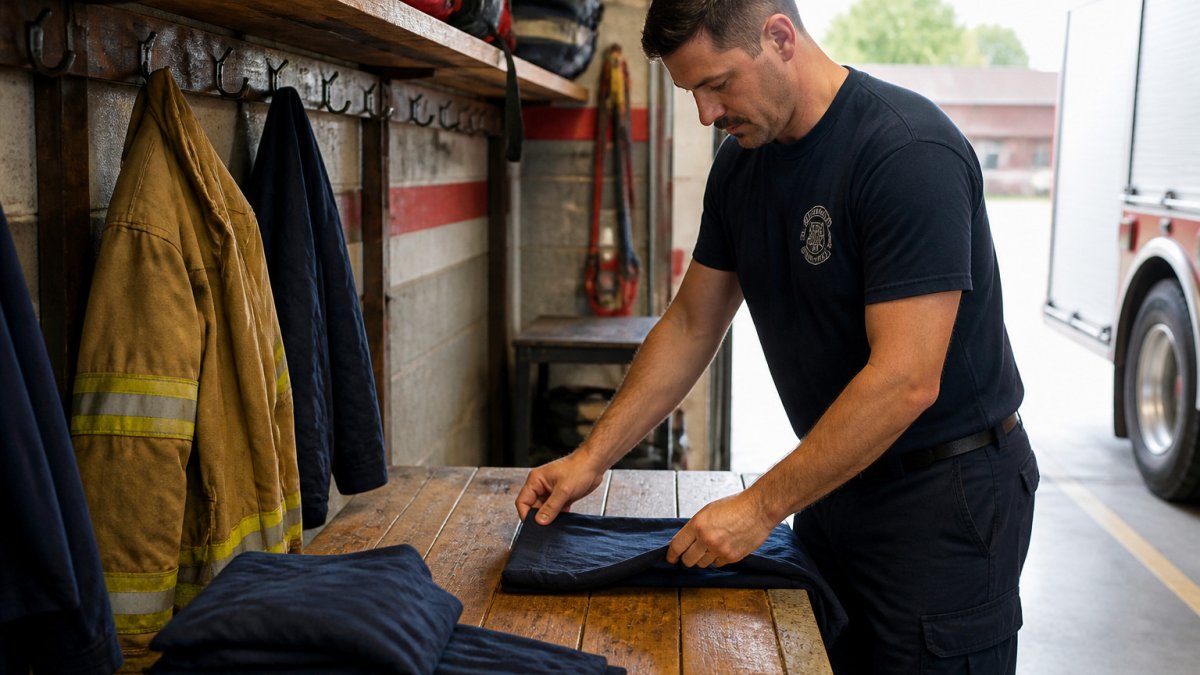
Choose fabrics and constructions deliberately. Cotton and synthetic blends behave differently under heat, and blends can change the melt and drip profile. Work from the test documentation for each specific garment rather than assuming a fiber type guarantees performance.
Maintain the program over time. Laundering, wear, and repeated washing can change how a garment performs. Inspect shirts and base layers regularly, and replace anything that is faded, stretched, thinned, or damaged.
Choosing Your Next Station Wear Order
When you are ready to order, start with the documentation. Confirm the standard, the edition, and the performance claim for each piece before you commit to quantities.
A firefighter who wants everyday apparel with station pride may need something different from a department specifying compliant station wear for a whole crew. Our how to choose firefighter station wear guide walks through the decision in order, and if you are placing a group order, how to order custom station shirts covers the details that matter for consistency across a crew.
Before you order, match your choice to the standard your department requires, and ask us for a quote on the quantities you need.
Frequently Asked Questions
Is NFPA 1975 still in use? A 2026 secondary-source summary says NFPA 1975 no longer exists as a standalone standard, so confirm the current governing document with your authority having jurisdiction before buying.
Does no melt no drip mean a garment is fireproof? No. The term describes resistance to melting and dripping. A no-melt, no-drip material can still ignite and burn for a limited time.
What is the difference between NFPA 1975 and NFPA 2112? NFPA 1975 addresses station wear and the molten-fabric hazard. NFPA 2112 covers flame-resistant garments for flash fire protection.
How do I verify a garment's certification? Request documentation from the manufacturer that names the standard, the edition, and the certifying test lab.
Frequently Asked Questions
What does 'no melt, no drip' mean in firefighter apparel?
No melt, no drip describes fabric that does not melt or drip when exposed to heat, which keeps molten material from sticking to skin. Such materials may still ignite and burn for a limited time, so they are not the same as flame-resistant clothing. NFPA 1975 sets the requirement for station uniform fabrics in this category. Treat no-melt/no-drip as one protection layer, and check the garment's label and certification before assuming it meets a specific edition of the standard.
Is NFPA 1975 mandatory for all fire departments?
Whether NFPA 1975 is mandatory depends on how your department, state, or local authority adopts it, and a standard only binds agencies that incorporate it into their rules or purchasing policies. Confirm the requirement with your department's policy or authority having jurisdiction. Verify the current edition and its status with the NFPA before specifying apparel.
What is the difference between NFPA 1975 and NFPA 2112?
NFPA 1975 addresses station work uniforms and their no-melt/no-drip behavior, while NFPA 2112 covers flame-resistant garments for protection from flash fire. The two address different hazards, and a garment meeting one does not automatically meet the other. Compare the scope, test methods, and edition of each standard against your department's needs. Choose station wear for daily duty and flame-resistant garments where the risk of flash fire requires that level of protection.
Do station uniforms need to be flame resistant?
Station uniforms are not automatically required to be flame resistant under NFPA 1975, which focuses on no-melt/no-drip performance. Flame-resistant garments provide a higher level of protection, as no-melt/no-drip materials can ignite and burn for a limited time. Your department's risk assessment and policy determine whether flame-resistant layers are needed. Review exposure conditions for your crew before deciding.
How does NFPA 1975 affect the choice of base layers?
Base layers worn under other protective clothing should be selected with the same no-melt/no-drip concern in mind, since synthetic fibers can melt onto skin when heated. Layering choices matter because synthetic fibers can melt onto skin when heated. Choose base materials that your policy approves and verify their performance data rather than relying on fiber type alone.
What materials are typically used to meet NFPA 1975 standards?
Materials used for NFPA 1975 station wear are fabrics that do not melt or drip under heat exposure, and their composition must be verified through the manufacturer's certification documentation. The supplied research does not give a verified list of approved fibers, so do not assume a fiber type meets the standard. Request the test results and edition from the supplier before purchasing.

