

PFAS-Free Turnout Gear: Brands and Buying Criteria for Departments
Last Updated: October 31, 2026
Quick Summary
PFAS-free turnout gear is protective clothing made without intentionally added PFAS in its layers, but the term is not standardized. Departments should verify which layers are covered, require NFPA 1970 Restricted Substances documentation for the exact model, and check repellency data.
- The term PFAS-free is not standardized, and a label may cover only the outer shell, not the whole garment.
- Require proof of compliance with NFPA 1970's Restricted Substances requirements, not just a marketing label.
- A North Carolina State University study found PFAS-free outer shells did not repel oil and hydraulic fluid.
- Ask each vendor which layers are PFAS-free: outer shell, thermal liner and moisture barrier.
- Shortlist vendors that can document layer coverage and produce test reports for the exact configuration you intend to buy.
Table of Contents
- Why PFAS Matters in Turnout Gear Purchasing
- What Turnout Gear Is PFAS-Free, and What the Label Does Not Prove
- PFAS-Free Turnout Gear Manufacturers and Brands to Evaluate
- How to Verify PFAS-Free Claims with NFPA 1970 and Testing Evidence
- Procurement Costs, Sizing and Service Life Considerations
- Fire Department Turnout Gear Purchasing Checklist
- Requesting Samples and Documentation Before Your Next Order
- Frequently Asked Questions
Why PFAS Matters in Turnout Gear Purchasing
Fire departments now ask a new question when buying turnout gear: does it contain PFAS? Many departments now see pfas free turnout gear as a core purchasing requirement.
At Black Helmet, we focus on what this decision means for the people wearing the gear every shift.
According to the U.S. Fire Administration, results from a second National Institute of Standards and Technology study show that studies have found firefighters have higher blood levels of some PFAS due to increased exposure (U.S. Fire Administration blog on the second NIST study on PFAS in turnout gear).
Purchasing teams face three pressures at once: protecting crews, staying within budget and meeting safety standards. pfas free turnout gear can address the first, but not automatically the other two.
What Turnout Gear Is PFAS-Free, and What the Label Does Not Prove
PFAS-free turnout gear is protective clothing made without intentionally added PFAS in its layers.
Turnout gear is built in layers, and each can be treated differently. Ask the manufacturer which parts of the garment are PFAS-free, not just whether the product is "PFAS-free" as a whole.
The International Association of Fire Fighters advises departments buying gear marketed as PFAS-free to require proof of compliance with NFPA 1970's Restricted Substances requirements (International Association of Fire Fighters guidance on purchasing PFAS-free gear).
Outer shell, thermal liner and moisture barrier
Each layer does a different job. The outer shell handles abrasion, heat and water resistance. The thermal liner provides insulation. The moisture barrier keeps liquids out while allowing some vapor to escape.
Map each claim to a specific layer. If a vendor cannot tell you what is in each one, note that gap before you order.
Oil and hydraulic fluid repellency tradeoffs
Repellency is where many PFAS-free products get questioned. A North Carolina State University study found that turnout gear without PFAS outer-shell coatings was not oil-repellent (North Carolina State University study on PFAS-free turnout gear).
That matters because firefighters encounter fuels, oils and hydraulic fluids on the fireground. Weigh repellency performance alongside PFAS claims rather than treating it as a minor detail.
PFAS-Free Turnout Gear Manufacturers and Brands to Evaluate
Most departments need a shortlist they can compare on the same criteria, layer by layer, with a clear note on what each brand claims and what evidence backs it up. The table below is a starting framework, not an endorsement. Confirm every entry against current vendor documentation before you specify it.
Layer-by-layer comparison framework
Turnout gear has three functional layers, and a brand can be PFAS-free in one and not another. Use this structure to compare vendors consistently:
| Brand / product line | Outer shell claim | Thermal liner claim | Moisture barrier claim | Verification evidence offered | Notes |
|---|---|---|---|---|---|
| Milliken (non-PFAS fabric) | Non-PFAS fabric offered | Non-PFAS fabric offered | Non-PFAS fabric offered | Company states non-PFAS fabric for every layer; request model-specific test reports | Company has reported 170 PFAS-free sets; source does not provide a date or outcome data, so treat the figure as a vendor statement |
| Fire-Dex AeroFlex (as ordered by San Francisco Fire Department) | Confirm with vendor | Confirm with vendor | Confirm with vendor | Request NFPA 1970 Restricted Substances documentation for the exact model | FireRescue1 reported the department partnered with MES Life Safety to individually size and order AeroFlex as part of a PFAS-free transition; the report does not give firefighter or set counts |
| Other manufacturers and distributors | Ask vendor | Ask vendor | Ask vendor | Ask for independent lab reports and current certification | The available sources do not provide a complete, verified brand-by-brand comparison; build your own using the questions below |
Treat a brand's marketing page as the start of the shortlist, not the end. The vendors that stand out answer the layer question without hedging and produce a test report matching the exact model you plan to buy.
Questions that separate brands
Ask every vendor on your shortlist the same five questions and record the answers in the same format:
- Which layers are PFAS-free? Get a specific answer for the outer shell, thermal liner and moisture barrier. "PFAS-free" without a layer scope is not a usable specification.
- What test method supports the claim? Ask for the method name and the lab that ran it, not just a pass/fail statement.
- Does the report cover the exact model and configuration? A report for a different shell fabric or an older product version does not verify the gear you are buying.
- What repellency data is available? Ask specifically about oil and hydraulic fluid, because that is where PFAS-free outer shells have drawn the most scrutiny.
- What is the service life and care requirement? A PFAS-free claim that depends on a cleaning regimen your department cannot follow is not a practical option.
What the current market does and does not show
Plan around that limitation: shortlist two or three vendors that can document layer coverage, request samples in the exact configuration you intend to buy, and run the same evaluation on each. A department that documents its comparison this way has a defensible purchasing record even before independent side-by-side wear data becomes widely available.
For departments phasing in new gear, the shortlist also needs a transition plan. Ordering a full replacement set for every firefighter at once is rarely feasible, so most departments phase the switch by company, by shift or by replacement cycle.
How to Verify PFAS-Free Claims with NFPA 1970 and Testing Evidence
Verification is where a purchasing decision either becomes defensible or stays a matter of trust. Most buying guides say to "ask for documentation" without specifying what documents, what they should contain, or how to tell a full-garment claim from an outer-shell claim. A defensible file should also distinguish what the evidence establishes about PFAS exposure from what remains uncertain, since the same questions arise when evaluating waterproof outdoor gear, including at Ecogoldencomfort.
The four documents to request
A credible PFAS-free claim should be supported by a package, not a sentence. Request these four items for the exact model and configuration you plan to buy:
- A written supplier declaration of conformity. The manufacturer's signed statement that the product does not contain intentionally added PFAS, identifying which layers and components it covers. Layer scope is critical, a declaration covering only the outer shell does not verify the thermal liner or moisture barrier.
- NFPA 1970 Restricted Substances documentation. Evidence that the specific model meets the Restricted Substances requirements of NFPA 1970, naming the model, configuration and standard edition evaluated.
- Test reports from an accredited independent laboratory. The report should identify the test method, sample configuration, lab and date. A summary statement or certificate without a method is not a test report.
- Repellency performance data. Ask specifically for oil and hydraulic fluid results, where PFAS-free outer shells have drawn the most questions.
Distinguish full-garment claims from layer claims
The most common verification failure is scope mismatch. A vendor may hold a valid test report for a PFAS-free outer shell and present it as if it covers the whole garment. Before you accept a claim, map it to the layer:
- Outer shell only: verifies the abrasion- and heat-facing fabric, not the thermal liner or moisture barrier.
- Outer shell plus moisture barrier: covers two layers but leaves the thermal liner unverified.
- Full garment: the only claim that supports a department-wide PFAS-free specification, and the only one that should be paired with a declaration naming all three layers.
Ask the vendor to state the scope in writing. A short email confirming which layers the documentation covers closes the gap and belongs in your purchasing file.
Match the evidence to the exact product
Documentation is only valid for the configuration it names. Check three things before you rely on a report:
- Model and configuration: the report should name the same shell fabric, liner and barrier combination you are ordering.
- Standard edition: confirm the NFPA 1970 edition cited is current for your specification cycle.
- Date and currency: confirm the certification or report has not expired and reflects the current product version.
If any of the three does not match, the report does not verify your purchase. Ask the vendor for documentation that matches, or move the product down the shortlist.
Build a verification file
Keep a file for each vendor containing the four documents, the scope confirmation and your notes on any gaps. Compare files side by side before you award an order. A department that can show a complete verification file for the winning vendor and a documented reason for rejecting the others has a purchasing record that will hold up to review.
Procurement Costs, Sizing and Service Life Considerations
Price is only one part of the picture. Pricing depends on quantity, sizing, delivery schedule and service life. Request a current quote from each vendor rather than relying on estimates.
Sizing matters more than many buyers expect. Proper fit affects mobility and protection and can drive reorders. Individual professional fitting can reduce the chance of gear that restricts movement or leaves gaps in coverage.
Service life is the other half of the equation. For guidance on maintaining flame-resistant clothing so it lasts longer, see our how to maintain flame resistant firefighter clothing guide. Before you decide whether to replace older gear, is replacing firefighter PPE worth the cost? walks through the tradeoffs.
If you are ordering across a range of body types, a firefighter apparel fit and sizing comparison can help you plan orders. Departments with leather fire gear should also review a step-by-step leather fire gear maintenance guide to extend equipment life.
Fire Department Turnout Gear Purchasing Checklist
A consistent checklist keeps procurement decisions comparable from one vendor to the next. Use the same set of questions for every product on your shortlist.
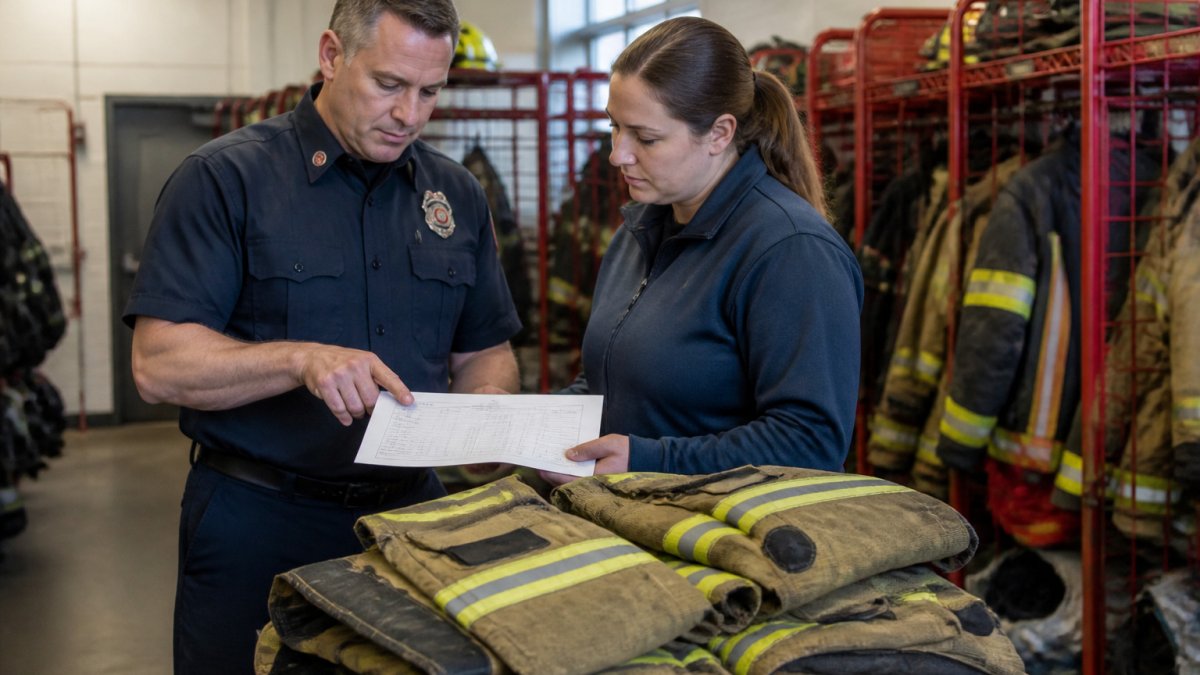
- Which specific layers (outer shell, thermal liner, moisture barrier) are PFAS-free?
- Is there documentation that the exact model meets NFPA 1970 Restricted Substances requirements?
- Is the testing from an independent lab, and is the report current?
Record each vendor's answers in the same format. Side-by-side comparison exposes gaps that a glossy brochure can hide.
Requesting Samples and Documentation Before Your Next Order
Samples and documentation are the final check before committing to a large order. Request them early so your evaluation team has time to review them properly.
When you ask a vendor for samples, specify the exact garment configuration you plan to purchase.
Share the paperwork with your safety officer, budget owner and crew representatives. Each group reads documents differently, and their questions often surface issues a single buyer might miss.
Frequently Asked Questions
What turnout gear is PFAS free?
No single brand or model is PFAS-free by default, so the answer depends on the specific product and the documentation the manufacturer provides. Some manufacturers state that they offer PFAS-free fabric, but the claim should be confirmed for the exact model you are buying. Ask for written confirmation that each layer, including the outer shell, thermal liner and moisture barrier, is free of PFAS, and request the supporting test records.
Does PFAS-free turnout gear meet applicable safety standards?
A PFAS-free label alone does not show compliance. The International Association of Fire Fighters advises departments to require proof that gear meets NFPA 1970's Restricted Substances requirements before purchase. Ask the supplier for the certification documentation and any third-party verification tied to the exact model and ensemble being ordered, not a general brand statement.
Do PFAS-free outer shells perform as well against oil?
Not always. PFAS-free outer shells may not repel oil and hydraulic fluid as effectively as treated shells. Departments should review oil and liquid repellency data alongside PFAS claims and consider how often their crews face these contaminants on the fireground.
How can a department verify that turnout gear is PFAS-free?
Start by requesting supplier documentation that identifies the restricted-substance testing performed on each gear layer. Ask for the test method, the laboratory, and the date of testing, and confirm the documents match the specific model and fabric being purchased. Where possible, review independent verification and compare claims across several manufacturers before committing to a bulk order.

