

How to Maintain Leather Fire Gear Step by Step
Table of Contents
- What You'll Need Before You Start
- Step 1: Inspect Your Leather Fire Gear for Damage
- Step 2: Pre-Treat and Remove Heavy Soil
- Step 3: How to Clean Soot Off Leather Without Damaging It
- Step 4: Choose the Best Leather Conditioner for Fire Gear
- Step 5: Dry and Store Leather Fire Gear Correctly
- NFPA 1851 Gear Maintenance Standards: What You Must Follow
- Repair or Replace? A Decision Guide for Worn Leather Gear
- Frequently Asked Questions
Last Updated: September 21, 2026
What You'll Need Before You Start
Learning how to maintain leather fire gear step by step starts with the right supplies, not the right technique. Gather these items before you touch a single soiled glove or helmet.
Here is your supply list:
- Two buckets (one for washing, one for rinsing)
- Mild soap or a pH-neutral leather cleaner
- Soft-bristle brush
- Clean microfiber cloths
- Leather conditioner made for fire gear
- Leather wax for added protection
- Warm water
- Drying rack or hanger
- Mild detergent for pre-treatment
Step 1: Inspect Your Leather Fire Gear for Damage
Inspection comes first, every single time. Routine inspection catches small problems before they become expensive ones.
Check these areas closely:
- Stitching along seams and stress points
- Leather surface for cracking, dry rot, or stiffness
- Moisture barrier for tears or delamination
- Thermal protection layers for thinning or charring
- Hardware like clips, D-rings, and snaps
Step 2: Pre-Treat and Remove Heavy Soil
Soiled gear needs pre-treatment before it touches any water. Heavy soot and particulate matter can grind into leather fibers if you scrub right away.
Step 3: How to Clean Soot Off Leather Without Damaging It
Cleaning soot off leather is simple if you keep two rules in mind: mild soap, gentle motion. Anything aggressive will shorten the life of your gear.
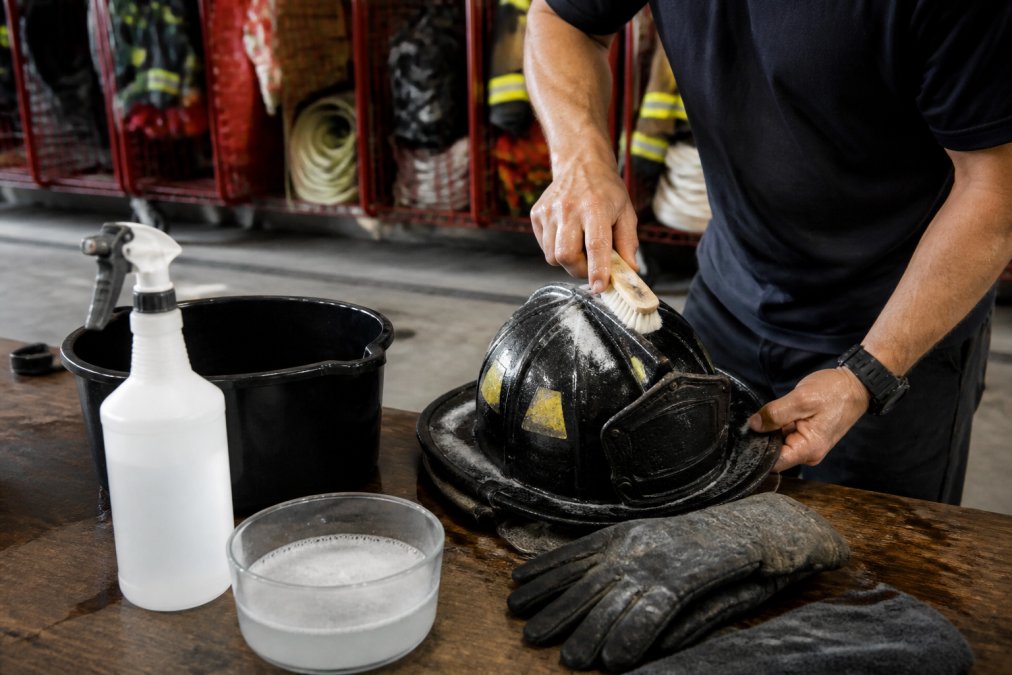
Here is the process:
- Mix mild soap with warm water in your wash bucket
- Dip the soft-bristle brush and scrub in small circles
- Work one section at a time, top to bottom
- Rinse the brush often to avoid cross-contamination
- Wipe with a clean microfiber cloth
- Rinse thoroughly with plain water
Step 4: Choose the Best Leather Conditioner for Fire Gear
The best leather conditioner for fire gear is one made specifically for the job, not a general-purpose product from a hardware store. Leather needs conditioning after every wash to stay supple and resist cracking.
What to look for:
- Made for fire service leather
- Non-petroleum based
- Restores flexibility without leaving residue
- Safe for flame-resistant treatments
Step 5: Dry and Store Leather Fire Gear Correctly
Air drying is the only safe way to dry leather fire gear. Heat and direct sunlight break down leather fibers and can warp the shape of helmets and gloves.
Follow these rules:
- Hang gear on a rack in a well-ventilated area
- Keep it out of direct sunlight
- Never use a dryer, radiator, or space heater
- Never store gear while it is still damp
- Rotate the gear periodically so air reaches the inside of gloves, sleeves, and collars
Drying Times You Can Plan Around
Leather does not dry on a fixed schedule. Ambient humidity and airflow drive the timeline more than anything else. As a working rule, most practitioners find that:
- A lightly soiled glove or helmet dries in a few hours in a ventilated bay
- A fully soaked coat or pair of pants can take a full day or more
- Gear dried in a closed, humid room can take twice as long and may never fully dry
Long-Term Storage in High-Humidity Environments
This is the part most guides skip. If you store gear in a basement, a coastal station, or any space where relative humidity stays high, mold and mildew are the real threat, not just stiffness.
Badge Bifold Used Bunker Gear Wallet →
What works:
- Use a breathable gear bag, never a sealed plastic bin. Sealed containers trap moisture against the leather and invite mildew.
- Keep gear off the floor and away from exterior walls, which stay cooler and condense moisture.
- Add a moisture-absorbing packet or a rechargeable desiccant canister to the storage area, and check it monthly.
- Run a dehumidifier or a fan in the storage room if the space stays damp.
- Inspect stored gear at least monthly for the first signs of mildew: a white or gray powdery film, a musty smell, or dark speckling along seams and stitching.
Storage Conditions to Avoid
Store gear away from fuel, solvents, and exhaust fumes. Those vapors settle into leather and can degrade the material over time. Also keep gear out of hot vehicles and unventilated apparatus bays in summer, heat accelerates the drying and cracking of leather even when the gear is not in use.
NFPA 1851 Gear Maintenance Standards: What You Must Follow
NFPA 1851 sets the standard for how fire departments and firefighters care for their protective gear. Following it is not optional in most departments, and it protects both your safety and your gear's lifespan.
The Cleaning Levels and When They Apply
- Routine cleaning, after every use. This is the mild soap and water wash you do at the station. It removes surface soot and light soil.
- Advanced cleaning, at least once a year, and any time gear has been heavily contaminated. This is a more thorough wash, often done with a gear washer or an established cleaning service, and it may include decontamination for carcinogens and other fireground contaminants.
- Specialized cleaning, when gear has been exposed to specific hazards such as bloodborne pathogens, certain chemicals, or other contaminants that routine and advanced cleaning cannot address. This is handled by a qualified service, not at the station.
The Inspection Levels and When They Apply
- Routine inspection, after each use and at least monthly. You are looking for obvious damage: tears, cracking, missing hardware, and contamination.
- Advanced inspection, at least once a year, and after any event that may have compromised the gear. This is a more detailed check of the moisture barrier, thermal liner, seams, and hardware, and it is often performed by a trained inspector or a verified service provider.
What Triggers Advanced Care
Gear does not need to look dirty to need advanced cleaning. Common triggers include:
- Heavy soot or charring from a working fire
- Exposure to bloodborne pathogens or bodily fluids
- Exposure to hazardous chemicals or unknown contaminants
- A visible failure in the moisture barrier or thermal liner
- Gear that has reached the manufacturer's recommended service interval
Documentation and Recordkeeping
The standard expects departments to keep records of cleaning, inspection, and repair for each piece of gear. In practice, that means a log that ties each garment or helmet to its cleaning dates, inspection results, repairs, and eventual retirement. If your department does not already have a system, a simple gear log, paper or digital, is enough to start, as long as it is kept current.
Manufacturer Instructions Override General Guidance
Always check manufacturer instructions before cleaning any piece of gear. Some liners and moisture barriers have specific care requirements that override general guidance. A liner that tolerates one cleaning method may be damaged by another, and using the wrong method can void the warranty and compromise protection. The NFPA 1851 standard documentation outlines the full requirements for each cleaning and inspection level.
PPE Lifecycle Management
PPE lifecycle management matters here. Gear that passes inspection stays in service. Gear that fails gets removed. Retirement is not just about age, it is about condition, exposure history, and whether the gear can still do its job. A piece of gear that has been through a significant fire event may be retired well before its nominal service life, and a piece that has been carefully maintained may serve longer.
Advanced cleaning and advanced inspection are not the same thing, and one does not substitute for the other. Gear can be clean and still fail an advanced inspection. Do not treat a wash as a substitute for a structural check.
Repair or Replace? A Decision Guide for Worn Leather Gear
Not every crack means replacement. Use this decision matrix to make the call.
| Condition | Action | Why |
|---|---|---|
| Minor surface scuffs | Condition and continue use | Cosmetic only, no safety impact |
| Small stitching repair needed | Send for repair | Structural repair is allowed |
| Cracking or dry rot | Replace | Thermal protection is compromised |
| Moisture barrier tear | Replace | Barrier cannot be repaired |
| Charred or melted areas | Replace immediately | Heat exposure has damaged fibers |
| Past manufacturer service life | Replace | Retirement criteria met |
Frequently Asked Questions
How often should you condition leather fire equipment?
Condition leather fire gear every 3 to 6 months under normal use, or immediately after any exposure to high heat, heavy soiling, or hazardous materials. Gear used frequently in structural firefighting may need conditioning more often. Check the leather after each wash cycle. If it feels stiff, dry, or shows early cracking, apply a leather conditioner approved for fire gear. Over-conditioning can attract dirt, so stick to the manufacturer's recommended interval and inspect regularly.
Can I use saddle soap on leather fire gear?
Saddle soap is designed for horse tack and similar leather goods, not for firefighting PPE. NFPA 1851 gear maintenance standards require cleaning agents that will not degrade flame-resistant properties or leave flammable residue. Some saddle soaps contain oils, glycerin, or waxes that can compromise thermal protection. Use a mild soap or a cleaner specifically approved for fire gear instead. Always follow the manufacturer's instructions on your gear's label before applying any product.
What is the best way to dry leather fire gear after exposure?
Air dry leather fire gear in a well-ventilated area away from direct sunlight and heat sources. Hang helmets and gloves so air circulates around them. Never use a dryer, radiator, or space heater, because high heat causes leather to crack and damages the moisture barrier. If gear is heavily soaked, blot excess water with a clean cloth first. Position a fan nearby to speed drying without adding heat. Leather should be fully dry before you condition it or return it to service.
What products should be avoided when cleaning leather fire gear?
Avoid petroleum-based products, bleach, harsh solvents, and household degreasers. These strip natural oils, weaken abrasion resistance, and can leave flammable residue on your gear. Do not use saddle soap, dish soap with heavy degreasers, or any cleaner not approved for firefighting PPE. Also skip wire brushes and abrasive pads, which scratch the leather surface and create weak points. Stick to mild soap, a soft-bristle brush, and conditioners formulated for fire gear to protect thermal protection and structural integrity.
