

Why Quality Firefighter Apparel Matters: Safety & Performance
Table of Contents
- Why Quality Firefighter Apparel Matters for On-Duty Performance
- NFPA Standards and Regulatory Compliance in Firefighter Gear
- Firefighter Turnout Gear Materials: Durability and Heat Resistance
- Proper Fit, Sizing, and Ergonomic Design in Station Wear
- Firefighter Gear Maintenance: Care, Cleaning, and Longevity
- Firefighter Apparel Technology: Breathability and Moisture-Wicking
- Long-Term Health Impacts and Sustainable FR Materials
- Budgeting for Quality Firefighter Apparel: Department vs. Individual Purchases
Last Updated: July 17, 2026
Why Quality Firefighter Apparel Matters for On-Duty Performance
Gear isn't just clothing, it's the barrier between a firefighter and an environment that can kill in seconds. Quality turnout gear directly correlates with survival rates, comfort during extended operations, and long-term health outcomes. A firefighter's gear must perform under extreme heat, chemical exposure, sharp debris, and moisture that compromises thermal protection. When gear fails or fits poorly, firefighters face increased burn injury risk, reduced mobility during rescue operations, and cumulative health damage from chemical exposure.
The Direct Link Between Gear Quality and Firefighter Safety
Premium firefighter apparel directly impacts survival in high-heat environments. Cheaper gear uses lower-quality outer shells that degrade faster, thinner moisture barriers that allow sweat and water to reach skin, and base layer materials that retain heat rather than wick it away. A firefighter wearing quality turnout gear experiences lower core body temperature during extended operations, reduced heat stress symptoms, and better dexterity during precision tasks like victim rescue.
Quality apparel also prevents contamination absorption. Firefighting environments contain carcinogenic particulates including benzene, formaldehyde, and polycyclic aromatic hydrocarbons (PAHs). Superior gear fabrics repel these particles and allow effective decontamination. Cheaper materials absorb contaminants into the fiber structure, creating persistent chemical exposure with every wear.
Station wear matters too. Quality station shirts and hoodies maintain integrity through hundreds of washes, resist fading, and support the professional identity of the fire service. Studies show that wearing professional, well-maintained gear increases confidence and team cohesion.
NFPA Standards and Regulatory Compliance in Firefighter Gear
NFPA 1971 sets minimum performance standards for structural firefighting protective ensembles. The standard specifies requirements for thermal protection, flame resistance, tear strength, moisture barrier integrity, and ergonomic design. Gear must pass rigorous testing including exposure to open flame and thermal shrinkage limits.
Low-quality barriers degrade faster, lose water-repellency after 50-100 washes, and fail in high-humidity environments. Premium gear uses advanced moisture-wicking synthetics that maintain barrier integrity for 200+ washes. Wildland firefighting gear follows NFPA 1977 standards, prioritizing visibility and mobility while maintaining thermal protection.
Departments should request NFPA certification documentation and test reports from manufacturers, not just take compliance claims at face value.
Firefighter Turnout Gear Materials: Durability and Heat Resistance
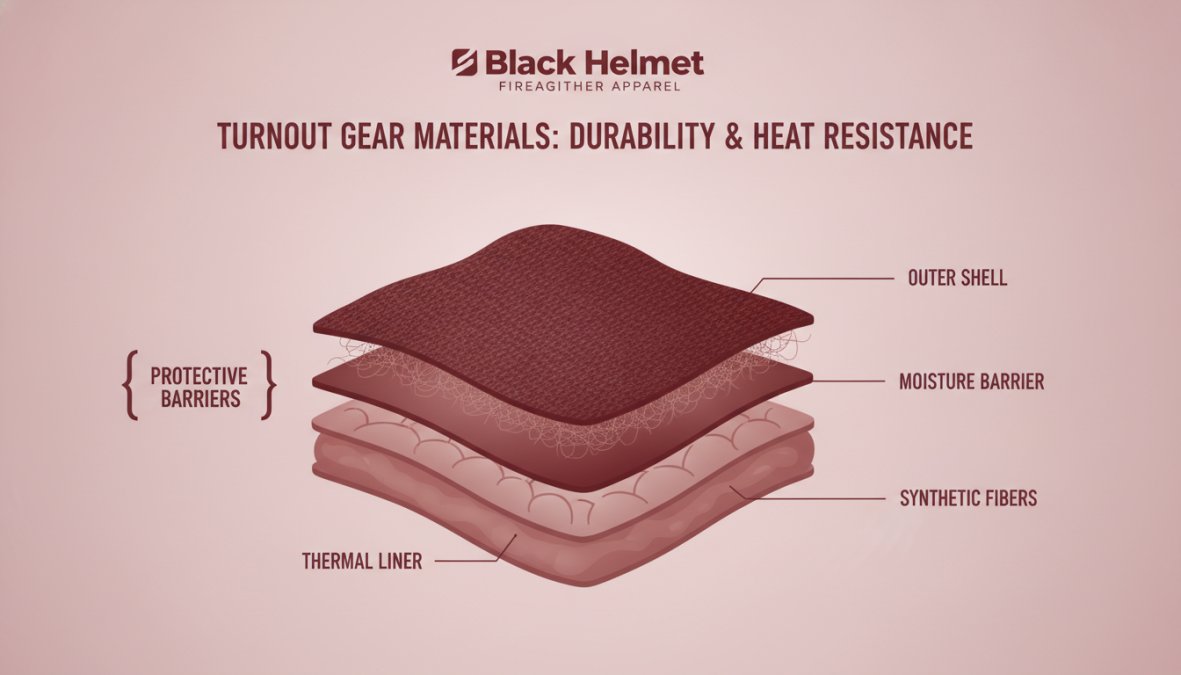
Turnout gear uses multiple material layers, each serving a specific function. The outer shell, typically a blend of aramid fibers (like Nomex) and polyester, must resist flame, tear, and abrasion. Premium outer shells use high-denier aramid with tight weaves that resist snagging and maintain structural integrity through hundreds of heat exposures.
The thermal liner provides insulation and heat resistance. Quality thermal liners use closed-cell foam or advanced synthetic batting that maintains thickness even when saturated. The moisture barrier prevents water and sweat from reaching the thermal liner and skin, preventing steam burns. Premium barriers use proprietary membranes that allow vapor transmission while blocking liquid water.
Base layers significantly impact thermal management. Quality base layers use moisture-wicking synthetic fibers that pull sweat away from skin. Cotton base layers retain moisture and increase heat stress. Seams must be sealed, not just stitched, quality gear uses taped or welded seams that prevent moisture and contaminants from entering through stitching holes.
Synthetic Fibers vs. Natural Materials: What Works Best
Aramid fibers (Nomex, Kevlar) are the gold standard because they maintain strength at temperatures where cotton and wool degrade. Aramid chars rather than melts, preserving the protective barrier longer than natural fibers. Polyester melts at lower temperatures and can stick to skin, increasing burn severity. Quality gear minimizes polyester in the outer shell.
Cotton performs poorly in firefighting applications, it absorbs moisture, loses strength when wet, and offers minimal flame resistance. Merino wool appears in some premium base layers because it naturally wicks moisture and regulates temperature, but should never be used in outer shells or thermal liners.
The best gear uses aramid-dominant blends in outer shells (85%+ aramid), advanced synthetic thermal liners with high loft retention, and moisture barriers combining multiple technologies.
Thermal Protection and Burn Injury Prevention
Thermal protection depends on how long gear maintains a barrier between skin and heat. NFPA 1971 requires gear to provide at least 24 seconds of protection in standardized thermal tests. Quality gear often exceeds this significantly, providing 35-45+ seconds of protection.
Moisture in gear dramatically reduces thermal protection. Wet gear conducts heat much faster than dry gear, which is why moisture barrier integrity is critical. Fit impacts thermal protection too, loose gear allows air circulation that carries heat toward skin, while tight gear maintains the protective barrier more effectively.
Repeated thermal exposure degrades gear. Every high-heat exposure causes materials to lose structural integrity. Quality gear maintains thermal protection through many exposures; cheap gear degrades rapidly.
Proper Fit, Sizing, and Ergonomic Design in Station Wear
Quality station wear uses ergonomic design accounting for actual firefighter movements: reaching overhead, bending to pick up objects, rotating to check gauges, and climbing stairs in full gear. Cheap station wear uses generic patterns that restrict movement.
Sizing matters tremendously. Gear that's too tight restricts movement and increases heat stress; gear that's too loose creates gaps allowing heat and contaminants to enter. Quality apparel maintains appearance through hundreds of washes using colorfast dyes and durable construction. Cheap station wear fades quickly, shrinks unpredictably, and falls apart within 50-100 washes.
The psychological impact of quality station wear shouldn't be underestimated. Firefighters wearing well-fitting, professional-looking gear feel more confident and connected to the brotherhood.
How Dexterity and Range of Motion Impact Rescue Operations
Turnout gear must allow full range of motion while maintaining protection. Quality gear achieves mobility through strategic design: articulated sleeves that bend at the elbow without bunching, gussets under the arms that expand when reaching overhead, and pants with crotch gussets allowing full stride.
Quality glove design balances protection with dexterity, the material must be thin enough to feel what you're touching while remaining thick enough to provide thermal and cut protection. The weight and distribution of gear matter too. Quality gear distributes weight evenly across shoulders and torso, minimizing fatigue during multi-hour operations.
Firefighter Gear Maintenance: Care, Cleaning, and Longevity
Proper maintenance extends gear life and maintains protective performance. Turnout gear should be cleaned after every exposure to remove carcinogenic particulates and prevent absorption deeper into the material.
Most departments use commercial gear washers designed specifically for turnout gear, using low-temperature water and specialized detergents. Gear should be air-dried in well-ventilated areas, never machine-dried. Quality gear dries within 24-48 hours. Station wear should be washed separately using standard commercial laundry equipment.
Storage matters too. Gear should be stored in cool, dry locations away from direct sunlight. UV exposure degrades materials over time. A well-maintained set of quality turnout gear lasts 5-7 years with regular use. Cheap gear often needs replacement within 2-3 years.
Decontamination Protocols and Off-Gassing Concerns
Turnout gear absorbs carcinogenic compounds during structure fires, including benzene, formaldehyde, and polycyclic aromatic hydrocarbons (PAHs). Quality gear with superior outer shells and moisture barriers resists absorption; cheap gear allows compounds to penetrate the material structure.
Once absorbed, contaminants must be removed through washing. Standard washing removes surface contaminants but may not fully extract compounds embedded in fiber structure. Off-gassing risk varies dramatically based on material quality. Premium gear materials resist absorption and allow effective cleaning. Cheap materials absorb contaminants deeply and retain them even after washing.
Departments should establish decontamination protocols including post-fire cleaning within a few hours of exposure, not days later.
Firefighter Apparel Technology: Breathability and Moisture-Wicking
Breathability refers to gear's ability to allow water vapor (sweat) to escape while blocking liquid water. Quality barriers allow vapor transmission rates of 3,000-5,000 g/m²/24h, preventing sweat buildup while maintaining water protection. Cheap barriers use basic plastic films that block both liquid water and water vapor, creating a sauna effect inside the gear.
Moisture-wicking base layers use synthetic fibers engineered to pull moisture away from skin. Quality base layers achieve this through fiber structure that moves sweat laterally across the fabric surface where it can evaporate. Seamless construction in base layers reduces friction and prevents chafing during extended operations.
Temperature regulation technology in premium gear helps maintain optimal core temperature. Some advanced materials use phase-change materials (PCMs) that absorb excess heat when overheating and release it when temperature drops.
Base Layers and Heat Stress Management
Quality base layers should use 100% synthetic fibers (polyester, polypropylene, or blends) that wick moisture effectively. A firefighter wearing quality base layers experiences lower core temperature during operations and reduced heat stress symptoms.
Fit is critical in base layers. Quality base layers use ergonomic cuts that fit snugly without restriction. Seamless or flat-lock construction prevents chafing. Standard stitching creates ridges that can cause blistering during extended operations. Thickness varies based on expected conditions, lightweight base layers (2-3mm) work well for structure fires; heavier base layers (5-7mm) provide better insulation for wildland firefighting.
Heat stress management depends on the entire system working together. Quality outer shell, thermal liner, moisture barrier, and base layers all contribute to maintaining safe core temperature.
Long-Term Health Impacts and Sustainable FR Materials
The conversation around firefighter apparel is expanding beyond immediate safety to include long-term health impacts and sustainability. Carcinogen exposure from firefighting is well-documented. Quality apparel reduces absorption and allows more effective decontamination, but doesn't eliminate exposure entirely.
Chemical off-gassing from synthetic materials is an emerging concern. Gear materials engineered to resist absorption and allow effective cleaning reduce these risks. Sustainability is becoming increasingly important for departments making large-scale gear purchases. Eco-friendly FR materials are emerging, including bio-based flame-resistant fibers that maintain performance while reducing environmental impact.
Chemical Exposure and Eco-Friendly Alternatives
Traditional FR materials rely on chemical treatments to achieve flame resistance. Advanced FR materials like aramid fibers are inherently flame-resistant, the fiber itself resists burning. Eco-friendly alternatives include bio-based aramid fibers and advanced polybenzimidazole (PBI) materials that are inherently flame-resistant without chemical treatments.
Departments should ask manufacturers about the FR treatment process. Quality manufacturers are transparent about whether materials are chemically treated or inherently flame-resistant. The cost difference between traditional and eco-friendly FR materials is significant, typically 15-25% higher for sustainable alternatives.
Budgeting for Quality Firefighter Apparel: Department vs. Individual Purchases
A complete structural firefighting ensemble from a quality manufacturer costs $3,000-5,000 per firefighter. For a 50-person department, this represents $150,000-250,000 in initial investment. When calculating total cost of ownership, quality gear wins. A quality ensemble lasts 5-7 years with proper maintenance; cheap gear needs replacement every 2-3 years.
Over a 10-year period, a department buying cheap gear needs 3-4 replacements, while a quality-focused department needs 1-2 replacements. The total cost is often comparable, but quality gear provides superior protection throughout.
| Gear Type | Quality Cost | Cheap Cost | Quality Lifespan | Cheap Lifespan | 10-Year Total (Quality) | 10-Year Total (Cheap) |
|---|---|---|---|---|---|---|
| Structural Ensemble | $4,000 | $2,000 | 6 years | 2.5 years | $6,500 | $8,000 |
| Wildland Ensemble | $2,000 | $1,000 | 5 years | 2 years | $4,000 | $5,000 |
| Station Wear (5 items) | $300 | $100 | 3 years | 1 year | $1,000 | $1,000 |
| Base Layers (3 sets) | $150 | $50 | 2 years | 1 year | $375 | $500 |
Department purchasing should prioritize bulk discounts from quality manufacturers rather than seeking the cheapest options. Most quality manufacturers offer volume pricing that makes bulk purchases more economical. Departments should also establish maintenance budgets, proper cleaning and care extends gear life and maintains protection.
Individual firefighters should invest in quality base layers and station wear even if their department provides turnout gear. Quality base layers cost $40-60 per set; cheap base layers cost $10-20. The difference in comfort and performance during 12+ hour shifts justifies the investment.
Quality firefighter apparel directly impacts survival, health, and long-term career sustainability. The difference between premium gear and cheap alternatives manifests in thermal protection, durability, contamination resistance, and the ability to maintain performance through hundreds of exposures. Departments and individual firefighters who prioritize quality gear make an investment that pays dividends through reduced injury risk, extended gear life, and better health outcomes over a career.
Frequently Asked Questions
What makes quality firefighter apparel different from standard clothing?
Quality firefighter apparel meets rigorous NFPA standards for flame resistance, thermal protection, and durability. It features multiple protective layers, moisture-wicking base layers, and materials engineered to resist extreme heat and burn injury. Standard clothing offers no thermal protection and fails to meet safety compliance requirements essential for structural and wildland firefighting operations.
How do NFPA standards impact firefighter gear requirements?
NFPA 1971 and related standards establish minimum performance criteria for turnout gear, including flame resistance, heat transfer resistance, and protective barrier integrity. Compliant gear must withstand specific thermal exposures and demonstrate durability through rigorous testing. Departments rely on these standards to ensure all station wear meets hazard mitigation requirements and protects firefighters from carcinogens and thermal hazards.
What are the long-term health impacts of poor-quality firefighter apparel?
Low-quality apparel offers inadequate protection against off-gassing from synthetic materials, increasing exposure to harmful chemicals during high-heat operations. Poor fit restricts dexterity and range of motion, leading to injury during rescue operations. Inferior materials degrade faster, creating gaps in the protective barrier. Inadequate breathability and moisture-wicking compounds heat stress, affecting firefighter wellness and performance over time.
How often should firefighters replace quality turnout gear?
Proper gear maintenance and decontamination protocols extend longevity, but turnout gear typically requires replacement every 5-10 years depending on use frequency and care. Regular cleaning removes contamination that degrades materials. Inspection for thermal damage, fit issues, and protective barrier integrity should occur annually. Quality FR materials maintain durability longer than inferior alternatives, making premium gear a cost-effective long-term investment for departments and individual firefighters.
This article was written using GrandRanker
