

What Is the Golden Rule in the Fire Service?
Table of Contents
- The Golden Rule in the Fire Service: One Phrase, Many Meanings
- Why the Term Causes Confusion
- The Golden Rule of Firefighting: Everyone Goes Home
- Firefighter Brotherhood Traditions That Carry the Rule
- Fire Service Core Values Behind Every Decision
- The Firefighter Code of Ethics as the Written Version
- The Psychological Golden Rule: Treating Crew the Way You Want to Be Treated
- Conclusion
- Frequently Asked Questions
Last Updated: September 16, 2026
The Golden Rule in the Fire Service: One Phrase, Many Meanings
Ask ten firefighters "What is the golden rule in the fire service?" and you may get ten answers: "Everyone Goes Home," the brotherhood code, how you treat your crew, or the written ethics that govern the job. This guide from Black Helmet breaks down every meaning behind the phrase.
Search the term and you'll find results about nutrition, hose-line tactics, and fireground decision-making, all claiming the same title. The fire service doesn't have one official golden rule, but a cluster of principles that all point in the same direction.
Most guides pick one definition and ignore the rest. The better approach is to understand where each version comes from and why it matters.
Why the Term Causes Confusion
The phrase "golden rule" gets applied to at least four ideas in fire service culture, and that overlap is the root of the confusion.
- Safety-first interpretation: "Everyone Goes Home," the idea that no property is worth a firefighter's life
- Brotherhood interpretation: Treat your crew the way you want to be treated
- Ethical interpretation: The formal code of conduct every firefighter is expected to follow
- Operational interpretation: The habits and tactics that keep a fireground under control
Each is legitimate, used by real departments, and shapes how firefighters think about the job.
A firefighter in one house might think about risk assessment before entering a structure fire; a firefighter in another might think about how they speak to a probie on their first shift. Both are correct.
That flexibility is a strength: the golden rule adapts to the situation in front of you, whether a working fire, a training drill, or a tough conversation in the day room.
The Golden Rule of Firefighting: Everyone Goes Home
The most common answer to "what is the golden rule in the fire service?" is simple: everyone goes home. Every firefighter who responds to a call returns safely to their family at the end of the shift.
That principle sits underneath almost every fireground decision: why incident command conducts a size-up before committing crews, why risk assessment comes before action, and why a defensive strategy sometimes beats an aggressive interior attack.
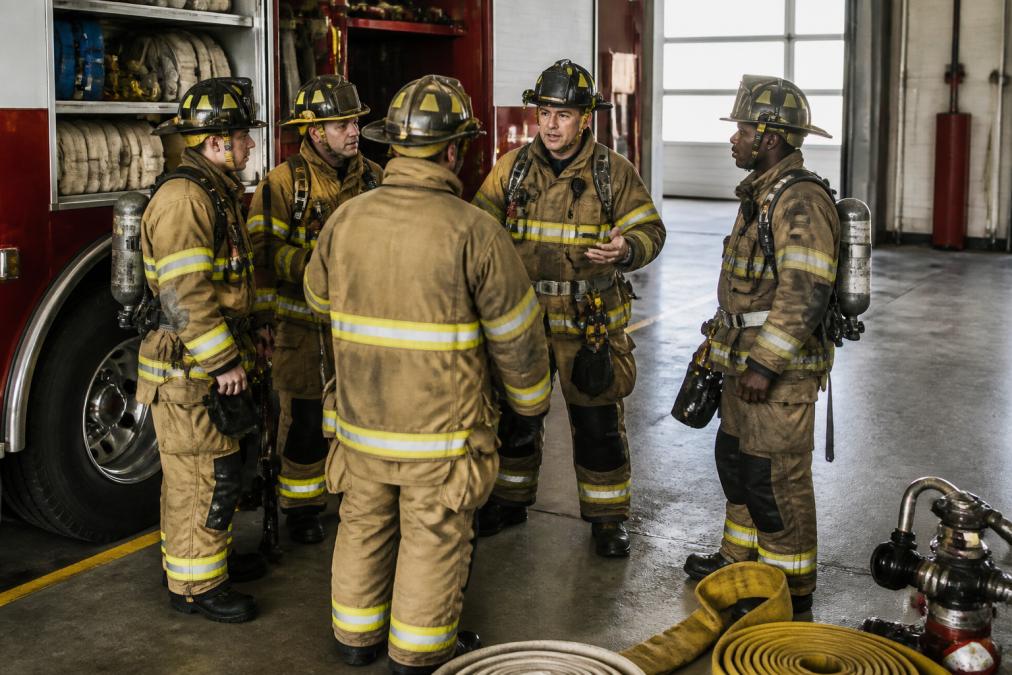
How the Rule Shows Up on the Fireground
The "everyone goes home" principle is not abstract. It shows up in concrete decisions every shift:
- A safety officer calls a mayday when a firefighter goes down inside a structure fire
- A crew backs out of a room when the floor shows signs of collapse
- An incident commander holds a company at the door until a backup line is charged
- A company officer enforces personal protective equipment standards, even when it's hot and the crew wants to move fast
These decisions don't feel heroic, but they keep life safety the priority on every call.
"Everyone goes home" isn't just about the firefighter. It's also about the family waiting at the kitchen table.
Firefighter Brotherhood Traditions That Carry the Rule
Firefighter brotherhood traditions are how the golden rule gets passed from one generation to the next.
Some traditions are formal. The National Fallen Firefighters Foundation honors the memory of firefighters who died in the line of duty and supports their families, which keeps the "everyone goes home" commitment visible long after a loss.
Others are informal but just as powerful:
- Wearing a fallen firefighter's helmet number or badge
- Passing a challenge coin to a new member who earned it
- Cooking for the crew on your shift, no exceptions
- Standing behind a brother or sister when they're struggling off the job
These traditions carry weight because they're earned, not given. A challenge coin isn't a souvenir but a token of respect that says you've proven yourself to the crew. That's why [Black Helmet's Fight Fire 4 Principles Challenge Coin](https://blackhelmetapparel.com/products/black-helmet-fight-fire-challenge-coin) carries the four principles of the fire service, tradition, dedication, courage, and sacrifice.

Fire Service Core Values Behind Every Decision
Fire service core values are the standards that guide how firefighters behave when no one is watching. They're not slogans but operating instructions, and they matter because the fireground strips away everything except the decision in front of you.
Fight Fire 4 Principles, Dedication →
There is no single federally mandated list of core values. The National Fire Protection Association (NFPA) publishes professional qualification standards such as NFPA 1001 and NFPA 1021, but those define job performance requirements, not a values statement. Departments write their own, so the wording varies even when the underlying commitments don't.
The values that show up most often across department mission statements and academy curricula include:
- Duty: Showing up ready, every shift, regardless of how you feel
- Integrity: Doing the right thing when the easy thing is available
- Courage: Acting despite fear, not in the absence of it
- Respect: Treating the public, your crew, and yourself with dignity
- Accountability: Owning your decisions and their outcomes
What separates a real value from a wall poster is whether it changes a decision.
Duty is the reason a company checks its self-contained breathing apparatus (SCBA) cylinders and PASS devices at the start of every shift rather than assuming the last crew did it. Skipping it is how a regulator fails on air.
Integrity is the reason a firefighter reports a damaged hose coupling instead of quietly returning it to the rack. The next crew would find out at the worst possible moment.
Courage is the reason a company officer calls a mayday instead of waiting one more minute to see if the situation improves. Delaying it invites a fatality.
Respect is the reason a crew treats a patient experiencing a mental health crisis the same way it treats a cardiac patient.
Accountability is the reason a department runs a post-incident analysis after a close call rather than moving on to the next alarm. The review is uncomfortable. It's also how the next close call becomes a non-event.
A common mistake in younger firefighters is treating core values as something you demonstrate on big calls.
The Firefighter Code of Ethics as the Written Version
- Act with integrity in every situation, on duty and off
- Place the safety of the public and your crew above your own
- Treat every person with dignity, regardless of the circumstances
- Refuse to compromise standards for convenience
- Hold yourself and your peers accountable
- Represent the fire service with pride in public
- Adoption: The department formally adopts the code, often by reference to the IAFC model, and includes it in the recruit academy curriculum.
- Acknowledgment: New members sign or otherwise acknowledge the code as a condition of membership, which converts it from a suggestion into an expectation.
- Application: Supervisors apply the code during performance reviews, promotion boards, and disciplinary proceedings, so it's cited in real decisions rather than filed away.
- Review: The department revisits the code periodically to confirm it still reflects the agency's values and the community it serves.
International Association of Fire Chiefs
The Psychological Golden Rule: Treating Crew the Way You Want to Be Treated
This version shows up in small moments:
- A senior firefighter correcting a probie without humiliating them in front of the crew
- A company officer admitting a mistake before the crew has to point it out
- A crew member checking in on a colleague who's been quiet since a tough call
Conclusion
The golden rule in the fire service is not one thing.
Frequently Asked Questions
What is the golden rule of firefighting?
The most common answer in the fire service is simple: everyone goes home. It means no firefighter's safety is traded away for speed, pride, or convenience. In practice it shapes tactics, risk assessment, and incident command on every call. It also shapes how crews treat each other in the station, because a crew that watches out for one another on the fireground usually does the same off it.
What is the fireman's code?
The fireman's code is a set of conduct commitments covering duty, integrity, and respect for the job. It asks firefighters to protect life and property, stay physically and mentally fit, follow orders, and keep the trust the public places in them. It overlaps closely with the firefighter code of ethics and with fire service core values like courage, accountability, and service. Departments often read it aloud at recruit graduations.
How does the golden rule impact firefighter brotherhood traditions?
Firefighter brotherhood traditions exist to keep the rule alive between calls. Station meals, shift rituals, challenge coins, and helmet decals all mark membership and remind a crew that the person beside them is counting on them. Those traditions also carry memory: they honor retirees and fallen members, which keeps the standard visible for the next generation of firefighters coming through the academy.
What are the core values that define the fire service?
The recurring values are courage, dedication, tradition, sacrifice, integrity, and service to others. Departments phrase them differently, but the theme is consistent: put the public and your crew ahead of yourself. Black Helmet's Fight Fire 4 Principles Challenge Coin ($24.50) names four of these directly (dedication, tradition, courage, sacrifice) as a physical reminder firefighters can carry every shift.
