

Signs of Burnout in First Responder Relationships
Table of Contents
- Recognizing the Signs of Burnout in First Responder Relationships
- First Responder Burnout Symptoms That Show Up at Home
- Burnout vs. Compassion Fatigue in First Responders
- How to Support a First Responder Spouse Without Enabling Withdrawal
- First Responder Relationship Communication: Scripts for Raising Concerns
- When Burnout-Related Relationship Strain Needs Professional Support
- Relationship Repair Strategies for First Responder Schedules
- Frequently Asked Questions
Last Updated: October 15, 2026
Recognizing the Signs of Burnout in First Responder Relationships
The signs of burnout in first responder relationships often show up long before anyone says "burnout" out loud. A firefighter goes straight to the garage.
This guide covers what to look for, how to talk about it, and when to get professional support.
The National Institute of Mental Health's resources on post-traumatic stress explains that repeated exposure to traumatic events changes how the brain and body respond to stress.
A Relationship-Specific Burnout Checklist
Burnout is physical and emotional exhaustion from prolonged stress the person can't recover from between shifts. In relationships, it shows up as withdrawal, short fuses, and a partner who feels more like a roommate than a teammate.
For the first responder:
- I feel drained before my shift even starts
- I snap at my partner over small things
- I'd rather be alone than talk when I get home
For the partner:
- I feel like I'm walking on eggshells
- I've stopped sharing things because it doesn't seem to matter
- I handle everything at home alone, even on their days off
You can find more symptom guidance through the Substance Abuse and Mental Health Services Administration's behavioral health resources. The checklist above is a starting point, not a diagnosis.
First Responder Burnout Symptoms That Show Up at Home
First responder burnout symptoms at home fall into recognizable patterns: emotional exhaustion (nothing left by dinner), chronic fatigue (ten hours of sleep, still wrecked), and insomnia from shift work or mandatory overtime.
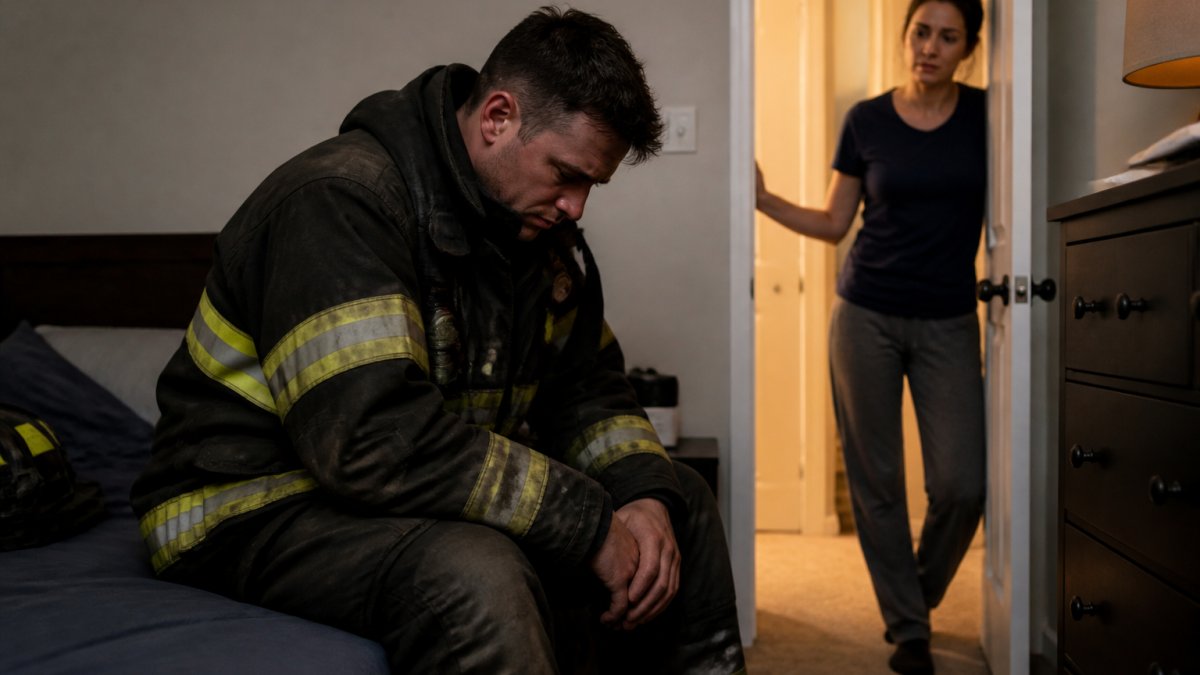
Watch for these at-home signs:
- Irritability and mood changes that seem out of proportion to the moment
- Emotional numbness where happy news gets a flat response
- Withdrawal into the garage, the phone, or the recliner
Burnout vs. Compassion Fatigue in First Responders
Burnout and compassion fatigue overlap but aren't the same. Burnout is exhaustion from chronic workplace stress: long hours, understaffing, no recovery time. Compassion fatigue is the emotional wear from repeatedly absorbing other people's trauma. Burnout responds to rest, boundaries, and workload changes; compassion fatigue often needs trauma-informed support.
| Factor | Burnout | Compassion Fatigue |
|---|---|---|
| Main cause | Chronic job stress, understaffing | Repeated exposure to others' trauma |
| Core feeling | Drained, detached, cynical | Numb, grieving, overwhelmed |
| Shows up as | Withdrawal, irritability, apathy | Intrusive memories, avoidance behaviors |
| Recovery path | Rest, boundaries, schedule changes | Trauma-informed therapy, peer support |
| Timeline | Builds over months or years | Can appear after a single bad call |
Many first responders deal with both at once, which is why a professional assessment beats self-diagnosis.
Where the Comparison Usually Stops, and Why That's a Problem
Most guides stop at burnout versus compassion fatigue.
Burnout-related relationship strain. The responder is depleted, not damaged, they withdraw because they have nothing left, not because they've stopped caring.
PTSD. The defining feature is re-experiencing, not exhaustion: intrusive memories, nightmares, flashbacks, and hypervigilance that doesn't switch off at home.
Ordinary relationship conflict. Sometimes the strain isn't clinical, an unresolved argument, an unfair division of labor, a resentment swallowed for years.
A Practical Way to Tell Them Apart
You don't need a diagnosis to know when to seek one. Use these questions as a filter:
- Does it track the schedule? Easing after genuine time off points to burnout; worsening during downtime points to PTSD or depression.
- Is it targeted or global? Avoidance of one place, person, or call points toward PTSD. A flat response to nearly everything points toward depression or severe burnout.
- Does rest fix it? Burnout usually responds to sleep, boundaries, and workload change within weeks. PTSD and depression typically do not.
When to Push for a Professional Assessment
Self-comparison has limits. Push for an assessment when:
- Symptoms last more than a few weeks and don't improve with rest
- The responder has stopped functioning at work or at home
- Alcohol or substance use has increased and isn't slowing down
A department peer support team, an employee assistance program, a primary care physician, or a licensed therapist are all reasonable first calls. The Substance Abuse and Mental Health Services Administration's behavioral health resources can help you find local options, and the Centers for Disease Control and Prevention's guidance on suicide prevention lists 988 as the Suicide and Crisis Lifeline for anyone in immediate crisis.
Getting the label right matters less than getting the response right. Burnout, compassion fatigue, PTSD, and depression respond to different things, and guessing wrong can mean months of the wrong kind of help.
How to Support a First Responder Spouse Without Enabling Withdrawal
Supporting a first responder spouse means staying present without becoming a doormat, keeping the door open while holding a line on what you need. Start with these steps:
- Name what you see, not what you assume. "You've been quiet since Tuesday" beats "You don't care about us anymore."
- Pick the timing. Right after a shift is the worst window. Wait until they've eaten and decompressed.
- Ask one question at a time. "How are you doing, really?" lands better than a list.
- Let silence sit. You don't need to fill every pause.
- Hold boundaries on the big stuff. Alcohol use, missed family events, and blowups are not things to tiptoe around.
- Take care of yourself on purpose. You cannot pour from an empty cup, and resentment builds fast when you try.
Partners need their own support system. A spouse with no one to talk to becomes a pressure cooker. Find a friend, a therapist, or a family support group, and use it.
First Responder Relationship Communication: Scripts for Raising Concerns
Good first responder relationship communication comes down to timing, tone, and one clear ask per conversation. Skip the ambush.
Here are three scripts you can adapt:
Opening the conversation:
"I want to talk about something, and it's not a fight. Can we find 20 minutes tonight after the kids are down?"
Naming the concern:
"I've noticed you've been pulling away lately, and I miss you. I'm not asking you to fix anything right now.
Asking for professional help:
"I love you, and I'm worried. I'd like us to talk to someone together.
When Burnout-Related Relationship Strain Needs Professional Support
Some situations need more than a good talk. Get professional support right away if you see:
- Talk of self-harm, suicide, or "everyone would be better off"
- Drinking or substance use that has increased and isn't slowing down
- Physical aggression, threats, or fear inside the home
The Centers for Disease Control and Prevention's guidance on suicide prevention lists 988 as the Suicide and Crisis Lifeline. Firefighters and their families can also reach the Firefighter Behavioral Health Alliance for peer-informed support.
Relationship Repair Strategies for First Responder Schedules
Repair takes time and a plan that fits shift work. You can't schedule connection like a normal couple when one person is on a 24-hour rotation, so build around it, not against it. A 24-hour shift, a swing to nights, or a bid change every few months resets the whole household clock. Strategies that ignore that reality fail within a week.
Build Around the Shift, Not the Calendar
Start by mapping the actual week: shift schedule, commute, mandatory training, recovery day. Then place connection where it can survive.
- Anchor rituals. Coffee together after every shift, no phones. Short, repeatable, and it doesn't require the responder to be fully "on."
- Decompression time on the calendar. Thirty to sixty minutes of alone time before family mode kicks in. Treat it as required, not a preference. A responder who walks straight from the rig into a birthday party isn't being rude, they're still running on the call.
- One protected day off per week. No errands, no overtime, no exceptions.
The Decompression Window Is Not Optional
The most common repair mistake is trying to connect during the transition home. Cortisol and adrenaline are still elevated after a hard shift, and the brain isn't ready for a heavy conversation. Give it an hour, a shower, and a meal first. A workable sequence:
- Arrival. Greeting only. No questions about the shift, no logistics, no problems.
- Reset. Shower, food, quiet. Twenty to sixty minutes, depending on the shift.
- Reentry. Now the household conversation can start. This is when you ask about the day, the kids, the schedule.
- Connection. Later in the day, not immediately. This is when the real talk happens.
Partners who skip step two aren't being ignored, they're asking someone whose nervous system hasn't come down yet to hold a conversation. That's a setup for a fight that has nothing to do with the real issue.
Repair After a Bad Call
Some shifts leave a mark, a pediatric call, a line-of-duty death, a close call on a structure fire. In the days after, the responder may be quieter, more irritable, or more withdrawn. That's a processing problem, not a relationship problem. What helps:
- Lower the demands, not the presence. Don't cancel plans and disappear. Stay nearby without requiring conversation.
- Ask once, then wait. "Do you want to talk about it, or do you want company?" Both answers are valid.
- Watch the alcohol. A drink to wind down after a bad call is common. A drink every night after every bad call is a pattern worth naming.
Protect the Partner's Wellbeing Too
Repair isn't a one-way job. The partner carrying the household, absorbing mood shifts, and managing the schedule is also under load, and it compounds quietly.
- Name your own limits out loud. "I can handle the quiet, but I can't handle being snapped at" is a fair boundary.
- Keep one thing that's yours. A friend, a class, a weekly walk, something that doesn't depend on the responder's schedule.
- Find your own support. A therapist, a family support group, or a trusted friend who understands the job. A partner with no outlet becomes a pressure cooker.
What Repair Actually Looks Like Over Time
Recovery isn't linear. Some weeks feel normal, then a bad call resets everything. That's not failure, that's the job.
What matters is the trend, not the day. Are you talking more this month than last? Are the decompression windows respected? Is the responder using available support? Is the partner getting their own needs met somewhere?
If the answers are mostly yes, you're repairing.
Frequently Asked Questions
What are the common symptoms of burnout in first responders?
Common first responder burnout symptoms include emotional exhaustion, chronic fatigue, sleep problems, irritability, emotional numbness, withdrawal from family, loss of motivation, and difficulty concentrating. You may also notice increased alcohol use, forgetfulness, or poor performance at work. These signs often appear gradually and can be mistaken for stress or just being tired after a long shift. If several of these symptoms persist for weeks, it is worth taking seriously and talking to a professional.
How can you tell the difference between burnout and PTSD in a first responder?
Burnout builds gradually from chronic workplace stress like mandatory overtime, understaffing, and administrative burden. PTSD usually follows a specific traumatic event and includes intrusive memories, avoidance behaviors, and negative changes in mood. A first responder can have both at the same time. If you notice flashbacks, nightmares, or avoiding certain calls, that points more toward PTSD. Burnout tends to show up as exhaustion and detachment without a clear trauma trigger. A mental health professional can help sort out which is which.
How can a partner support a burned-out first responder?
Start by learning the signs of burnout in first responder relationships so you can name what you are seeing without blame. Offer concrete help like handling meals or childcare after a tough shift. Give them space to decompress before you bring up heavy topics. Use first responder relationship communication tools like 'I' statements and pick calm moments to talk. Encourage professional support without pushing. Take care of your own wellbeing too, because you cannot pour from an empty cup.
When should a first responder seek professional help for burnout?
Seek professional support when symptoms last more than a few weeks, when they interfere with your marriage or parenting, or when you notice alcohol use increasing. If you have thoughts of self-harm or feel hopeless, reach out immediately to a crisis line or your department's peer support team. Many departments offer employee assistance programs and confidential counseling. A therapist who understands first responder culture can make a real difference. Asking for help is not weakness; it is maintenance.
