

Firefighter Everyday Carry Gear Checklist for Shift Work
Last Updated: October 27, 2026
Quick Summary
A firefighter everyday carry checklist covers the personal items kept on your person during a shift. Core items include a flashlight, a legal cutting tool, work gloves, radio accessories, and a pen, all checked at the start, mid-shift, and end of shift. Each item should be reachable with gloves on and allowed under department policy.
- Ask whether each item is needed within minutes or only during a call.
- Confirm that every item can be reached with gloves on.
- Check the flashlight, knife, and gloves at the mid-shift inspection.
- Clean or replace gear that touched a call scene at end of shift.
- Anything duplicating department-issued PPE needs approval under department policy.
Table of Contents
- What Firefighter Everyday Carry Covers on Shift
- Shift Checklist: What to Pack at Start, Mid-Shift, and End of Shift
- Personal Carry vs. Department-Issued PPE and Apparatus Equipment
- Pocket-by-Pocket Gear Organization and Safe Tool Placement
- Carry Essentials: Lighting, Knives, Multi-Tools, Gloves, and Radio Accessories
- Role-Specific Variations for Engine, Ladder, Medic, and Wildland Assignments
- Maintaining Personal Gear and Setting Replacement Criteria
- Building Your Station Bag and Printable Checklist for Your Next Shift
- Frequently Asked Questions
What Firefighter Everyday Carry Covers on Shift
Everyday carry, or EDC, is the set of personal items a firefighter keeps on their person or in their gear during a shift. This checklist can help firefighters decide what belongs in their pockets, what stays in the station locker, and what should never be left to chance.
A useful kit has to work during a quiet kitchen break, a medical call, and a late-night alarm, all in the same day.
Start with three questions for every item:
- Will I need it within the next few minutes, or only during a call?
- Can I reach it with gloves on?
- Does it fit the department's rules for what can be carried?
Shift Checklist: What to Pack at Start, Mid-Shift, and End of Shift
Start of shift:
- Flashlight with a charged battery, clipped where you can reach it
- Folding knife or cutting tool, confirmed to be legal under department policy
- Work gloves, one clean pair in a pocket
- Radio accessories, including a spare earpiece if your department uses one
- Pen and small notebook for shift notes
- Personal medication, if needed, in a labeled container
Mid-shift check:
- Confirm the flashlight still turns on and the batteries are not low
- Check that the knife is still clipped and secure
- Make sure gloves are not soaked, torn, or left in a wet pocket
- Confirm the radio strap or clip is holding
End of shift:
- Empty the pockets and inspect everything for damage or contamination
- Clean or replace gear that touched a call scene
- Recharge lights and radio batteries for the next shift
- Leave the station bag ready for the next crew
Personal Carry vs. Department-Issued PPE and Apparatus Equipment
Personal EDC is what you choose to carry on top of that.
Pocket-by-Pocket Gear Organization and Safe Tool Placement
- Most-used items (flashlight, gloves) go in the pocket you reach first, on the side your dominant hand favors.
- Medium-use items (pen, notebook, radio accessories) go in secondary pockets.
- Rarely used items (spare batteries, small first-aid items) go in deeper or zipped pockets.
Carry Essentials: Lighting, Knives, Multi-Tools, Gloves, and Radio Accessories
Lighting:
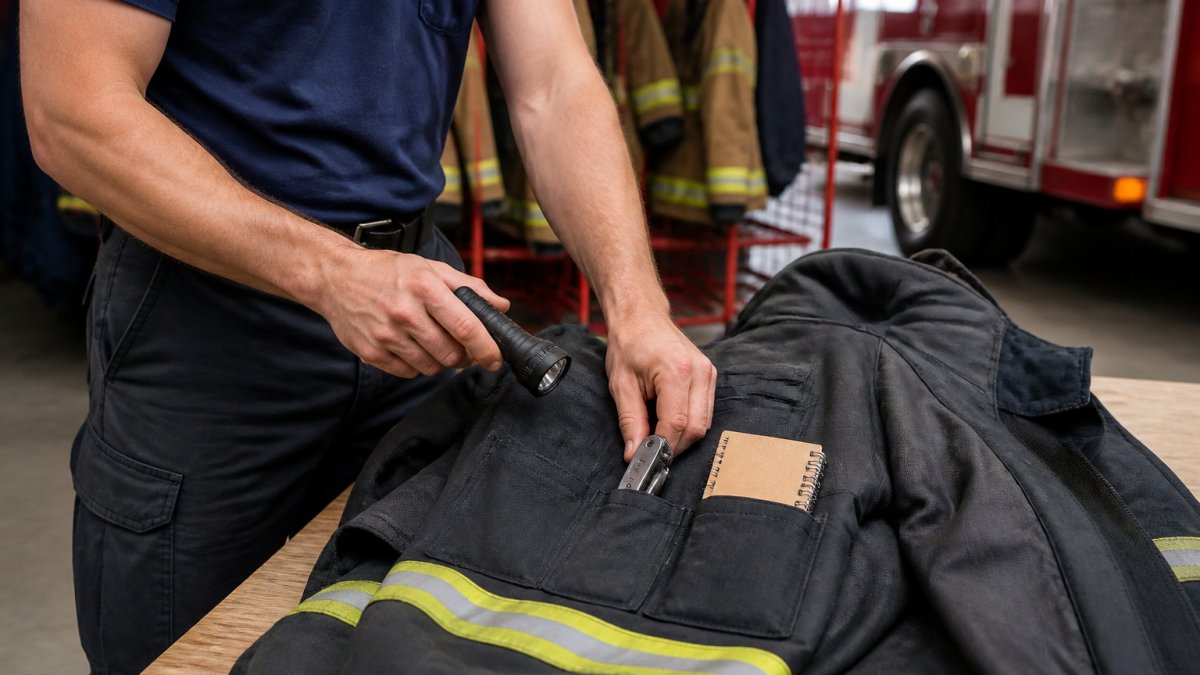
Knives and cutting tools:
Multi-tools and hand tools:
Gloves:
Radio accessories:
The Thin Red Line Paracord Paracord Keychain with Carabiner ($8.00) allows access to 4.5 feet of paracord when disassembled. Its metal clasp can hold keys and add-on pieces, and the cord can be used to secure objects while camping or hiking. Small utility items like this keychain often serve as practical tokens of appreciation when selecting gifts for families who support their loved ones through the demands of the fire service.
The Used Bunker Gear Money Clip ($45.00) is made in the USA from real, decommissioned bunker gear. Each piece is one of a kind, and limited supply is available.
Role-Specific Variations for Engine, Ladder, Medic, and Wildland Assignments
Engine company.
Ladder company.
Medic and firefighter-paramedic.
Wildland.
Volunteer and combination departments.
Maintaining Personal Gear and Setting Replacement Criteria
Start-of-shift inspection (two minutes).
Post-call inspection.
Weekly deep check.
- Flashlight: fails if it flickers, dims within minutes on a fresh battery, has a loose or cracked lens, or the switch does not click firmly.
- Knife: fails if the pivot has side-to-side play, the lock does not hold under light pressure, or the edge will not shave paper after sharpening.
- Gloves: fail if seams are torn, palms are visibly thin, or the material has stiffened from heat exposure.
- Clips and straps: fail if cracked, bent out of shape, or slipping under a light pull.
- Radio accessories: fail if cords are frayed, connectors are loose, or audio cuts in and out.
Building Your Station Bag and Printable Checklist for Your Next Shift
Minimal loadout: flashlight, knife (if allowed), one pair of gloves, radio accessories, pen.
Expanded loadout: everything in the minimal set, plus spare batteries, a second pair of gloves, a small first-aid item approved by your department, a notebook, personal medication, and a labeled water container.
The Embrace the Chaos 40oz Stainless Steel Travel Mug ($38.50) fits into most car cup holders and has a spill-proof plastic lid. For writing shift notes, the Into the Heat Firefighter Notebook ($17.50) includes 140 dotted pages and a wire-o binding that lays flat.
Frequently Asked Questions
What should a firefighter carry every day?
Most firefighters carry a flashlight, a folding knife or shove knife, a pair of work gloves, a small multi-tool, a pen and notebook, and their personal ID and keys. Personal items should be compact and secured so they do not shift during calls. Department-issued PPE such as turnout gear, SCBA equipment, and radios stays under department control and should not be replaced with personal substitutes. Start with a short list, test it on a few shifts, and add items only when you can name a specific task they solve.
What should firefighters pack for a 24-hour shift?
A 24-hour shift bag usually holds a change of clothes, toiletries, a refillable water bottle, medications, phone charger, a headlamp, and snacks that do not need refrigeration. Pack the bag the night before and keep it in the same place each shift so nothing gets left behind. Check whether your station provides laundry, bedding, or a kitchen before you add bulky items. Keep the bag light enough to carry from the apparatus bay to the bunk room in one trip.
How do firefighters organize their everyday carry gear?
Organize by access speed: tools needed during a call go in the most reachable pockets, while items used only at the station go in a bag or locker. Keep knives clipped where they are secured and visible to you, and avoid carrying anything that could snag on hose, ladders, or apparatus compartments. Do a pocket dump at the start of each shift to confirm everything is present and nothing sharp is loose. Review the layout after any call that required you to reach for something quickly.
What should firefighters avoid carrying on duty?
Avoid loose items that can fall into equipment, catch on gear, or interfere with SCBA or radio use. Leave valuables, large sums of cash, and non-essential electronics in a locker. Do not carry personal tools that duplicate or conflict with department-issued equipment unless your department allows it. Check your department's policy on personal knives and tools before adding them to your carry.

