

Firefighter Apparel for Cold Weather Training
Table of Contents
- Why Cold Weather Apparel Matters for Firefighter Training
- Firefighter Base Layers for Winter: Foundation of Thermal Regulation
- Moisture-Wicking Apparel for Fire Training: Managing Sweat in Cold
- Insulation and Outerwear: Selecting the Right Jacket
- Cold Weather Fire Department Training Tips: Practical Strategies
- Maintenance and Care of FR Gear
- Station Wear vs. Field Gear: Choosing What to Wear
- Frequently Asked Questions
Last Updated: September 27, 2026
Why Cold Weather Apparel Matters for Firefighter Training
Proper firefighter apparel for cold weather training isn't just about comfort, it's about survival, performance, and getting home safe.
The difference between adequate apparel and exceptional apparel shows up in the field: reduced hypothermia risk, maintained dexterity, better focus during drills, and crews that actually want to train hard instead of rushing through exercises to get warm.
Firefighter Base Layers for Winter: Foundation of Thermal Regulation
A base layer moves moisture away from your body and traps warm air close to your skin. Without a proper base layer, everything else in your system fails.
Cotton absorbs moisture and accelerates heat loss. Use synthetic fabrics or merino wool that actively move sweat away from your body.
Moisture-Wicking Materials That Keep You Dry
Synthetic fabrics like polyester and nylon excel at moisture-wicking. Merino wool is a natural alternative that wicks moisture just as effectively and resists odor. Choose based on your budget and sweat rate.
Look for fabrics engineered for high-output athletic use, not casual wear.
Weight and Fit Considerations
Lightweight base layers work for moderate activity; midweight provides more insulation for harder training or colder conditions. Heavyweight options can overheat you during intense drills.
A snug fit that moves with your body without binding is critical, too loose reduces insulation, too tight restricts movement.
Moisture-Wicking Apparel for Fire Training: Managing Sweat in Cold
Moisture management is where most cold weather training fails. Evaporative cooling can lower core body temperature by 2-4 degrees Fahrenheit in minutes, enough to trigger early-stage hypothermia during a one-hour training session.
If your apparel traps moisture against your skin instead of moving it away, you accelerate heat loss. Moisture-wicking isn't a comfort feature, it's a survival mechanism.
Moisture-wicking apparel for fire training pulls sweat away across your entire system: base layer moves moisture to the next layer, mid-layer continues without absorbing water, outer shell sheds wind and water while allowing vapor to escape (breathability).
How Moisture Moves Through Layers
Sweat travels as vapor through a proper layering system. Your base layer moves liquid sweat through capillary action, which evaporates or moves into the mid-layer. Your insulation allows that vapor to pass to the outer shell, where it escapes.
If any layer breaks this chain, the system fails. A mid-layer that absorbs moisture holds sweat and prevents it from reaching the outer shell. An outer shell that's too waterproof traps vapor inside. A base layer that's too thick slows vapor transmission.
Test your layering system during training: if your base layer feels wet or clammy after 20 minutes, moisture isn't moving fast enough. If your mid-layer feels damp, your outer shell isn't breathable enough. Identify these problems during training, not during emergency response.
Practical Moisture Management Strategies
Rotate your base layers between sessions. Wash in cool water with minimal detergent and air-dry, heat damages synthetic fibers.
Carry a spare base layer for longer sessions. Changing into a dry one prevents the cold-wet-skin scenario that increases hypothermia risk.
Monitor your team for visible dampness inside outer shells. If found, stop, let them dry out, and adjust the system before continuing.
Water-resistant fabrics shed rain and snow while allowing vapor to escape; waterproof blocks both. For cold weather training, water-resistant maintains breathability. Reserve waterproof gear for sustained heavy rain or snow.
Insulation and Outerwear: Selecting the Right Jacket
Insulation traps air to keep you warm, but thicker insulation adds bulk and weight that affects mobility during training.
Synthetic vs. Natural Insulation
Synthetic insulation is affordable, durable, and performs well when wet. It maintains insulating properties longer than down and handles repeated compression.
Down fails catastrophically when wet. Synthetic insulation is the practical choice for firefighter training despite requiring slightly more material to match down's insulating value.
Embroidered Skull Logo Pullover Hoodie →
Wind and Water Resistance
Your outer shell protects insulation from wind and water. A 20-mph wind at 20°F feels like minus 10°F, a proper shell blocks that wind.
You need a shell that sheds water while allowing moisture vapor to escape. A fully waterproof shell traps sweat inside, defeating your moisture-wicking layers.
Look for water-resistant coatings that maintain breathability. FR (fire-resistant) outer shells protect against arc flash hazards.
Cold Weather Fire Department Training Tips: Practical Strategies
Cold weather fire department training tips start with preparation and honest assessment of your gear. Plan, layer strategically, protect extremities, monitor your team for cold stress, and understand trade-offs between minimum-standard and high-performance gear.
Layering Systems That Work
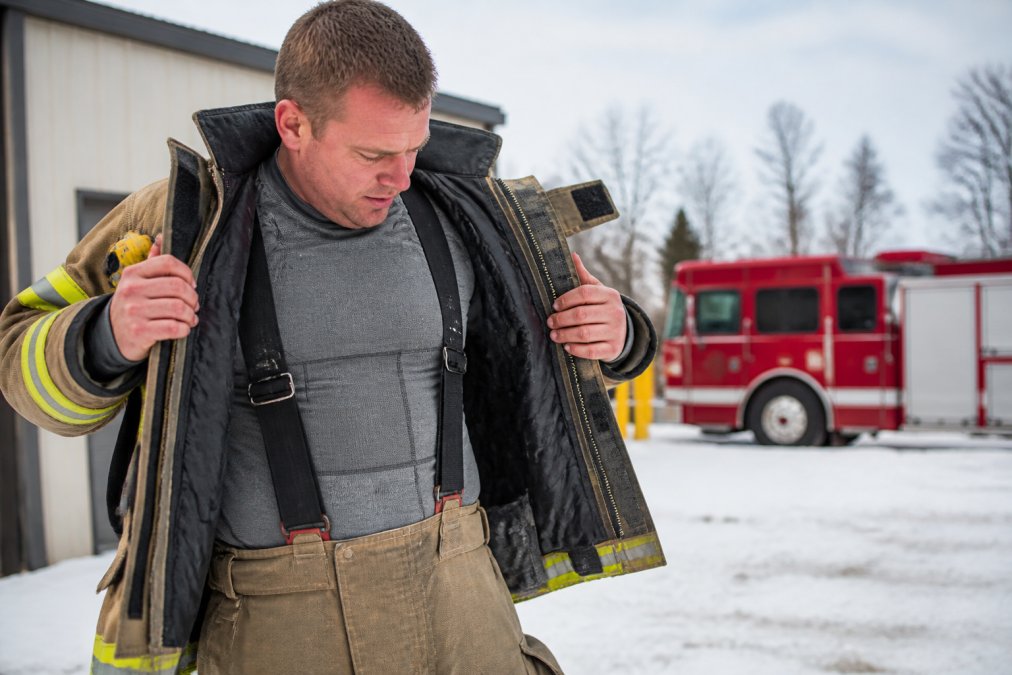
A functional layering system has three components: base layer, insulation layer, and outer shell. Your base layer is moisture-wicking synthetic or merino wool. Your insulation layer traps air, fleece, synthetic down, or wool all work, though synthetic materials are more reliable in wet conditions. Your outer shell is wind and water resistant with FR protection.
The beauty of layering is flexibility. If you're warm during intense activity, you remove the insulation layer. If you cool down during rest periods, you add it back. This approach beats trying to find one perfect jacket that works across all conditions.
Avoid cotton at every layer. Even in your outer shell, cotton absorbs water and loses insulating value. Stick with synthetics and FR-rated materials.
Budget-Friendly vs. Professional-Grade Gear: Making the Right Choice
New recruits often face a difficult decision: buy affordable gear that meets academy requirements or invest in professional-grade apparel that performs better but costs significantly more. Understanding the difference helps you make a choice aligned with your training intensity and long-term career.
Budget-friendly cold weather gear often uses thinner synthetic insulation, basic moisture-wicking fabrics, and standard water-resistant coatings. These items will keep you warm during moderate training. However, they tend to compress faster under repeated use, lose insulating value after 20-30 washes, and may not maintain breathability during high-intensity drills.
Professional-grade gear ($120-$250+ per layer) uses denser synthetic insulation that resists compression, advanced moisture-wicking fabrics engineered for high-output athletic use, and premium water-resistant treatments that maintain breathability longer. The seams are reinforced, the fabrics are more durable, and the gear typically performs consistently for 50+ washes before noticeable degradation.
The practical recommendation: invest in professional-grade base layers and insulation layers, which you'll wear for years and which directly contact your skin where moisture management is critical. For your outer shell, budget-friendly FR jackets often perform adequately because the shell's job is simpler, block wind and shed water, and doesn't require the same level of engineered breathability as inner layers.
If you're a recruit on a tight budget, prioritize in this order: (1) a quality moisture-wicking base layer, (2) a synthetic insulation mid-layer, (3) an FR-rated outer shell, (4) insulated gloves and a balaclava. You can upgrade each piece as your budget allows, and you'll notice the biggest performance gains from the base layer and insulation upgrades.
Ergonomics and Mobility: Gear That Doesn't Restrict Training
Bulky cold-weather gear affects your ability to perform training drills. A jacket that's too stiff limits your range of motion when climbing, bending, or moving through tight spaces. Insulation that's too thick in the shoulders restricts arm movement. Gloves that are too bulky make it impossible to handle equipment or perform fine motor tasks.
Test your apparel during actual training drills, not just during casual wear. Climb a ladder in your full cold weather system. Perform a crawl-under-obstacle drill. Practice donning and doffing your SCBA with your insulation layers on. You'll quickly discover which pieces restrict movement and which ones work seamlessly.
Many experienced firefighters use a layering strategy that accounts for activity level.
Headgear and Hand Protection
Heat loss through your head is real, roughly 10-15% of your body's heat escapes through your head and neck. A proper balaclava or insulated hat that covers your ears and neck makes a measurable difference in how long you can train comfortably. Look for balaclavas with moisture-wicking liners so sweat doesn't accumulate inside.
Maintenance and Care of FR Gear
FR (fire-resistant) gear requires specific care to maintain its protective properties. Washing, drying, and storage all affect how long your gear performs.
Station Wear vs. Field Gear: Choosing What to Wear
Station wear and field gear serve different purposes. Station wear is what you wear around the firehouse when you're not actively training or responding. Field gear is your cold weather training apparel and what you'd wear during actual operations.
Frequently Asked Questions
What are the best layering techniques for firefighters training in freezing temperatures?
Start with a moisture-wicking base layer to pull sweat away from skin, add an insulation layer for warmth retention, and finish with a wind- and water-resistant outer shell. Avoid cotton entirely, it traps moisture and loses insulation when wet. Merino wool or synthetic base layers work best because they regulate temperature and dry quickly. Ensure each layer fits snugly without restricting movement, and choose apparel designed for cold weather fire training that supports dexterity during drills.
How does cold weather impact firefighter performance during training exercises?
Cold reduces muscle flexibility, slows reaction time, and increases risk of hypothermia and frostbite if gear fails to insulate properly. Wind chill accelerates heat loss, making proper firefighter apparel for cold weather training critical. Cold stress also impacts hand dexterity, making insulated gloves and proper thermal regulation essential. Proper moisture-wicking apparel prevents sweat from cooling the body further, maintaining performance and safety during extended outdoor drills.
What materials should firefighters avoid when training in cold weather?
Avoid cotton entirely, it absorbs and retains moisture, losing all insulation value when wet and accelerating heat loss. Avoid loose-fitting gear that allows wind to penetrate and create cold pockets. Avoid single-layer jackets without wind resistance, as they offer no protection against wind chill. Choose fire-resistant, moisture-wicking synthetic fabrics or merino wool instead. Ensure outerwear provides arc-flash protection while maintaining breathability for active training.
How do you maintain mobility while wearing heavy cold weather gear?
Select lightweight synthetic insulation over bulky materials, and ensure all layers fit close to the body without binding at joints. Moisture-wicking apparel for fire training reduces the need for excessive bulk by managing sweat efficiently. Choose articulated jackets with stretch panels at elbows and shoulders. Practice drills in full gear to build muscle memory, and select hand protection that preserves grip strength and dexterity. Proper fit is more important than thickness, tight, technical layers outperform loose, heavy ones.
